
KARACHI: The new owner of the recently privatized Pakistan International Airlines (PIA) said this week the management plans to renovate PIA aircraft, increase its current fleet with new planes, improve maintenance and flight schedule to revive the carrier.
A Pakistani consortium, led by Arif Habib Group, on Dec. 23 secured a 75 percent stake in PIA for Rs135 billion ($482 million) after several rounds of bidding, valuing the airline at Rs180 billion ($643 million).
The sale marked Pakistan’s most aggressive attempt in decades to reform the debt-ridden airline, which had accumulated more than $2.8 billion in financial losses.
Once considered among Asia’s leading carriers, PIA struggled with chronic mismanagement, political interference, overstaffing, mounting debt and operational issues that led to a 2020 ban on flights to the European Union, UK and the US after a pilot licensing scandal. The EU and the UK lifted the bans, providing fresh momentum to the carrier.
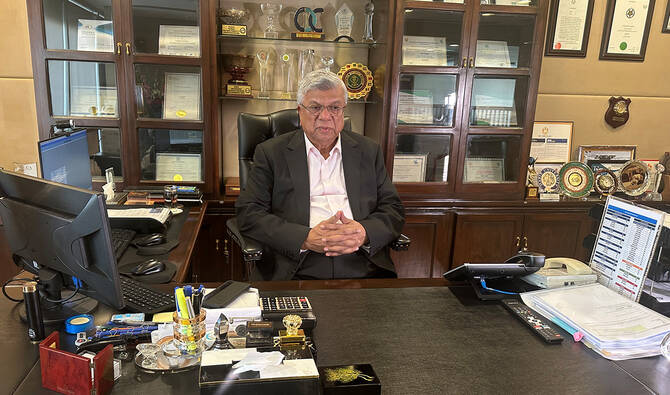
“We will renovate the check-in counters and the cabins. We will replace the seats and put the entertainment equipment into it,” Arif Habib, CEO of Arif Habib Group, told Arab News in an interview on Monday.
“We will also ensure the punctuality of flights. That will bring market confidence, and with that there will be a culture change.”
Habib said the new management plans to more than triple its fleet to 64 aircraft from the existing 19 in up to eight years. In the first phase, the airline would induct 38 four to seven-year-old, narrow and wide-body aircraft. This would then increase to 64 in the second phase.
“There are routes where there is incremental demand there, but because of the limited aircraft available with PIA, they are not able to serve the whole market,” Habib said.
PIA’s new owner sees the region comprising the UK, US and Canada as a “lucrative market” for the airline’s business.
“There we can increase the frequency of the flight,” he said. “We will also try to run flights to Canada from Karachi, Lahore, and I think it’s already in Islamabad.”
Habib said the PIA management was in talks with the US Federal Aviation Administration about resuming flights to the US.
Bound by his agreement with the government that he will not change PIA’s logo and name, Habib did not rule out that the new management could change the staff’s uniform.
“It’s too early, but I definitely will consider all options whereby we improve the brand,” he said.
’HUGE MARKET’
The PIA’s privatization and that of other loss-making, state-run enterprises is a key requirement of the International Monetary Fund (IMF) under its $7 billion loan program for Pakistan.
Habib, whose conglomerate is involved in businesses ranging from stock brokerage services to real-estate projects, plans to invest about $400 million in PIA to sustain its initial losses, fund overhauling that he aims to complete in the next seven years.
He said he would invest two-thirds of the planned investment in the airline upon taking it over in April, while another one-third would be injected a year later.
“Since we are putting in a large sum, about $400 million, into the company, that $400 million will be available to the company for all these improvements,” he said.
“If PIA is able to improve its services and improve its cabin and aircraft, I think there is a huge market waiting for PIA,” he said.
’RESONABLE RETURN’
Habib, however, said the airline will continue to face losses for a few years before it starts to provide “reasonable returns” to its investors. These include AKD Group Holdings, Fatima Fertilizer Company, City Schools, Lake City Holdings and Fauji Fertilizer Company, a publicly listed firm owned by Pakistan’s military.
PIA currently has around Rs9 billion ($32 million) liabilities on its balance sheet.
“It may take about one to two years’ time because in initial period of one to two years, we may see some losses but into medium term, I think, that would be turned around,” Habib said.
“In a longer period of time, if we say about 10 years’ time, this business is expected to give a reasonable return to the investors.”
He said the consortium may look to buy the government’s remaining 25 percent stake and offer part of it to a “strategic investor,’ preferably a foreign airline, to make PIA more competitive.
“The government has given [us] an option of acquiring 25 percent and that option we have to exercise in 90 days,” Habib said. “We are thinking of bringing in some foreign airline as our partner who would be the technical partner for [our] airline.”
The existing members of the consortium will hold 75 percent shares of the airline for the next three-year mandatory period and may expand the group afterwards.
“We may consider getting this company listed on the stock exchange and also bring in some partners if additional capital is required,” he added.