

Islamabad rejects Israel's recognition of Somaliland, alleged plans to displace Palestinians

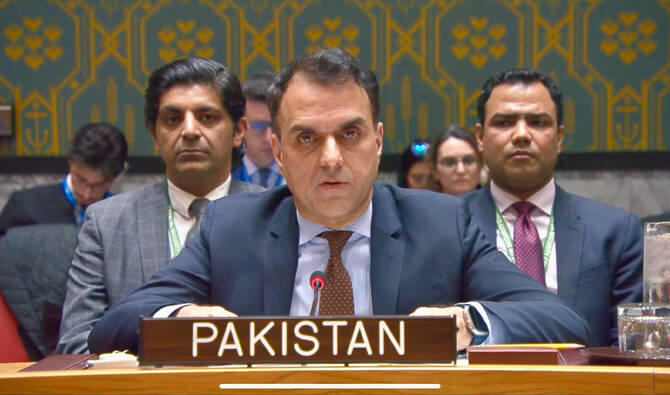
Pakistan’s acting permanent representative to the UN, Usman Jadoon, speaking at a meeting of the Security Council in the New York, US, on December 29, 2025. (@PakistanUN_NY/X)
Short Url
Updated 30 December 2025
Follow

Islamabad rejects Israel's recognition of Somaliland, alleged plans to displace Palestinians

  • Israel last week became the world’s first country to recognize Somaliland, a breakaway region from the African nation
  • As per media reports, Israel has contacted Somaliland over potential relocation of Palestinians forcibly removed from Gaza

ISLAMABAD: Pakistan’s Acting UN Ambassador Usman Jadoon this week rejected Israel’s recognition of the breakaway Somaliland region by describing it as a unilateral and unlawful move, saying Islamabad stands opposed to any plans aimed at forcefully displacing Palestinians from Gaza. 

Last week, Israel announced it had recognized Somaliland, a breakaway African region that declared independence from Somalia in 1991. The move sparked anger among Muslim states, with 21 Islamic nations and the Organization of Islamic Cooperation (OIC) rejecting Israel’s move collectively in a joint statement last week. 

Several international news outlets months earlier reported that Israel had contacted Somaliland over the potential resettlement of Palestinians forcibly removed from Gaza. Muslim countries fear Israel’s recognition of the breakaway region could be part of its plan to relocate Palestinians forcibly from Gaza to the region. 

“We strongly condemn the unilateral and unlawful recognition by Israel of the ‘Somaliland’ region of the Federal Republic of Somalia,” Jadoon, Pakistan’s acting permanent representative to the UN, said at a meeting of the Security Council on Monday.

“It is a direct assault on Somalia’s internationally recognized borders and constitutes a flagrant violation of international law.”

Jadoon said Israel’s move is alarming, especially when Somalia seems to be showing encouraging progress on its political and institutional trajectory.

“This positive momentum must be protected and reinforced, not undermined by actions that risk fragmenting the country and reversing hard-won progress,” he said. 

Jadoon pointed to Israel’s previous references to Somaliland as a destination for deported Palestinians, especially from Gaza, saying Tel Aviv’s recognition of the region in this context is “deeply troubling.”

It said Israel’s occupation of Palestinian land has been a source of conflict in the Middle East, noting that it was now exporting this “destabilizing conduct” to the Horn of Africa. 

“Pakistan unequivocally rejects any proposals or plans aimed at the forced displacement of Palestinians,” Jadoon said. “Any actions that advocate or imply displacement or resettlement not only violate international law but also undermine the prospect of a just and lasting peace.”

He said Islamabad stands firmly with the government of Somalia as it attempts to uphold peace and ensure progress in the country. 

“In conclusion, Pakistan calls upon the Security Council and the broader international community to speak with one voice and reject all actions that undermine Somalia’s unity and territorial integrity,” Jadoon added. 


Pakistan high court pauses tree-cutting in Islamabad until Feb. 2

Updated 10 sec ago
Follow

Pakistan high court pauses tree-cutting in Islamabad until Feb. 2

  • Islamabad High Court asks CDA to ‘explain and justify’ tree-cutting at next hearing
  • CDA officials say 29,000 trees were cut due to allergies, deny felling in green belts

ISLAMABAD: The Islamabad High Court has ordered an immediate halt to tree-cutting in the federal capital until Feb. 2, seeking justification from civic authorities over the legality of a large-scale felling drive that has seen thousands of trees removed in recent months.

The interim order, issued by a single-judge bench led by Justice Khadim Hussain Soomro, came during proceedings on a petition challenging the Capital Development Authority’s (CDA) tree-cutting operations in Islamabad’s Shakarparian area and H-8 sector.

At the outset of the hearing, the petitioner’s counsel argued that trees were being felled in violation of the Pakistan Environmental Protection Act 1997, the Islamabad Wildlife Ordinance 1979 and the city’s master plan.

“Respondents shall not cut trees till the next date of hearing,” Justice Soomro said in the court order released on Friday while referring to CDA officials.

“Respondents are directed to come fully prepared and to file paragraph-wise comments before the next date of hearing, along with a comprehensive report explaining the justification and legal basis for the cutting of trees,” he added.

According to the court order, the petitioner maintained that the CDA had not made any public disclosure regarding the legal basis for the operation and that the felling was causing environmental harm.

The petition sought access to the official record of tree-cutting activities and called for the penalization of CDA officials responsible for the act under relevant criminal and environmental laws.

It also urged the court to impose a moratorium on infrastructure projects in Islamabad, order large-scale replanting as compensation and constitute a judicial commission headed by a retired Supreme Court judge to probe the alleged violations.

CDA officials acknowledge around 29,000 paper mulberry trees have been cut in the capital in recent months, arguing that the species triggers seasonal allergies such as sneezing, itchy eyes and nasal congestion.

They also maintain that no trees have been removed from designated green belts and that the number of replacement trees planted exceeds those felled.

Designed in the 1960s by Greek architect Constantinos Doxiadis, Islamabad was conceived as a low-density city with green belts and protected natural zones at its core.

Critics, however, say the recent felling has extended beyond paper mulberry trees and question whether authorities are adhering to the city’s master plan and the legal protections governing forested and green areas.

The court has adjourned its hearing until Feb. 2, 2026.