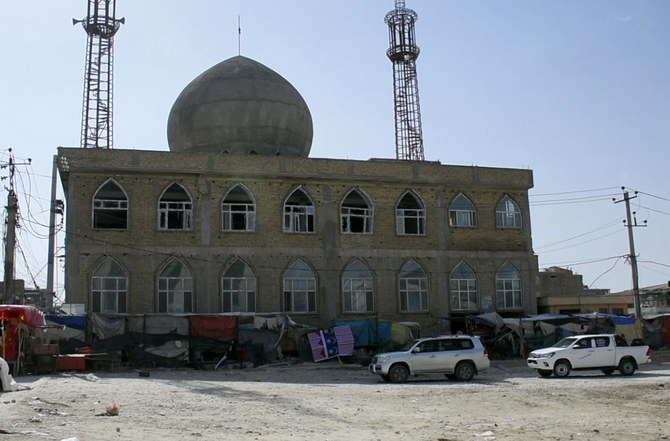
KABUL: A Taliban official says a bombing at a mosque and religious school in northern Afghanistan on Friday killed at least 33 people, including students of a religious school.
Zabihullah Mujahid, the Taliban’s deputy culture and information minister, said the bombing in the town of Imam Saheb, in Kunduz Province, also wounded another 43 people, many of them students.
No one immediately claimed responsibility, but Afghanistan’s Daesh affiliate on Friday claimed a series of bombings that happened a day earlier, the worst of which was an attack on a Shiite mosque in northern Mazar-e-Sharif that killed at least 12 Shiite Muslim worshippers and wounded scores more.
Earlier the Kunduz provincial police spokesman put the death toll at the Malawi Bashir Ahmad Mosque and madrassa compound in Imam Saheb at two dead and six injured. Mujahid later tweeted the higher casualty numbers, saying “we condemn this crime ... and express our deepest condolences to the victims.”
Friday’s bombing is the latest in a series of deadly attacks across Afghanistan. Mujahid called the perpetrators of the Kunduz attack “seditionists and evil elements.”
The United Nations called the attack “horrific.” Deputy special representative to Afghanistan Ramiz Alakbarov said in a tweet that the “killings must stop now and perpetrators brought to justice.”
Since sweeping to power last August, the Taliban have been battling the upstart Daesh affiliate known as Islamic State in Khorasan Province or IS-K which is proving to be an intractable security challenge for Afghanistan’s religiously driven government.
Last October the IS-K claimed a brutal bombing also in northern Kunduz province at a Shiite mosque that killed at least 50 people and wounded more than 100. In November the Taliban’s intelligence unit carried out sweeping attacks on suspected IS-K hideouts in eastern Nangarhar province, where the deadly affiliate is headquartered.
In a statement Friday, the IS-K said the explosive devise that devastated Mazar-e-Sharif’s Sai Doken mosque was hidden in a bag left inside among scores of worshippers. As they knelt in prayer, it exploded.
“When the mosque was filled with prayers, the explosives were detonated remotely,” the Daesh statement said, claiming that 100 people were injured.
The Taliban say they have arrested a former IS-K leader in northern Balkh province, of which Mazar-e-Sharif is the capital. Zabihullah Noorani, information and culture department chief in Balkh province, said Abdul Hamid Sangaryar was arrested in connection with Thursday’s mosque attack.
The IS-K had been relatively inactive in Afghanistan since last November, but in recent weeks have stepped up its attacks in Afghanistan and in neighboring Pakistan, taking aim at Shiite Muslim communities reviled by Sunni radicals.
Earlier this month two bombs exploded in Kabul’s Shiite neighborhood of Dasht-e-Barchi, killing at least seven students and wounding several others.
The IS-K established its headquarters in eastern Afghanistan in 2014 and have been blamed for some of the worst attacks in Afghanistan, including a vicious assault on a maternity hospital and at a school that killed more than 80 girls in 2021, months before the Taliban took power.
The IS-K also took responsibility for a brutal bombing outside the Kabul International Airport in August 2021 that killed more than 160 Afghans who had been pushing to enter the airport to flee the country. Thirteen US military personnel also were killed as they oversaw America’s final withdrawal and the end of its 20-year war in Afghanistan.


![]()

Death toll in Afghan mosque bombing rises to 33, Taliban say
Short Url
https://arab.news/zjr8s
Death toll in Afghan mosque bombing rises to 33, Taliban say
- Afghanistan’s Daesh affiliate on Friday claimed a series of bombings that happened a day earlier


Latest updates


© 2026 SAUDI RESEARCH & PUBLISHING COMPANY, All Rights Reserved And subject to Terms of Use Agreement.