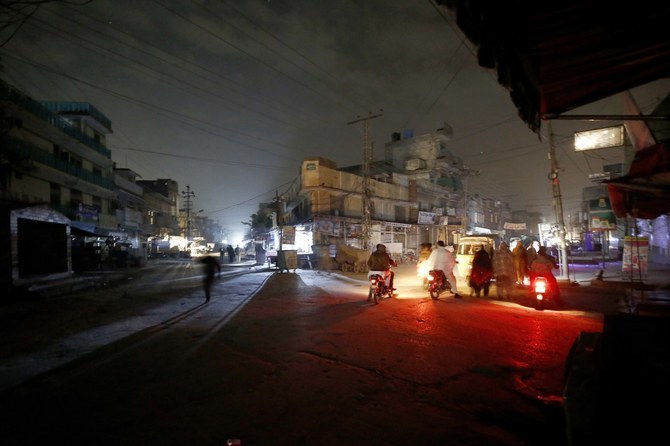
ISLAMABAD: Pakistan is witnessing eight to ten hours of unannounced power outages especially in rural areas as the country faces acute fuel shortage after a historic surge in prices of liquefied natural gas (LNG) and coal in the international market in recent weeks.
The overall energy shortfall is higher than 7,000 megawatts (MWs) due to insufficient fuel supply to power plants along with issues related to their upkeep.
“The reason behind load shedding is that over 5,000 MWs are out of service due to fuel shortage and over 2,000 MWs are out of service due to maintenance issues,” Finance Minister Miftah Ismail told Arab News before leaving for Washington on Thursday to meet senior International Monetary Fund (IMF) officials and ensure the revival of a stalled $6 billion loan program.
The minister failed to specify the reason behind the fuel shortage or how long would the maintenance of power plants take.
Pakistan is struggling to meet its soaring energy needs amid surging fuel prices in Europe and Asia, partly as a consequence of the Russian invasion of Ukraine in February. Also, the country’s foreign exchange reserves are depleting fast due to its rising imports and it has become difficult to afford to LNG and coal from the international market to generate electricity.
“We will improve the situation in a few weeks,” the finance minister promised.
However, electricity consumers are finding it difficult to deal with the problem right in the middle of Ramadan.
“Summer is just starting and we have been facing eight to ten hours daily of unannounced load-shedding,” Usman Naseem, a resident of Chakwal, told Arab News.
Economists and analysts said the power crisis was mainly caused by the “mismanagement” of the power sector and it would take some time to fix it.
“It is a delicate and challenging job to ensure smooth fuel supply throughout the year to fulfill the energy requirements,” Khurram Husain, editor Profit magazine, told Arab News.
He blamed the managers of the previous government for their failure to ensure timely LNG procurement since they were running power plants on furnace oil. “The nation is paying for their blunders now,” he said.
Syed Atif Zafar, chief economist at Topline Securities, said the power outages would continue to be observed this summer since there was no short-term strategy in sight to deal with the challenge.
“The LNG prices have skyrocketed in the international market in recent months, and Pakistan unfortunately doesn’t have a viable plan in place to procure the costly product to ensure its energy security,” he said.
Zafar pointed out that Pakistan’s foreign exchange reserves had fallen to $10.5 billion and the government was struggling to pay for essential imports.
“Our economic managers in the government need to chart out a long-term strategy to ensure timely procurement of the LNG to fulfill domestic and industrial energy needs,” he added.


![]()

Fuel shortage leads to prolonged power cuts in Pakistan
Short Url
https://arab.news/2zey6
Fuel shortage leads to prolonged power cuts in Pakistan
- The country faces 7,000-megawatt shortfall and is witnessing eight to ten hours of power outages
- Experts say Pakistan’s economic managers need to devise long-term strategy for energy security
Latest updates




© 2026 SAUDI RESEARCH & PUBLISHING COMPANY, All Rights Reserved And subject to Terms of Use Agreement.