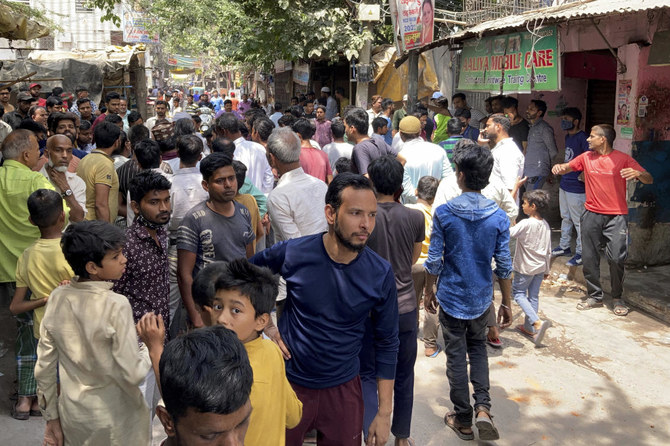
NEW DELHI: Authorities riding bulldozers razed a number of Muslim-owned shops in New Delhi before India’s Supreme Court halted the demolitions Wednesday, days after communal violence shook the capital and saw dozens arrested.
Shop owners weeded through the rubble of their shops afterward to collect their belongings. But for nearly an hour after the Supreme Court order, officials continued to demolish structures, including the outer entrance and stairs leading into a mosque. They stopped the bulldozers just outside the entrance of a Hindu temple, about 50 meters from the mosque, and began to retreat, spurring outrage from Muslim residents who said they were being targeted.
Anti-Muslim sentiment and attacks have risen across India in the past 10 days, including stone-pelting between Hindu and Muslim groups during religious processions and demolitions of a number of properties, many belonging to Muslims, in another state last week.
On Sunday, police arrested over 20 suspects a day after after communal violence broke out during a Hindu religious procession in New Delhi’s northwest Jahangirpuri neighborhood. They said Hindu and Muslim groups threw stones at each other during a procession to mark the birth date of Hindu god Hanuman, leaving eight police officers and a civilian injured, local media reported.
Officials say their demolition drive targets illegal buildings and not any particular community. But critics argue this is the latest attempt to harass and marginalize Muslims, who are 14 percent of India’s 1.4 billion population, and they point to a pattern of rising religious polarization under Prime Minister Narendra Modi’s Hindu nationalist Bharatiya Janata Party.
On Wednesday morning, bulldozers demolished a string of shops on the roadside in Jahangirpuri while the owners peered out from windows in their homes, watching helplessly as their stalls were destroyed or taken away on trucks.
“They don’t want Muslims to live in this country. Why? Are Muslims terrorists?” said Sabiran Bibi, 31, who has lived in the area all her life.
Raja Iqbal Singh, mayor of the North Delhi Municipal Corporation which is ruled by the BJP, said authorities were only bringing down “illegal buildings that have encroached onto the roads.” He added that the action had nothing to do with the earlier violence but that some of the shops belonged to people accused of rioting.
The drive occurred as the area in northwest New Delhi was swarmed by paramilitary forces in riot gear and comes after the city’s BJP chief Adesh Gupta urged the municipal corporation to “take action on the illegal construction and encroachment of the rioters,” he said in a tweet on Wednesday. “I congratulate the corporation for taking quick action on it,” he said.
While authorities have termed it a “routine exercise,” the call from Gupta and the timing of the move — four days after the violence in the neighborhood erupted — have raised questions.
A similar demolition drive was seen last week in central Madhya Pradesh state’s Khargone city after a Hindu procession on April 10 to mark the birth anniversary of Lord Ram erupted in violence, with Hindu mobs brandishing swords and sticks as they marched past Muslim neighborhoods and mosques. Soon, groups from both communities began pelting stones at each other, according to police.
A day later, bulldozers razed down about 45 buildings, including homes and shops, in five parts of Khargone city. Many of them, though not all, belonged to the Muslim population, reported local media.
“The buildings demolished were illegal structures set up on encroached land belonging to people from both communities,” P Anugraha, district collector in the city, told The Indian Express last week.


![]()

Shops demolished in Indian capital after communal violence
Short Url
https://arab.news/5aeyk
Shops demolished in Indian capital after communal violence
- Anti-Muslim sentiment and attacks have risen across India in the past 10 days
- Hindu and Muslim groups threw stones at each other during a procession to mark the birth date of Hindu god Hanuman, according to authorities


Latest updates



© 2026 SAUDI RESEARCH & PUBLISHING COMPANY, All Rights Reserved And subject to Terms of Use Agreement.