

Martinez brace powers Inter past Milan for a spot in Italian Cup final

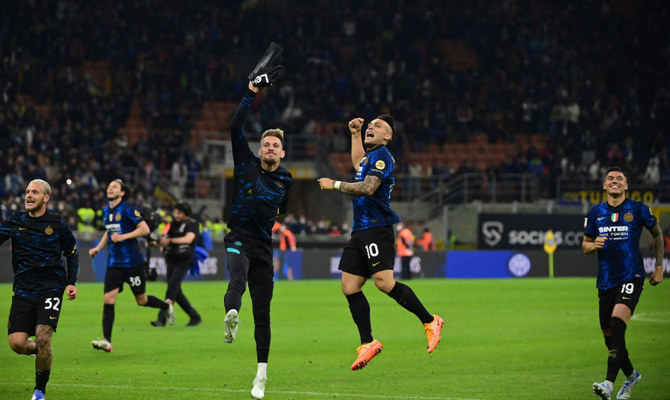
Inter Milan's Argentine forward Lautaro Martinez, center right, and teammates acknowledge the crowd at the end of their Italian Cup semifinal second leg football match against AC Milan on April 19, 2022 at the San Siro stadium in Milan. (AFP)
Short Url
Updated 20 April 2022
Follow

Martinez brace powers Inter past Milan for a spot in Italian Cup final

  • Inter Milan enjoy a dream start as they struck inside the first four minutes

MILAN: Lautaro Martinez scored twice as Inter Milan beat city rivals AC Milan 3-0 on Tuesday to reach the Italian Cup final, where they will face either Juventus or Fiorentina.

The semifinal second leg was closer than the scoreline suggested, but Inter ultimately were comfortable winners on aggregate after a goalless draw in the first fixture.

Simone Inzaghi's men will take on the winners of Wednesday's other semifinal, which Juventus lead 1-0 after the first leg, at the Stadio Olimpico on May 11.

"I am happy because we are playing another final, we work to bring Inter to the top and tonight we proved it again," said Martinez. "The fans are pleased and so are we."

AC Milan remain without a major trophy since winning the 2011 Serie A title, but the Scudetto is still up for grabs this season.

Stefano Pioli's men lead Inter by two points in the table, although the reigning champions have a game in hand.

Inter Milan made a dream start on Tuesday as they struck inside the first four minutes.

Matteo Darmian's dinked cross found its way to Martinez, and the Argentinian slammed a volley into the top corner to score his 18th goal of the season in all competitions.

AC Milan eventually burst into life around the half-hour mark, with Inter goalkeeper Samir Handanovic having to make smart saves from Rafael Leao and Alexis Saelemaekers.

They almost levelled again twice in quick succession five minutes before half-time, as Ivan Perisic somehow scrambled the ball off the line with his chest, before Leao's effort was kept out by Handanovic's legs.

But Inter sprung straight up the other end to double their advantage against the run of play, as Joaquin Correa played a lovely through ball into the path of Martinez, who coolly chipped the ball over advancing goalkeeper Mike Maignan.

Milan started the second half brightly, with the defence producing crucial blocks from attempts by Brahim Diaz, Olivier Giroud and Pierre Kalulu.

The Serie A leaders thought they had given themselves hope in the 66th minute through Ismael Bennacer's excellent long-range drive.

But the goal was disallowed by VAR due to Kalulu standing in front of Handanovic in an offside position.

Pioli was angered by the decision, which took the wind out of Milan's sails.

"Look at Handanovic's reaction. He doesn't even complain," Pioli told Mediaset.

"Tell me a goalkeeper who doesn't react after conceding if a Milan player had damaged his view. Instead, he does nothing, they only complained about a handball that wasn't even there. Come on! Come on."

Inter secured their place in the final with eight minutes remaining on the counter-attack, as Marcelo Brozovic crossed for substitute Robin Gosens to score.


Saudi football leaders shift focus from big names at WFS

Updated 5 sec ago
Follow

Saudi football leaders shift focus from big names at WFS

  • Privatization and community building is focus of Saudi officials
  • Al-Kholood’s success under Ben Harburg seen as benchmark

RIYADH: Saudi Arabia is recognized as one of football’s fastest-rising nations, but there was a noticeable shift in tone on the first day of the World Football Summit, which returns to Riyadh for the second consecutive year. 

Instead of conversations about which global superstar would arrive next, speakers touched on the foundations of Saudi football — infrastructure, governance and sustainable growth.

WFS brings together leaders from around the world to explore how football can evolve, from ticketing systems to artificial intelligence models offering deeper player insights. Yet it was the future of Saudi football — particularly its trajectory in the lead-up to the 2034 FIFA World Cup — that dominated the main stage.

The event’s first panel, “Saudi Sport — A Changing Landscape with a Bright Future,” moderated by Ben Jacobs, featured Ibrahim Al-Moaiqel of the Ministry of Sport. He emphasized the Kingdom’s privatization program was not simply about selling clubs but “bringing partners with the know-how to develop them.”

Privatization has been a defining topic around the Saudi Pro League, especially after Ben Harburg’s acquisition of Al-Kholood, making him the first-ever foreign owner of a Saudi football club. Harburg’s impact has been immediate, with Al-Kholood making the King’s Cup final four for the first time in their history just six months into his tenure. 

But while privatization dominated early discussion, it quickly shifted to whether the SPL could one day rival Europe’s top five leagues — particularly England’s Premier League. Al-Moaiqel downplayed the comparison, highlighting the long-term work still required to reach that level. 

SPL CEO Omar Mugharbel expanded on the theme, stressing the importance of building communities and developing stadiums capable of supporting a broader football ecosystem. 

The SPL has seen its revenues triple since 2023, but it didn’t stop Mugharbel saying things were just getting started. “How do we build something for Saudi that we can export to the world?” he asked.

This sentiment was also shared by club management. Al-Hilal CEO Esteve Calzada said that while their heroics at the 2025 FIFA Club World Cup highlighted the SPL’s rising competitiveness, the club’s priority moving forward was sustainable revenue generation. 

“We want to put the best products possible in front of our fans,” he said, a statement that encapsulated the day’s theme: The future lies not solely in marquee signings, but in building clubs, communities and systems that endure.

This shift in rhetoric marks a defining moment for Saudi football as it approaches its next major milestone — the AFC Asian Cup 2027, the first of several flagship events on the Kingdom’s long-term football roadmap.

If Day 1 of the WFS made anything clear, it was that Saudi Arabia’s footballing ambitions are no longer measured by the stars they attract, but by the structures they build.