

Egypt must ‘immediately’ release Egyptian journalist, says CPJ

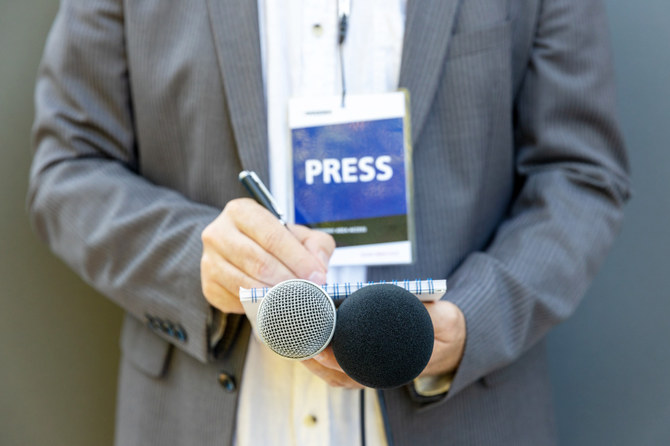
As of December 2021, Egypt was the world’s third-worst jailer of journalists, with at least 25 journalists imprisoned in the country, according to CPJ’s prison census. (Shutterstock)
Short Url
Updated 20 April 2022
Follow

Egypt must ‘immediately’ release Egyptian journalist, says CPJ

  • Committee to Protect Journalists calls for release of Ahmed Al-Bahy, a correspondent for local independent news website Masrawy
  • At least 25 journalists imprisoned in Egypt as it gains infamous reputation as a reporter jailer

DUBIA: The Egyptian government has been pressured by a press rights NGO to immediately release a journalist who was arrested from his home on Saturday.

Ahmed Al-Bahy, a correspondent for the independent news website Masrawy, was charged with inciting violence the next day.

“Egyptian authorities must immediately and unconditionally release journalist Ahmed Al-Bahy and drop any charges filed against him,” the Committee to Protect Journalists (CPJ) said yesterday.  

Al-Bahy was based in the Monufia Governorate in Egypt’s Nile Delta region. The prosecutor’s office in Al-Sadat City ordered that he spend four days in pretrial detention pending investigation.

Sherif Mansour, CPJ’s program coordinator for the Middle East and North Africa region, said: “Egyptian authorities must immediately and unconditionally release journalist Ahmed al-Bahy, drop all charges against him, and ensure that journalists can cover issues of local interest freely and without fear of imprisonment.”

Al-Bahy’s arrest is related to the killing of a young man in Al-Sadat City on April 15. Police officers asked Al-Bahy to stop filming and to refrain from publishing anything about the case. He was arrested despite complying with the request by leaving the site and not publishing relating to the killing, reported Egyptian news site Darb.

“It has become the norm that Egyptian authorities shut down journalistic investigations into political and human rights issues and imprison journalists covering them,” said Mansour.

“However, shutting down an investigation into a seemingly non-political incident marks a clear attack against the journalism sector in Egypt as a whole.”

As of December 2021, Egypt was the world’s third-worst jailer of journalists, with at least 25 journalists imprisoned in the country, according to CPJ’s prison census.



Paris exhibition marks 200 years of Le Figaro and the enduring power of the press

Updated 17 January 2026
Follow

Paris exhibition marks 200 years of Le Figaro and the enduring power of the press

  • The exhibition celebrated the bicentennial of Le Figaro, offering visitors a rare opportunity to step inside the newspaper’s vast historical archive

PARIS: One of France’s most influential newspapers marked a major milestone this month with a landmark exhibition beneath the soaring glass nave of the Grand Palais, tracing two centuries of journalism, literature and political debate.
Titled 1826–2026: 200 years of freedom, the exhibition celebrated the bicentennial of Le Figaro, offering visitors a rare opportunity to step inside the newspaper’s vast historical archive. Held over three days in mid-January, the free exhibition drew large crowds eager to explore how the title has both chronicled and shaped modern French history.
More than 300 original items were displayed, including historic front pages, photographs, illustrations and handwritten manuscripts. Together, they charted Le Figaro’s evolution from a 19th-century satirical publication into a leading national daily, reflecting eras of revolution, war, cultural change and technological disruption.
The exhibition unfolded across a series of thematic spaces, guiding visitors through defining moments in the paper’s past — from its literary golden age to its role in political debate and its transition into the digital era. Particular attention was paid to the newspaper’s long association with prominent writers and intellectuals, underscoring the close relationship between journalism and cultural life in France.
Beyond the displays, the program extended into live journalism. Public editorial meetings, panel discussions and film screenings invited audiences to engage directly with editors, writers and media figures, turning the exhibition into a forum for debate about the future of the press and freedom of expression.
Hosted at the Grand Palais, the setting itself reinforced the exhibition’s ambition: to place journalism firmly within the country’s cultural heritage. While the exhibition has now concluded, the bicentennial celebrations continue through special publications and broadcasts, reaffirming Le Figaro’s place in France’s public life — and the enduring relevance of a free and questioning press in an age of rapid change.