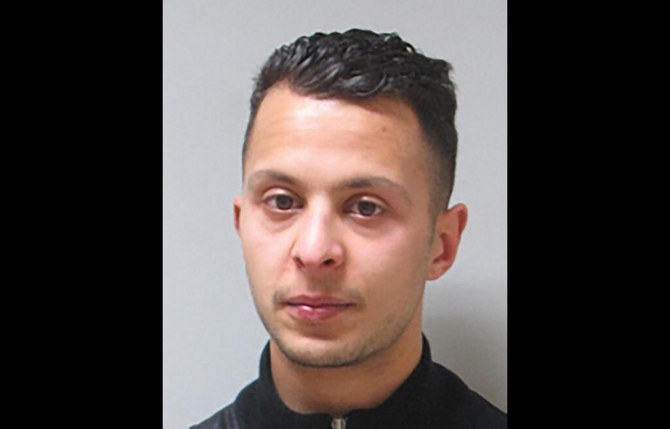
PARIS: The only surviving member of the Daesh attack team that terrorized Paris in 2015 asked Friday for forgiveness and expressed condolences for the victims, wiping away tears during court testimony as he pleaded with survivors to “detest me with moderation.”
For years, Salah Abdeslam stayed silent about what happened Nov. 13, 2015 in the Bataclan Theater, Paris cafes and the national stadium, and the 130 people who were killed. After his trial opened last year, he had a few outbursts of extremist bravado, but for months he refused to answer most questions.
Then this week, his words started flowing, in lengthy testimony that at times contradicted earlier statements. His words at times prompted angry outbursts from the public.
Survivors and victims’ families, who hope the extensive trial helps them find justice and clarity, had mixed reactions.
Abdeslam said the mastermind of the attacks convinced him two days beforehand to join the team of suicide bombers. The next day, Abdeslam said his brother Brahim showed him the café in northern Paris where Salah was meant to detonate himself in a crowd.
“For me, it was a shock. I didn’t know how to react. I showed that I wasn’t ready for that,” Abdeslam told the court. “He ended up convincing me.”
He recounted donning an explosive belt the night of Nov. 13, as his brother and other Daesh extremists who had fought in Syria were fanned out around Paris mounting parallel attacks.
“I enter the café, I order a drink,” Abdeslam said. “I was thinking. I looked at people laughing, dancing. And that’s when I knew that I couldn’t do it.”
“I told myself, I’m not going to do it,” he said, citing a sense of “humanity.”
A police explosives expert has told the court that the suicide belt was faulty, but Abdeslam testified that he disabled it.
Last month, he expressed “regret” that he hadn’t followed through on the attack.
But this week, he started showing signs of remorse.
“There are no words for this,” he said.
Questioned Friday by his lawyer about his mother, and her loss over her older son’s death, Abdeslam started to cry for the first time since the trial began in September, according to French media reports.
“I ask you today to detest me with moderation,” he told the victims. “I offer my condolences, and I ask forgiveness for all the victims.”
He has also repeatedly asked forgiveness of three fellow defendants being tried for helping him escape.
Georges Salines, whose daughter Lola was killed in the Bataclan, was quoted by France-Info radio as saying: “Abdeslam is trying to settle a mountain of contradictions in his head. He’s trying to resolve them, but his path will be long.”
After leaving the café, Abdeslam described desperate attempts to reach friends to ask for help, and taking a taxi across Paris to the suburb of Montrouge, where he said he removed the detonator from his explosive vest and tossed the vest in a garbage bin. He hid out at first near Paris, and then fled with friends to Brussels, where he was arrested four months later.
He faces life in prison if convicted on murder charges.
The more than 2,400 civil parties to the case present their final arguments next month, and the verdict is expected on June 24. It’s among the biggest trials in modern French history.


![]()

‘Detest me with moderation,’ Paris attacks defendant pleads
Short Url
https://arab.news/8qpnp
‘Detest me with moderation,’ Paris attacks defendant pleads
- For years, Salah Abdeslam stayed silent about what happened Nov. 13, 2015 in the Bataclan Theater, Paris cafes and the national stadium
- Then this week, his words started flowing, in lengthy testimony that at times contradicted earlier statements


Latest updates



© 2026 SAUDI RESEARCH & PUBLISHING COMPANY, All Rights Reserved And subject to Terms of Use Agreement.