
BEIRUT: Saudi Arabia has expressed its support for the people of Lebanon and its desire to bolster ties between the two nations following the return of its envoy to Beirut.
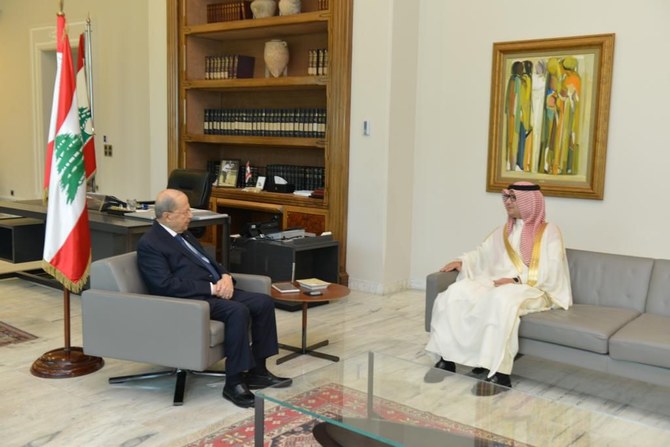
Walid Bukhari, the Saudi ambassador to Lebanon, told Lebanese President Michel Aoun on Wednesday that “the Kingdom is keen on helping the Lebanese people during difficult circumstances and strengthening relations between the two countries.”
According to the president’s media office, the two men discussed bilateral relations and Bukhari told Aoun about “the mechanism of the Saudi-French joint fund aimed at providing humanitarian support and achieving stability and development in Lebanon.”
Saudi Arabia, Kuwait and other Gulf states recalled their ambassadors from Lebanon in October in protest against insulting statements made by former Information Minister George Qordahi regarding the war in Yemen.
Bukhari last met Aoun in March 2021. That meeting took place after a failed attempt to form a government led by former Premier Saad Hariri and the exchange of accusations of disrupting the process between Hariri and Aoun.
Since returning to Beirut, Bukhari has held talks with religious authorities, current and former prime ministers and interior ministers, foreign diplomats and other politicians.
Kuwaiti Ambassador Abdul-Al Sulaiman Al-Qenaei has also returned to Beirut. He said after meeting Prime Minister Najib Mikati on Wednesday that “restoring diplomatic relations and the return of ambassadors indicate the success of the Kuwaiti initiative.”
He added that both Lebanon and the Gulf states had mutually agreed that their long history was above everything else and that “what happened is in the past and the return of ambassadors will lead to further rapprochement and cooperation that benefit the brotherly countries.”
Wednesday’s developments coincided with the 47th anniversary of the start of the civil war in Lebanon. Hariri tweeted: “The suffering of the Lebanese is repeated in different forms.”
Meanwhile, the joint parliamentary committees were unable to approve a draft Lebanese capital control law on Wednesday.
Ibrahim Kanaan, chair of the Finance and Budget Committee, said: “We are making amendments to the current draft.”
Politicians have failed to pass the law since 2019 when Lebanon descended into a financial crisis that has paralyzed its banking system and frozen depositors out of their US dollar accounts.
Formal capital controls are a policy recommendation of the International Monetary Fund, from which Lebanon hopes to secure an aid package.
Lawmaker Bilal Abdullah said the draft contained “defects and needs amendments.”
He told Arab News: “The conditions of the IMF are harsh … How will we face people if the flour and medicines are no longer subsidized? What is the point of competing for parliamentary seats in a bankrupt country?
“Some people are preventing any progress toward the country’s recovery plan. However, some are forgetting that the country is bankrupt, and we must not stop negotiations with the IMF.”
Pressure is mounting on last week’s preliminary agreement between an IMF team and Lebanese authorities to implement the fund’s conditions to prevent a complete financial collapse.
The Depositors Outcry Association protested in Beirut against the draft capital control law. Alaa Khorshid, its head, said: “We cannot accept the theft of our money followed by the enactment of a law to protect the thieves.”
In another development, the US Department of State’s report about human rights in Lebanon referred to reliable information about “serious political interference with the judiciary and judicial affairs and imposing severe restrictions on the freedom of expression and media, including violence, threats of violence, arrests, unjustified prosecutions against journalists, censorship and the existence of laws criminalizing defamation, severe restrictions on internet freedom and the forced return of refugees to a country where their lives or freedom are threatened.”
The report mentioned “the presence of serious high-level and widespread official corruption” and added that “government officials enjoyed a measure of impunity for human rights abuses, including evading or influencing judicial processes.”
The report also cited “unofficial detention facilities by the terrorist Hezbollah party and Palestinian militias.”