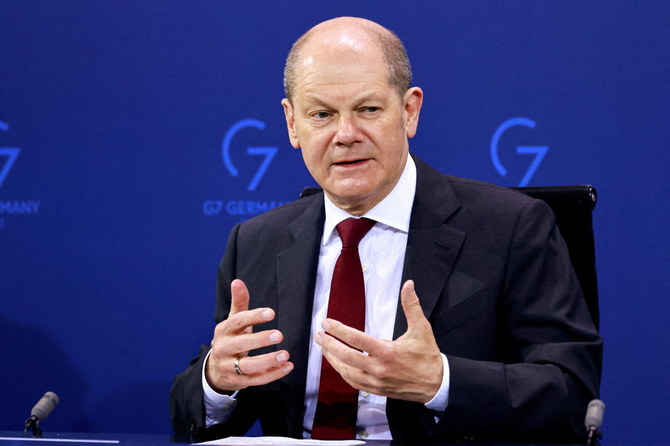
BERLIN: Chancellor Olaf Scholz said Wednesday he was “irritated” by Kyiv’s rejection of a proposed visit by Germany’s president, a snub that has ruffled diplomatic feathers at a time when the war-hit nation is seeking more weapons from Berlin.
The Ukrainian presidency has instead said it wants to welcome Scholz to Kyiv, but the chancellor indicated he had no plans to visit anytime soon.
Asked by RBB public radio when he would follow in the footsteps of other EU leaders and travel to Kyiv, Scholz dodged the question and stressed his “very regular” phone calls with President Volodymyr Zelensky.
Berlin has reacted with dismay to President Frank-Walter Steinmeier’s revelation on Tuesday that he had offered to visit Ukraine, but Kyiv had told him he was “not wanted” right now.
The move against Steinmeier — a former foreign minister who recently acknowledged “errors” in a too conciliatory stance toward Moscow in the past — was widely seen as a diplomatic affront in Germany.
Scholz said he was “irritated, to put it politely,” noting that Steinmeier had strongly condemned Russia’s aggression. “It would have been good to receive him,” he told RBB.
Ukrainian presidential adviser Oleksiy Arestovych told German public television on Wednesday it had not been Zelensky’s intention to offend Berlin.
“I think the main argument was different — our president expects the chancellor, so that he (Scholz) can take direct practical decisions, including weapons deliveries,” he told broadcaster ZDF.
The German president has a largely ceremonial role while the chancellor heads the government.
The spat comes as Scholz is facing growing pressure to step up support for Ukraine in the face of the seven-week-old Russian invasion which has cost the lives of thousands of civilians.
Arestovych said the fate of the strategic port city of Mariupol and the civilian population of eastern Ukraine “depends on the German weapons we could get,” but that have not been promised.
Time is of the essence because “every minute that a tank doesn’t arrive... it is our children who are dying, being raped, being killed,” Arestovych said.
The German political class “has seen the terrible images” of the war which he said recalled the destruction of Berlin in 1945. What the Russian army is doing in Ukraine “isn’t any different.”
Scholz, like Steinmeier a Social Democrat, initially responded to the Russian onslaught by promising a dramatic about-face in German defense and foreign policy including a massive increase in military spending.
But he has thus far refused, primarily for historical reasons, to send heavy weapons to Ukraine.
Germany has until now sent defensive arms including anti-tank weapons, missile launchers and surface-to-air missiles in response to the conflict.
The stance has sharpened tensions within Scholz’s government, with ministers from the co-ruling Green party urging additional weapons deliveries.
“There is only one person who can point the way and that is Chancellor Olaf Scholz,” said Marie-Agnes Strack-Zimmermann, head of the defense committee in the lower house of parliament and a leading deputy from the Free Democrats, the third party in Scholz’s coalition.
However members of the Social Democrats indicated their opposition to stepping up arms supplies to Ukraine, warning of a spiral of escalation.
“If we deliver heavy weapons, then we quickly face the question whether German training teams or volunteers from Germany to run the weapons systems are necessary,” MP Joe Weingarten told daily Die Welt.


Scholz ‘irritated’ by Kyiv’s snub to German president
https://arab.news/j6d5u
Scholz ‘irritated’ by Kyiv’s snub to German president

- The Ukrainian presidency has instead said it wants to welcome Scholz to Kyiv, but the chancellor indicated he had no plans to visit anytime soon
- Scholz said he was "irritated, to put it politely", noting that Steinmeier had strongly condemned Russia's aggression


India, EU agree on trade deal slashing tariffs on 99.5% of Indian exports
- Agreement expected to be signed later this year and come into force in early 2027
- Duty cuts on 99.5% Indian exports to EU unlikely to offset US tariff impact, expert says
NEW DELHI: India and the EU have concluded negotiations on a deal creating a free trade zone of 2 billion people, European Commission President Ursula von der Leyen and Indian Prime Minister Narendra Modi said on Tuesday.
Talks for the pact, referred to by both leaders as the “mother of all deals,” started in 2007 and stalled repeatedly over the years, with the negotiation process only speeding up last year, following new US tariff polices.
The agreement is expected to be signed later this year and may come into force in early 2027.
“People around the world are calling it the ‘mother of all deals.’ This agreement brings huge opportunities for India’s 1.4 billion people and for millions of people across European countries,” Modi said during a joint press conference with Von der Leyen and European Council President Antonio Costa in New Delhi.
“It represents 25 percent of the global GDP and one-third of global trade.”
The deal paves the way for India to open its vast market to free trade with the EU, its biggest trading partner, and gain preferential access for almost all of its exports to the 27-nation European bloc.
“We have created a free trade zone of 2 billion people, with both sides set to gain economically,” Von der Leyen said. “We have sent a signal to the world that rules-based cooperation still delivers great outcomes.”
The conclusion of negotiations comes as US President Donald Trump slapped India with 50 percent tariffs and has threatened to impose new duties on several EU countries unless they support his efforts to take over Greenland.
“This is a signal to the US that like-minded entities, EU and India, are willing to come together and work together,” Prof. Harsh V. Pant, vice president of the Observer Research Foundation, told Arab News.
“Here are two countries that are bringing in a greater predictability and less volatility in their relationship, and they will move ahead irrespective of what the US does.”
The deal is expected to double EU goods exports to India by 2032 as tariffs on 96.6 percent of EU goods exports — from automobiles and industrial goods to wine and chocolates — will be eliminated or reduced, saving up to $4.75 billion per year in duties on European products, according to a European Commission press release on Tuesday.
At the same time, the EU will eliminate or reduce tariffs on 99.5 percent of goods imported from India over seven years, India’s Ministry of Commerce and Industry said in a statement, projecting gains mainly in labor-intensive sectors like textiles, leather, marine products, gems and jewelry.
“Indian services will also benefit from the trade deal. But, more than just export growth, the deal is part of a broader EU-India alliance on green tech, critical raw materials, digital rules and other aspects, which should channelize higher FDI (foreign direct investment) into India,” said Dr. Anupam Manur, professor of economics at the Takshashila Institution.
“India can potentially have a welfare and income gain of 0.5 percent of its GDP in the long run. It would also boost Indian exports to the EU by about $5 billion from the current level of about $76 billion.”
The agreement is unlikely to fully compensate for a slowdown in trade with the US.
“In the near term, this will partially offset the loss of exports to the US due to tariffs but cannot be expected to entirely mitigate it. Shifting supply chains and exports take time,” Manur said.
“The implementation of the FTA would take about a year’s time. The deal is expected to come into force by early 2027.”


