

Makkah: Kiswa maintenance staff work hard to ensure Kaaba cover looks its best during Ramadan

1 / 2
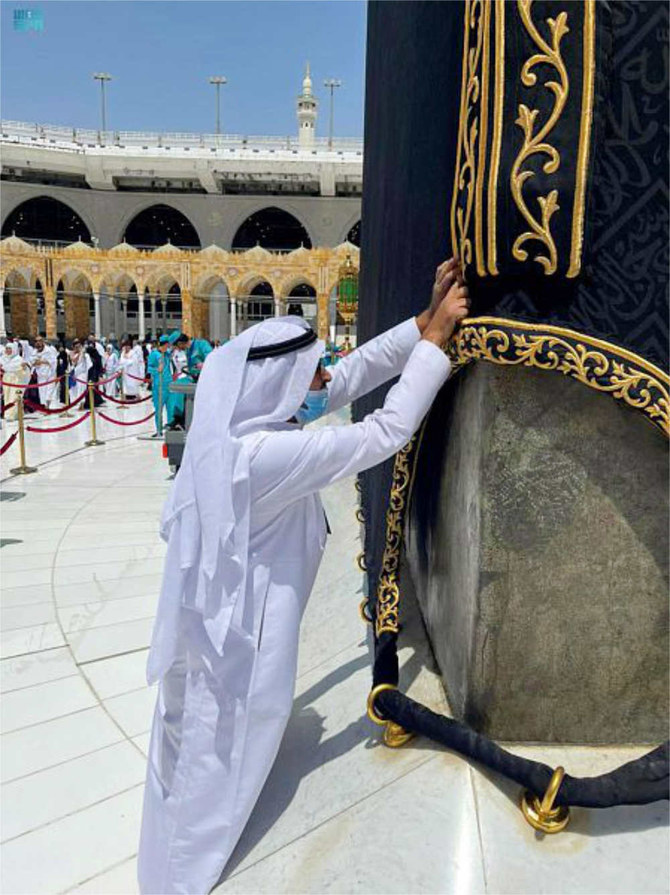
The Kiswa is checked on a daily basis and maintained by a specialized Saudi team with the experience of some of its members exceeding 26 years. (SPA)
2 / 2
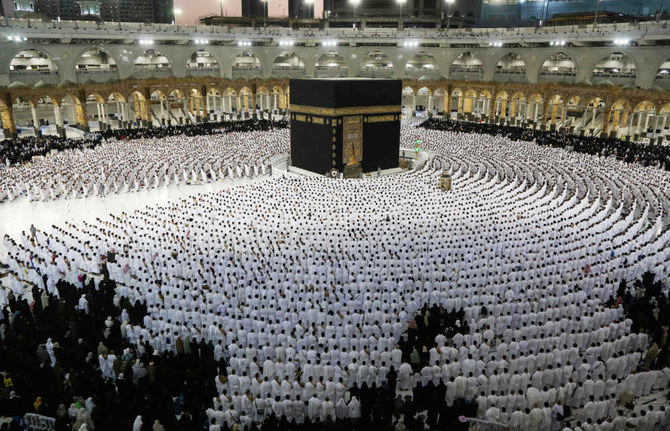
Muslims pray around the Kaaba, Islam's holiest shrine, at the Grand Mosque complex in the Saudi city of Makkah, during the fasting month of Ramadan, on April 9, 2022. (AFP)
Short Url
Updated 10 April 2022
Follow

Makkah: Kiswa maintenance staff work hard to ensure Kaaba cover looks its best during Ramadan

  • The recent work they have carried out to maintain the Kiswa included repairs to its edges and a tightening of the belt that surrounds it

MAKKAH: The Grand Mosque’s Kiswa Maintenance Department said that it has carried out work recently to maintain the Kiswa that covers the Kaaba, fix its edges and tighten the belt that surrounds it, to help ensure it looks its best during Ramadan.

The department’s director, Fahd Al-Jabiri, said: “This comes as part of the periodic work undertaken by the unit charged with taking care of the Kaaba’s Kiswa. It is carried out in accordance with a fixed program that is implemented through the Kaaba’s comprehensive maintenance and cleaning processes throughout the year.”

This comes as part of the periodic work undertaken by the unit charged with taking care of the Kaaba’s Kiswa. It is carried out in accordance with a fixed program that is implemented through the Kaaba’s comprehensive maintenance and cleaning processes throughout the year.

Fahd Al-Jabiri, Department director

Based on the department’s operational and technical plan, he added, the Kiswa is checked on a daily basis and maintained by a specialized Saudi team “with the experience of some of its members exceeding 26 years. The team charged with this task inspects all of the Kiswa’s parts as well as the rings keeping it in place.”
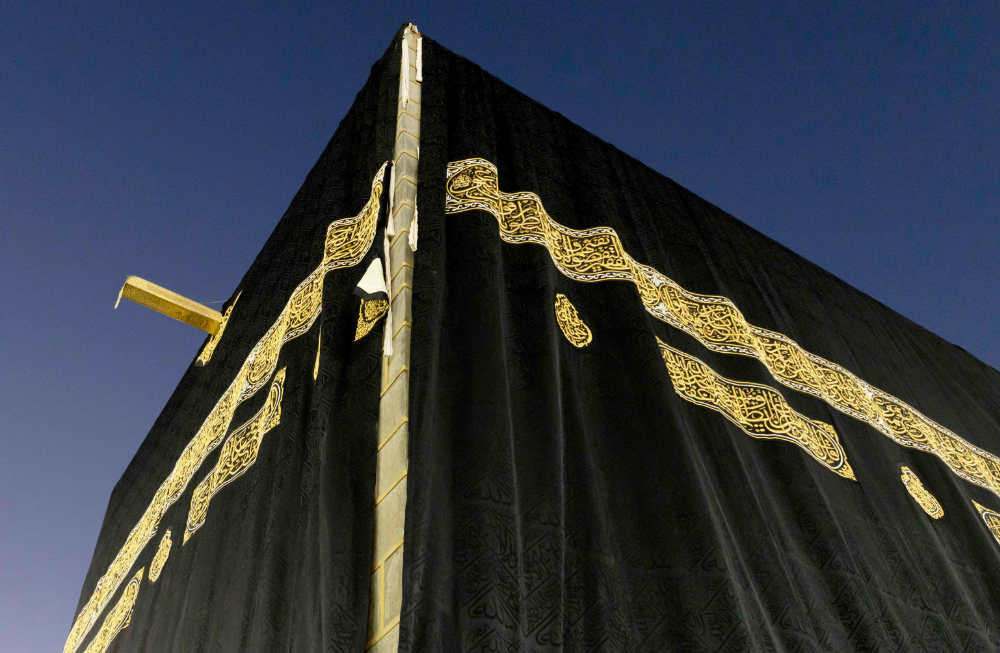
Describing the most recent work, Al-Jabiri said: “The team of specialists and technicians organized the work and set the priorities based on the adopted plan. It started by tightening the Kiswa on the rings and the rope in preparation for the holy month of Ramadan, because the Kiswa requires tightening, maintenance and cleaning.

“It also maintained the frames of the Black Stone, Al-Hajar Al-Aswad, and Rukn Al-Yamani. All of the technical team’s members are keen to apply the highest standards of accuracy, quality, performance and completion within a record time in order to finish the task while complying with the preventive measures to ensure everyone’s safety.”


ALSO READ: Books that depict the beauty and history of Islam


He said that the maintenance department, which is affiliated with the General Presidency for the Affairs of the Two Holy Mosques, makes use of the latest technology and the finest materials during work to maintain the Kiswa “due to the attention and care given by King Salman and Crown Prince Mohammed bin Salman to the Two Holy Mosques and their visitors.”

During the era of the First Saudi State, the Kiswa received great attention. It was imported from Egypt for many centuries, a tradition that only ended in 1925. At that time King Abdulaziz ordered the establishment of a factory in Ajyad district, near the Grand Mosque, to weave the Kiswa. It was the first such facility dedicated to the task in the Hijaz region.

BACKGROUND

During the era of the First Saudi State, the Kiswa received great attention. It was imported from Egypt for many centuries, a tradition that only ended in 1925. At that time King Abdulaziz ordered the establishment of a factory in Ajyad district, near the Grand Mosque, to weave the Kiswa. It was the first such facility dedicated to the task in the Hijaz region.

King Abdulaziz, and later his sons, continued to oversee and direct the manufacture and development of the Kiswa. In March 1977, the factory was moved to new premises in the Umm Al-Joud district of Makkah. It was equipped with the most advanced machines available at the time and it continues to manufacture the Kiswa to this day.

In May 2017, King Salman issued an order to change the factory’s name to the King Abdulaziz Complex for Holy Kaaba Kiswa.
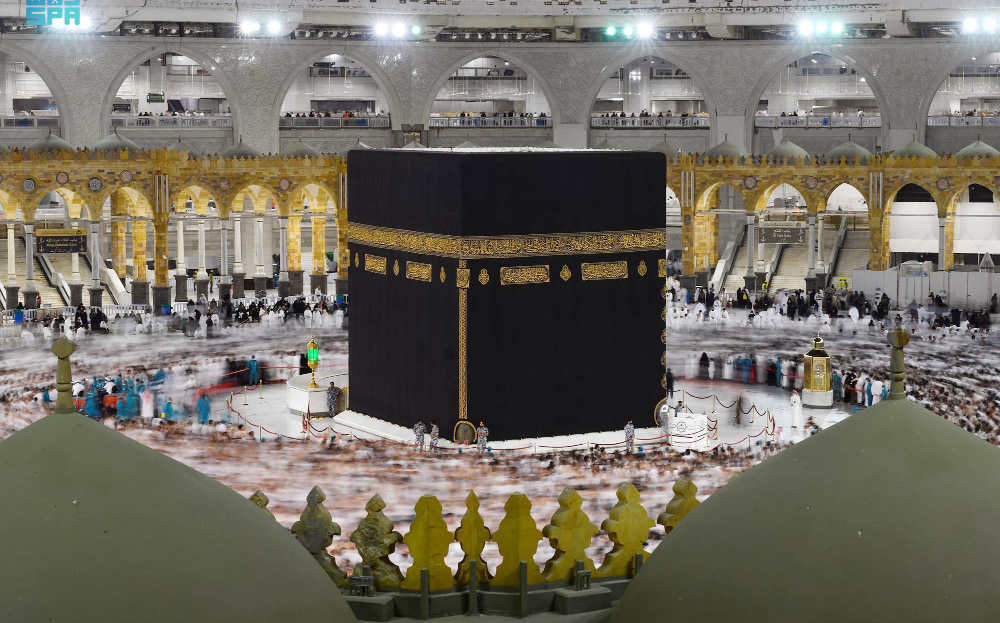
The complex has its own desalination division tasked with maintaining the quality of the water used during the production process, which is a vital component that affects the quality and texture of the silk. It desalinates the groundwater used in the washing and dying process, ensuring that the total dissolved solids ratio does not exceed one part per million.

The complex also has its own dyeing division, which first removes a protein layer known as sericin from the silk threads. The silk is then dyed black and green in hot pools of special chemicals that are carefully measured and mixed to achieve the desired colors. The outer cover is dyed black, and the inner cover is dyed green.


Ramadan boosts dates demand as Saudi sector sees seasonal rush

Updated 53 min 30 sec ago
Follow

Ramadan boosts dates demand as Saudi sector sees seasonal rush

RIYADH: Dates hold an important place in Saudi Arabia’s spiritual and cultural fabric, and their association with hospitality and religious tradition makes them a staple of iftar tables during Ramadan.

The holy month also reshapes one of the Kingdom’s most established agricultural sectors, with the date industry shifting gear. Faith-driven consumption and a gifting culture amplifies demand throughout supermarkets and premium packaging segments.

Economic adviser Fadhel Al-Buainain told Arab News that while demand for dates remained steady across the year, domestic consumption rose noticeably during Ramadan.

“Recently, there has also been growing global demand for Saudi dates. However, local demand increases noticeably during Ramadan due to the association of dates with the iftar meal,” he said.

Many people prefer to break their fast with fresh rutab dates or, when these are unavailable, with dried dates, as per tradition. Along with the religious aspect, dates are also valued for their nutritional benefits — valuable during long fasting hours.

Al-Buainain said Ramadan was “a driver for increased sales and exports,” reinforcing the sector’s seasonal momentum, but he stressed Ramadan did not represent the industry’s true economic peak.

“I do not believe it creates a peak season, despite its marketing importance,” he said. “The true peak season is the period following the date harvest, when markets flourish and large quantities are sold as farm output supplies the market. However, in the retail sector, Ramadan can be considered one of the important seasons in which marketing activity increases.”

The distinction highlights a key dynamic in the industry. While Ramadan accelerates retail turnover and boosts demand in supermarkets and gift markets, production cycles and wholesale auctions remain closely tied to harvest season.

“The peak of date sales occurs at the time of harvest, both in terms of sales volume and prices,” Al-Buainain said.

Date auctions, he added, are linked to the beginning of the harvest, after which large quantities are sold wholesale — the most important channel for producers — before reaching retailers and consumers. By contrast, sales during Ramadan are mostly from previously harvested stock.

“For example, the upcoming Ramadan will arrive before this year’s harvest season,” he said. “Therefore, the dates being sold are from last year’s crop. This further illustrates the point.”

Despite the seasonal rise in consumption, Al-Buainain said production volumes remained sufficient to prevent significant price volatility.

“Production volumes are large, and supply exceeds demand,” he said, adding that traditional dates marketed through conventional channels were expected to maintain stable prices. Any price increases are largely confined to processed or attractively repackaged varieties.

“Price increases are linked to dates packaged in modern, gift-like formats or processed dates that include added ingredients such as nuts and others. Traditional dates, however, still have stable prices,” he said.

Most dates available locally are domestically produced, with limited processed products manufactured abroad. Price differences are primarily determined by type, quality and packaging rather than Ramadan-related demand pressures.

“There are also some practices carried out by wholesale traders through auctions, where buyers bid against one another, artificially driving prices up, filming these scenes and broadcasting them to influence prices. This cannot be taken as a reliable benchmark,” Al-Buainain told Arab News.

At a structural level, the sector has expanded significantly in recent years. Saudi date exports reached SAR 1.695 billion in 2024, according to the National Centre for Palms & Dates, citing data from the General Authority for Statistics. Production exceeded 1.9 million tonnes, with exports reaching 133 countries — a 15.9 percent increase in value compared to 2023.

Since the launch of Vision 2030, export value has grown by 192.5 percent between 2016 and 2024.

Saudi Arabia, the world’s second-largest date producer, is home to more than 33 million palm trees — representing 27 percent of the global total — across approximately 123,000 agricultural holdings.

Dates also recorded the highest self-sufficiency ratio among fruits at 121 percent, according to the General Authority of Statistics.

Al-Buainain described dates as a strategic commodity and a core component of the Kingdom’s food security framework.

The sector holds significant potential to further support agricultural diversification, provided it is backed by clearer long-term strategy, improved pest control and stronger coordination across the value chain.

“The date sector needs a clear strategy that ensures maximum benefit from dates produced in the Kingdom. It also requires full protection from expatriate labor that focuses solely on profit and harms the date sector, its future, and its sustainability,” he said.

“The sector also needs a final solution to pests that damage palm trees, including the red palm weevil, as well as the establishment of a national date company to purchase crops, process, package, distribute, and export them, in addition to entering date-based industries to generate added value for the economy.”