

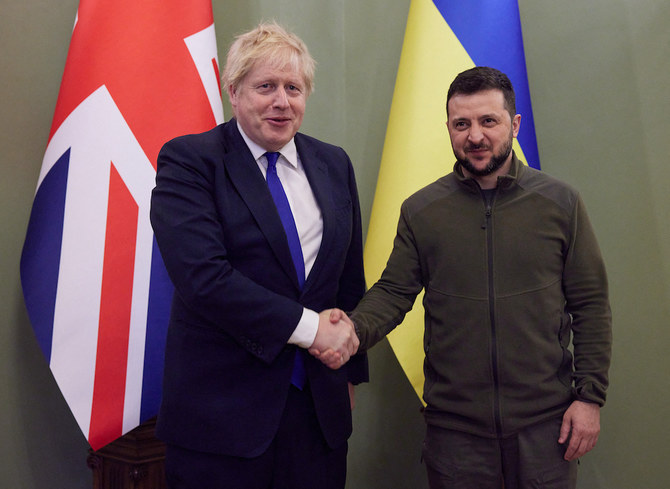
UK’s Johnson meets Ukraine’s Zelensky in Kyiv, offers more armored vehicles and missiles

Short Url
Updated 10 April 2022
Follow

UK’s Johnson meets Ukraine’s Zelensky in Kyiv, offers more armored vehicles and missiles

  • Boris Johnson paid an unannounced visit to Kyiv in a 'show of solidarity' with Ukraine
  • The prime minister says will continue to intensify the sanctions on Russia week by week

LONDON: British Prime Minister Boris Johnson, on a visit to Kyiv, Saturday vowed UK armored vehicles and anti-ship missiles for Ukraine as he acclaimed its military for “the greatest feat of arms of the 21st century.”
“It is because of President (Volodymyr) Zelensky’s resolute leadership and the invincible heroism and courage of the Ukrainian people that (Vladimir) Putin’s monstrous aims are being thwarted,” he said after meeting Zelensky, according to a Downing Street statement.
Johnson set out extra military aid of 120 armored vehicles and new anti-ship missile systems, “to support Ukraine in this crucial phase while Russia’s illegal assault continues,” the statement said.
That is on top of UK aid announced Friday of additional Starstreak anti-aircraft missiles and another 800 anti-tank missiles, along with “loitering” drones for “precision strikes” against the Russians.

As world powers held a fundraising round for Ukraine, Johnson also promised an extra $500 million via the World Bank, taking its total loan guarantee to $1 billion, and would liberalize tariffs on most imports from Ukraine and take other measures to free up trade. 
Johnson also said that countries supporting Ukraine following its invasion by Russia would continue to tighten the economic sanctions on Moscow.
“Together with our partners, we are going to ratchet up the economic pressure and we will continue to intensify, week by week, the sanctions on Russia,” Johnson said in comments to the media, standing alongside Ukrainian President Volodymyr Zelensky. His visit to the Ukrainian capital was previously unannounced.
Johnson said the measures would include moving away from the use of Russian hydrocarbons. 
Johnson said it had been a “privilege” to meet Zelensky in person on his surprise visit, which was not pre-announced in London and was meant as a show of support for Ukraine against what he called “Russia’s barbaric campaign.”

“Ukraine has defied the odds and pushed back Russian forces from the gates of Kyiv, achieving the greatest feat of arms of the 21st century,” he said.
“I made clear today that the United Kingdom stands unwaveringly with them in this ongoing fight, and we are in it for the long run.”
Johnson is the latest European leader to visit Kyiv this weekend, following the discovery a week ago of the bodies of civilians in towns from which the Russian had just army retreated.
The Ukrainian leader is known to have a warm relationship with Johnson, about whom he speaks with admiration.
“Boris Johnson is one of the most principled opponents of the Russian invasion, a leader in sanctions pressure on Russia and defense support for Ukraine,” Zelensky said.
Johnson’s trip to the Ukrainian capital followed visits to Kyiv by European Commission president Ursula von der Leyen and the EU’s foreign policy chief Josep Borrell on Friday and the visit of the Austrian Chancellor Karl Nehammer earlier on Saturday.
(With AFP and Reuters)


Indonesia threatens to ban Musk’s Grok AI over degrading images of children and women

Updated 07 January 2026
Follow

Indonesia threatens to ban Musk’s Grok AI over degrading images of children and women

  • Grok has been complying with user requests to alter images of real people  
  • Other countries, including Malaysia and France, have also threatened action against X 

JAKARTA: Indonesia’s Communications Ministry threatened on Wednesday to ban Elon Musk’s X and its artificial intelligence chatbot Grok after degrading pictures of women and children generated without consent surged on the social media platform. 

Grok has been complying with requests from X users to modify images of real women and children stripped to their underwear, creating a viral trend that has sparked concerns across the globe. 

A preliminary investigation found that Grok “does not yet have explicit and adequate regulations to prevent the production and distribution of pornographic content based on real photos” of Indonesian citizens,” Indonesia’s Ministry of Communications and Digital Affairs said in a statement. 

Indonesia has strict laws against the production and distribution of pornography, with the government regularly instructing internet service providers to block access to websites containing such content. 

“The obligation to comply with Indonesian laws and regulations applies to all digital platforms operating in Indonesia,” the ministry said. 

“Should there be non-compliance or lack of cooperation, the Ministry of Communications and Digital Affairs may impose administrative sanctions, including termination of access to Grok’s AI services and the X platform.” 

Indonesia has joined a growing list of countries, which includes Malaysia, India and France, that are calling for investigations and threatening action against Grok.

Concerns grew after a December update to the chatbot made it easier for users to post photographs of people and ask for their clothing to be removed.

In a report published on Tuesday, European non-profit organization AI Forensics said Grok is “systematically ‘undressing’ women.”  

Its analysis of 20,000 images generated by Grok between Dec. 25 and Jan.1 found that 53 percent of them contained individuals in minimal attire, with 81 percent of them being women, while two percent of the images depicted persons appearing to be 18 years old or younger. 

Indonesia’s Communications Ministry said AI service providers and users are also subject to administrative or criminal sanctions under Indonesian law if they are proven to have produced or distributed pornographic content or modified personal images without permission. 

“Every digital platform must ensure that the technology they provide does not become a medium for privacy violation, sexual exploitation or the degradation of a person’s dignity,” said Alexander Sabar, director-general of digital space at the ministry.  

“We urge all parties to use artificial intelligence technology responsibly. The digital space is not a lawless space; every citizen’s privacy and right to their image must be respected and protected.”