BRUSSELS: The EU is to discuss its support for war crimes probes in Ukraine in meetings over the next two days with the International Criminal Court’s chief prosecutor, the European Commission said on Saturday.
Karim Khan, of The Hague-based court, is to meet EU foreign policy chief Josep Borrell on Sunday in Luxembourg, then take part in a meeting of EU foreign ministers in the city on Monday.
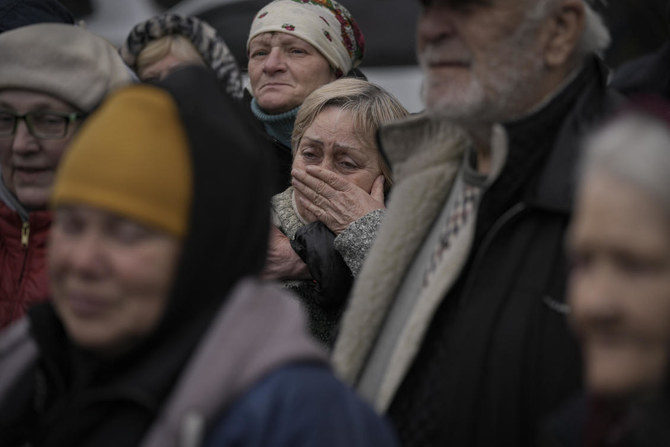
The meetings underline the European Union’s strong support — also voiced in a G7 statement on Thursday — for investigations into atrocities in Ukraine, spurred on notably by killings in the town of Bucha, near Kyiv.
Ukraine’s government and some neighboring EU countries have said Russia — whose troops occupied Bucha before the discovery of the corpses — was responsible and guilty of war crimes. Moscow denies that.
Top EU officials have been more prudent, observing due process and preferring to await the results of war crimes investigations conducted by Ukraine’s prosecution service with help from the ICC, the EU, the UN human rights commissioner and the OSCE.
European Commission chief Ursula von der Leyen, who visited Bucha on Friday with Borrell, said as she left Ukraine on Saturday: “If this is not a war crime, what is a war crime?“
But, she added, a rigorous investigation was needed so that any future war crimes charges stood up in court.
The EU is providing 7.5 million euros ($8.2 million) to train Ukrainian prosecutors to investigate war crimes.
Scrutiny of possible war crimes intensified further Friday with the missile strike on an eastern Ukraine train station packed with civilians fleeing a feared Russian offensive in which 52 people were killed.
The UN rights chief, Michelle Bachelet, has also said her office has received “credible allegations that Russian armed forces have used cluster munitions in populated areas.”
The ICC’s Khan said early last month his service had opened several probes into alleged war crimes in Ukraine.
Borrell said in a Kyiv media conference on Friday alongside Ukrainian President Volodymyr Zelensky: “We are in the presence of war crimes and we will help you, we will help the Ukrainian prosecutor, to present the proofs in front of the International Criminal Court.”
The EU has set up a joint investigation team with the Ukrainians to gather evidence in Bucha and elsewhere, with forensic experts drawn from some EU member states.
A commission spokesman said: “There are ongoing talks between Eurojust (the EU agency for judicial cooperation) and the International Criminal Court to join forces and for the court to be part of the joint investigation team.”
Additionally, 10 of the EU’s 27 member states have opened national investigations into alleged crimes committed by Russia in Ukraine, he said.
It is “important that we connect the dots and work together to ensure that those responsible for atrocities and war crimes in Ukraine will be held accountable,” the commission spokesman said.


![]()

EU discusses Ukraine war crime probes with ICC prosecutor
Short Url
https://arab.news/mq527
EU discusses Ukraine war crime probes with ICC prosecutor
- Karim Khan, of The Hague-based court, is to meet EU foreign policy chief Josep Borrell on Sunday
- Ukraine’s government and some neighboring EU countries have said Russia was responsible and guilty of war crimes.


Latest updates


Recommended


© 2026 SAUDI RESEARCH & PUBLISHING COMPANY, All Rights Reserved And subject to Terms of Use Agreement.