

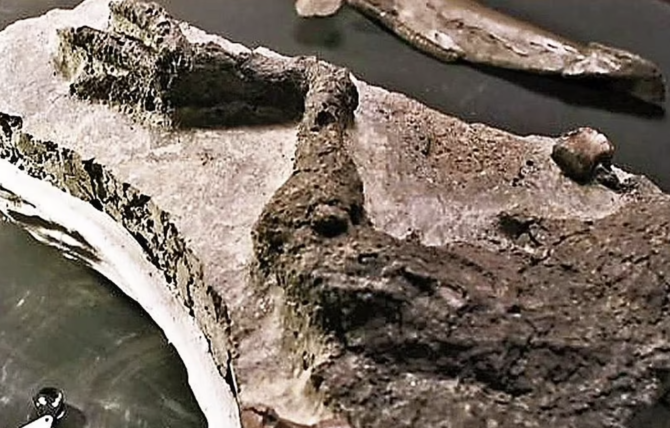
Palaeontologists unearth fossil from the day dinosaurs wiped out by asteroid 66 million years ago

Palaeontologists unearthed the fossil of a Thescelosaurus leg — a small herbivorous dinosaur. (Screenshot/BBC)
Short Url
Updated 08 April 2022
Follow

Palaeontologists unearth fossil from the day dinosaurs wiped out by asteroid 66 million years ago

  • Experts believe the limb, complete with skin, was “ripped off” when the asteroid hit

LONDON: The fossilized remains of a dinosaur believed to have been killed on the day a massive asteroid destroyed much of life on Earth 66 million years ago has been discovered.

Palaeontologists unearthed the fossil of a Thescelosaurus leg — a small herbivorous dinosaur — near a fragment of the plummeting asteroid, known as the Chicxulub Event, which killed it.

Experts believe the limb, complete with skin, was “ripped off” when the asteroid hit and caused a catastrophic, global flash flood and the creature is thought to have been “buried on the day of impact,” Daily Mail reported.

The leg was found alongside a series of discoveries at the Tanis fossil site in North Dakota, and a new BBC documentary fronted by Sir David Attenborough will reveal the findings.

“This is the most incredible thing that we could possibly imagine here, the best case scenario, the one thing that we always wanted to find in this site and here we've got it,” University of Manchester palaeontologist Robert DePalma, who made the discoveries, told the BBC.

“Here we've got a creature that was buried on the day of impact – we didn't know at that point yet if it had died during the impact but now it looks like it probably did,” he added. 

The findings were reported by the BBC after it was granted exclusive access, along with Attenborough, to the site for the documentary.


NASA and families of fallen astronauts mark 40th anniversary of space shuttle Challenger accident

Updated 23 January 2026
Follow

NASA and families of fallen astronauts mark 40th anniversary of space shuttle Challenger accident

CAPE CANAVERAL, Florida: Families of the astronauts lost in the space shuttle Challenger accident gathered back at the launch site Thursday to mark that tragic day 40 years ago.
All seven on board were killed when Challenger broke apart following liftoff on Jan. 28, 1986.
At the Kennedy Space Center memorial ceremony, Challenger pilot Michael Smith’s daughter, Alison Smith Balch, said through tears that her life forever changed that frigid morning, as did many other lives. “In that sense,” she told the hundreds of mourners, “we are all part of this story.”
“Every day I miss Mike,” added his widow, Jane Smith-Holcott, “every day’s the same.”
The bitter cold weakened the O-ring seals in Challenger’s right solid rocket booster, causing the shuttle to rupture 73 seconds after liftoff. A dysfunctional culture at NASA contributed to that disaster and, 17 years later, shuttle Columbia’s.
Kennedy Space Center’s deputy director Kelvin Manning said those humble and painful lessons require constant vigilance “now more than ever” with rockets soaring almost every day and the next astronaut moonshot just weeks away.
Challenger’s crew included schoolteacher Christa McAuliffe, who was selected from thousands of applicants representing every state. Two of her fellow teacher-in-space contenders — both retired now — attended the memorial.
“We were so close together,” said Bob Veilleux, a retired astronomy high school teacher from New Hampshire, McAuliffe’s home state.
Bob Foerster, a sixth grade math and science teacher from Indiana who was among the top 10 finalists, said he’s grateful that space education blossomed after the accident and that it didn’t just leave Challenger’s final crew as “martyrs.”
“It was a hard reality,” Foerster noted at the Space Mirror Memorial at Kennedy’s visitor complex.
Twenty-five names are carved into the black mirror-finished granite: the Challenger seven, the seven who perished in the Columbia disaster on Feb. 1, 2003, the three killed in the Apollo 1 fire on Jan. 27, 1967, and all those lost in plane and other on-the-job accidents.
Relatives of the fallen Columbia and Apollo crews also attended NASA’s Day of Remembrance, held each year on the fourth Thursday of January. The space agency also held ceremonies at Virginia’s Arlington National Cemetery and Houston’s Johnson Space Center.
“You always wonder what they could have accomplished” had they lived longer, Lowell Grissom, brother of Apollo 1 commander Gus Grissom, said at Kennedy. “There was a lot of talent there.”

.