





MAKKAH/JEDDAH: Madinah’s Quba Mosque, the first place of worship built by Prophet Muhammad (peace be upon him), will increase tenfold in size, Crown Prince Mohammed bin Salman has announced.
In 2018, the crown prince ordered the restoration of 130 historical mosques, which forms part of the government’s national revitalization program.
The crown prince believes in the importance of these ancient mosques, for their rich religious, social, cultural and architectural significance.
The structure will undergo the largest development in its history, expanding to 50,000 square meters.
Named after King Salman, the project aims to increase the mosque’s capacity to 66,000 worshipers.
Its current praying area is 5,000 square meters, with the building and facilities taking up 13,500 square meters. It has a total capacity for 20,000 worshipers.
The crown prince said the plan would ensure the mosque can cater for large numbers of worshipers during peak seasons.
It will preserve the architectural style of the mosque and other monuments close to it.
Shaded courtyards will be constructed on four sides, which will connect to prayer areas that are not structurally attached to the current building.
The crown prince said the revitalization would heighten the devotional and cultural experience for visitors.
It would further solve overcrowding and enhance the safety of worshipers. In addition, the road system would be revamped to provide easier access to the mosque.
As many as 57 sites, including wells, farms and orchards, are to be developed or rehabilitated as part of the project.
The crown prince praised King Salman for his commitment to these preservation initiatives, which forms part of the goals and objectives of Vision 2030.
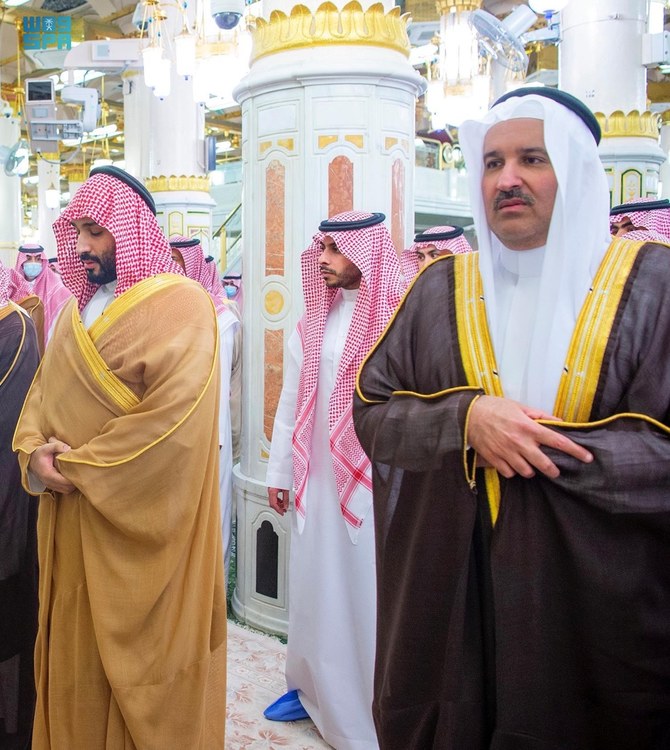
During his visit to Madinah, the crown prince prayed at the Prophet’s Mosque, including at the Rawdah, an area between the Sacred Chamber (known as the Prophet’s house), and the Prophet’s minbar (or pulpit).
He was accompanied by Prince Faisal bin Salman, governor of Madinah, and several senior officials.
He also visited and prayed at Quba Mosque.
At Taiba Palace in Madinah later, the crown prince met with prominent scholars and leaders, and a group of citizens who came to greet him.
Quba Mosque is located 5 kilometers south of the Prophet’s Mosque. It was the first place of worship in the history of Islam, and constructed in 1 A.H. (622 A.D).
It is believed that Prophet Mohammed used to frequently pray in Quba Mosque, especially on Saturdays. He also urged his companions to do so.
There is a Hadith about the mosque, with the Prophet reported to have said: “Whoever makes ablutions in this house and offers one prayer therein, will be rewarded the equivalent of one Umrah.” This is why the mosque remains of considerable religious and historical importance to Muslims.
The mosque was renovated during the eras of both caliphs Othman bin Affan and Omar ibn Al-Khattab. The latter was the first to add a minaret to the structure.
A number of benefactors over the years have renovated the mosque, including in 1057, 1177, 1293, 1355, 1462 and 1503. This includes several times during the Ottoman era, the last of which was during the reign of Sultan Abdul Majid.
During the Saudi era, Quba Mosque, along with other houses of worship, were regularly revitalized. In 1968, its northern side was expanded, and then in 1985 King Fahd ordered several enlargements, while maintaining the building’s historically significant architectural features.
Abdul Haq Al-Uqbi, an architect who specializes in mosque architecture in Madinah, welcomed the King Salman development project, which he said would not only increase the capacity for worshipers but also ensure that its cultural and religious significance would be enhanced.
An additional positive element was that the entire Quba complex and surrounding area would be revitalized. This forms part of the “exceptional” urban regeneration program that the government has embarked on throughout the country. Many visitors would now be able to learn more about the 57 historically significant locations around the mosque, he said.
Dr. Hamza Al-Muzaini, a writer and academic, agreed that the expansion was of considerable social and cultural importance, and was fitting for the city of Madinah, which is a center of such symbolism and history for Muslims around the globe.
He added that residents of Madinah would be able to comfortably attend prayers in the mosque during Hajj and Eid Al-Fitr, when there is normally an increase in the number of pilgrims visiting the city.


