PM Khan says will ‘fight till last ball’ as Supreme Court rules against him

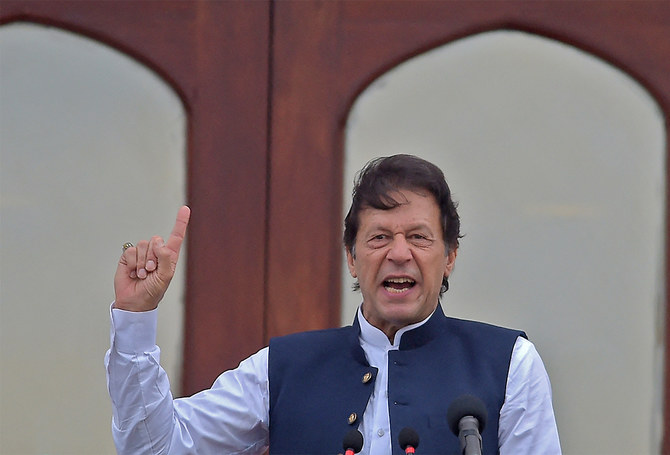
Pakistan's Prime Minister Imran Khan addresses the nation outside the Prime Minister Secretariat building in Islamabad, Pakistan, on August 30, 2019. (AFP/File)
Short Url
Updated 07 April 2022
Follow

PM Khan says will ‘fight till last ball’ as Supreme Court rules against him

  • Khan calls cabinet and parliamentary meeting tomorrow, Friday
  • Supreme Court rules Khan push to disallow no-trust motion unconstitutional

ISLAMABAD: Prime Minister Imran Khan called a meeting of his cabinet tomorrow, Friday, after Pakistan’s Supreme Court ruled on Thursday that Khan’s move to dissolve parliament last week was unconstitutional.
The former cricket star had moved to break up the lower house of parliament ahead of a no-confidence vote against him that he was widely expected to lose. The court said in its judgment that the vote should now go ahead on Saturday, April 9.
Khan said he had called a cabinet and a parliamentary meeting tomorrow, Friday.
“Tomorrow evening I will address the nation,” Khan said on Twitter. “My message to our nation is I have always & will continue to fight for Pak till the last ball.”

The PM’s tweet came after the Supreme Court ruled that’s Khan push last week to disallow a no-confidence motion against him in parliament was unconstitutional.
Thursday’s ruling in the capital Islamabad could spell the premature end of Khan’s tenure in a country where no elected leader has finished their full term in office.
The 69-year-old, who steered Pakistan to cricket World Cup victory in 1992, came to power in 2018 after rallying the country behind his vision of a corruption-free, prosperous nation respected on the world stage.


Pakistan says multilateralism in peril, urges global powers to prioritize diplomacy over confrontation

Updated 8 sec ago
Follow

Pakistan says multilateralism in peril, urges global powers to prioritize diplomacy over confrontation

  • The country tells the UN international security system is eroding, asks rival blocs to return to dialogue
  • It emphasizes lowering of international tensions, rebuilding of channels of communication among states

ISLAMABAD: Pakistan warned the world community on Monday that multilateralism was “in peril” amid rising global tensions, urging major powers to revive diplomacy and dialogue to prevent a further breakdown in international security.

Speaking at a UN Security Council briefing, Pakistan’s ambassador to the UN, Asim Iftikhar Ahmad, said the world was drifting toward confrontation at a time when cooperative mechanisms were weakening.

His comments came during a session addressed by Finland’s foreign minister Elina Valtonen, chairing the Organization for Security and Co-operation in Europe (OSCE), the world’s largest regional security body.

Formed out of the 1975 Helsinki Final Act, the OSCE was designed during the Cold War to reduce tensions, uphold principles of sovereignty and human rights and promote mechanisms for peaceful dispute resolution.

“Today, the foundational ethos of international relations, multilateralism, cooperation and indivisible security, as envisaged in the preamble of Helsinki Final Act, is perhaps facing its biggest challenge in decades,” Ahmed said. “The OSCE, too, is navigating a difficult geopolitical landscape, with conflict raging in the heart of Europe for nearly four years, depletion of trust and unprecedented strains on peaceful co-existence.”

He said a return to the “Helsinki spirit” of dialogue, confidence-building and cooperative security was urgently needed, not only in Europe but globally.

“This is not a matter of choice but a strategic imperative to lower tensions, rebuild essential channels of communication, and demonstrate that comprehensive security is best preserved through cooperative instruments, and not by the pursuit of hegemony and domination through military means,” he said. “Objective, inclusive, impartial, and principle-based approaches are indispensable for success.”

Ahmed’s statement came in a year when Pakistan itself fought a brief but intense war after India launched missile strikes at its city in May following a militant attack in Indian-administered Kashmir. New Delhi blamed Pakistan for the assault, an allegation Islamabad denied while calling for a transparent international investigation.

The Pakistani diplomat said the international system was increasingly defined by bloc politics, mistrust and militarization, warning that such trends undermine both regional stability and the authority of multilateral institutions, including the UN itself.

He urged member states to invest more in preventive diplomacy and the peaceful settlement of disputes as reaffirmed by the Council in Resolution 2788.

Ahmad said Pakistan hoped the OSCE would continue reinforcing models of cooperative security and that the Security Council would back partnerships that strengthen international law and the credibility of multilateral frameworks.

The path forward, he added, required “choosing cooperation over confrontation, dialogue over division, and inclusive security over bloc-based divides.”