

In emergency move, Pakistan jacks up key interest rate by 2.5% to 12.25%

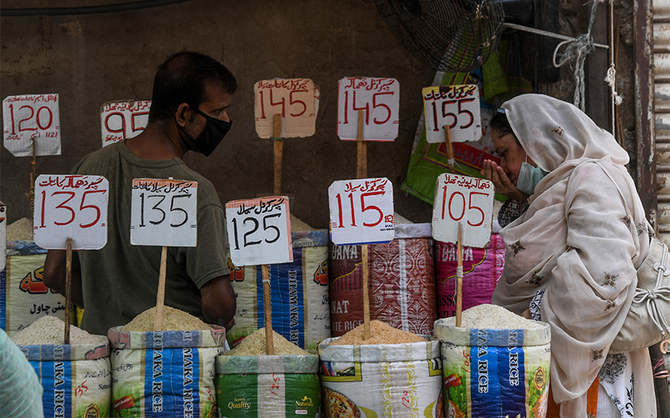
A woman checks the smell of rice at a market in Karachi, Pakistan, on June 10, 2020. (AFP/File)
Short Url
Updated 07 April 2022
Follow

In emergency move, Pakistan jacks up key interest rate by 2.5% to 12.25%

  • Decision has been taken due to rising inflationary pressure, external financial stability
  • SBP says heightened political uncertainty contributed to 5% depreciation in Pak rupee

KARACHI: Pakistan’s central bank on Thursday increased key interest rate by 250 basis points to 12.25 percent in an emergency meeting, citing inflation outlook deterioration and rising risks to external stability due to political uncertainty and the Russia-Ukraine war.

The State Bank of Pakistan had increased the policy rate by 100 basis points to 9.75 percent in December 2021. Since then, the rate has remained unchanged.

“The Monetary Policy Committee (MPC) noted that the (external and domestic) developments necessitated a strong and proactive policy response,” the SBP announced in a statement issued on Thursday while explaining the rationale behind its decision. “Accordingly, the MPC decided at its emergency meeting today, to raise the policy rate by 250 basis points to 12.25 percent.”

It added since the last MPC meeting on March 8, the outlook for inflation had deteriorated and risks to external stability had been exacerbated by the Russia-Ukraine conflict.

“Externally, futures markets suggest that global commodity prices, including oil, are likely to remain elevated for longer and the Federal Reserve is likely to increase interest rates more quickly than previously anticipated, likely leading to a sharper tightening of global financial conditions,” the statement continued.

The SBP noted the inflation out-turn in March 2022 surprised on the upside on the domestic front, with significant increase in core inflation in both urban and rural areas.

It maintained that timely demand moderating measures and strong exports and remittances had caused a shrinkage in the current account deficit that amounted to $0.5 billion in February, bringing it to its lowest level during the current fiscal year.

The central bank said heightened domestic political uncertainty had contributed to a five percent depreciation in the rupee along with a sharp rise in domestic secondary market and Pakistan’s Eurobond yields.

In addition, there had been a decline in the foreign exchange reserves with the SBP which was largely due to debt repayments and government payments pertaining to the settlement of an arbitration award related to a mining project.

The bank said some of this decline in reserves was also expected to be reversed as official creditors renewed their loans.

It also increased its inflation forecast from 9 to over 11 percent in the current fiscal year (FY22), saying the trend was likely to moderate in FY23.

The current account deficit is still expected to remain around four percent of the GDP in FY22. While it said the non-oil current account balance had continued to improve, the overall current account remained dependent on global commodity prices.

The bank said it was in the process of taking further actions to reduce inflationary pressure and current account deficit, adding this included interest rate increase on the export refinance scheme (EFS) and widening the set of import items subject to cash margin requirements.

It informed these items were mostly finished goods, including luxury items, and excluded raw materials.

The SBP statement also highlighted that Pakistan’s external financing needs for the current fiscal year had been fully met from identified sources.

It noted the increase in key interest rate, together with a reduction in domestic political uncertainty and prudent fiscal policies, should help ensure that Pakistan’s economic recovery from COVID-19 remained sustainable.


Pakistan approves first national gemstones policy, targets $1 billion exports

Updated 09 January 2026
Follow

Pakistan approves first national gemstones policy, targets $1 billion exports

  • Government seeks to overhaul certification, mining, processing to curb smuggling and boost value-added exports
  • Move follows broader push to tap Pakistan’s vast mineral wealth and attract much-needed foreign investment

ISLAMABAD: Pakistan has granted in-principle approval to its first national policy framework for gemstones and precious stones, aiming to reform the sector, align it with international standards and lift annual exports to $1 billion within five years, the prime minister’s office said on Friday.

The decision was taken during a meeting chaired by Prime Minister Shehbaz Sharif, which reviewed reforms for the largely underdeveloped gemstones sector despite Pakistan holding significant reserves of emeralds, rubies, sapphires, peridot and topaz.

The move comes as Pakistan intensifies efforts to monetize its untapped mineral resources amid fiscal pressures and an IMF-backed reform program. Over the past two years, Islamabad has hosted international minerals conferences and signed cooperation agreements with countries including the United States, Saudi Arabia and China to improve governance, attract foreign investment and move up the value chain in mining and minerals processing.

Despite officials estimating Pakistan’s gemstone reserves at around $450 billion, formal exports remain negligible, at about $5.8 million annually, due to weak certification systems, limited domestic processing capacity, widespread smuggling and fragmented regulation across federal and provincial authorities.

“Sharif has granted in-principle approval to a national policy framework to reform Pakistan’s gemstones and precious stones sector and align it with international standards,” the PM’s office said in a statement. 

“The Ministry of Industries and Commerce, after identifying challenges during the preparation of the national policy framework, has developed a comprehensive set of priority policy measures which aim to achieve $1 billion in gemstone-related exports within five years through sectoral reforms.”

According to the statement, the policy framework includes geological mapping to accurately assess reserves, the establishment of internationally accredited laboratories and certification regimes and the creation of a dedicated authority to regulate and promote the sector. The government also plans to set up a National Warranty Office and at least two centers of excellence this year to support training, research and value-added processing.

The policy prioritizes private sector participation, particularly encouraging young entrepreneurs, and seeks to shift Pakistan away from exporting raw stones toward domestic cutting, polishing and branding. The statement said this approach could significantly increase export earnings while generating skilled jobs.

The prime minister also directed the ministry of finance to ensure timely allocation of financial resources required to implement the reforms and stressed the need to involve provincial governments, industry stakeholders and international experts to address structural bottlenecks.

“Pakistani precious stones are renowned globally for their quality, and curbing smuggling while ensuring exports through legal channels will secure billions of dollars in foreign exchange,” the prime minister said, according to the statement.