

Pakistan’s Sindh starts inoculating cattle as lumpy skin disease spreads to Punjab

A man washes a cow for a customer at a car service station ahead of the Muslim festival of Eid al-Adha in Karachi, Pakistan, on July 14, 2021. (AFP/File)
Short Url
Updated 07 April 2022
Follow

Pakistan’s Sindh starts inoculating cattle as lumpy skin disease spreads to Punjab

  • The disease was first reported in Jamshoro district in November and has since affected over 33,000 animals
  • The Sindh administration has received the first tranche of 1.1 million vaccines from Turkey to deal with the disease

KARACHI: Authorities in Pakistan’s Sindh province have kicked off an inoculation drive for cows after lumpy skin disease (LSD) affected thousands of these animals while killing hundreds, though cattle farmers said on Wednesday the disease had now spread to the country’s Punjab province.
First observed in 1929 in Zambia, LSD is a viral infection that causes fever and multiple nodules on the skin and mucous membrane of animals. The disease is transmitted by bloodsucking insects like ticks and mosquitoes and can also prove fatal. Doctors say it does not affect humans.
LSD was first reported in Pakistan’s Jamshoro district in Sindh last November. Since then, 33,483 animals have been infected in the province while 339 have died.
On Saturday, authorities said they had imported 1.1 million doses of vaccine ordered from a Turkish company.
“The Sindh government took immediate action and swiftly imported vaccines which are now administered to cows in Karachi and other parts of the province,” said Shakir Umar Gujjar, president of the Dairy and Cattle Farmers Association, adding the disease was, however, spreading to Punjab now, especially in districts adjacent to Sindh.
“We hope we will soon be able to take control of the disease in Sindh, but similar administrative action is also required in Punjab,” he told Arab News.
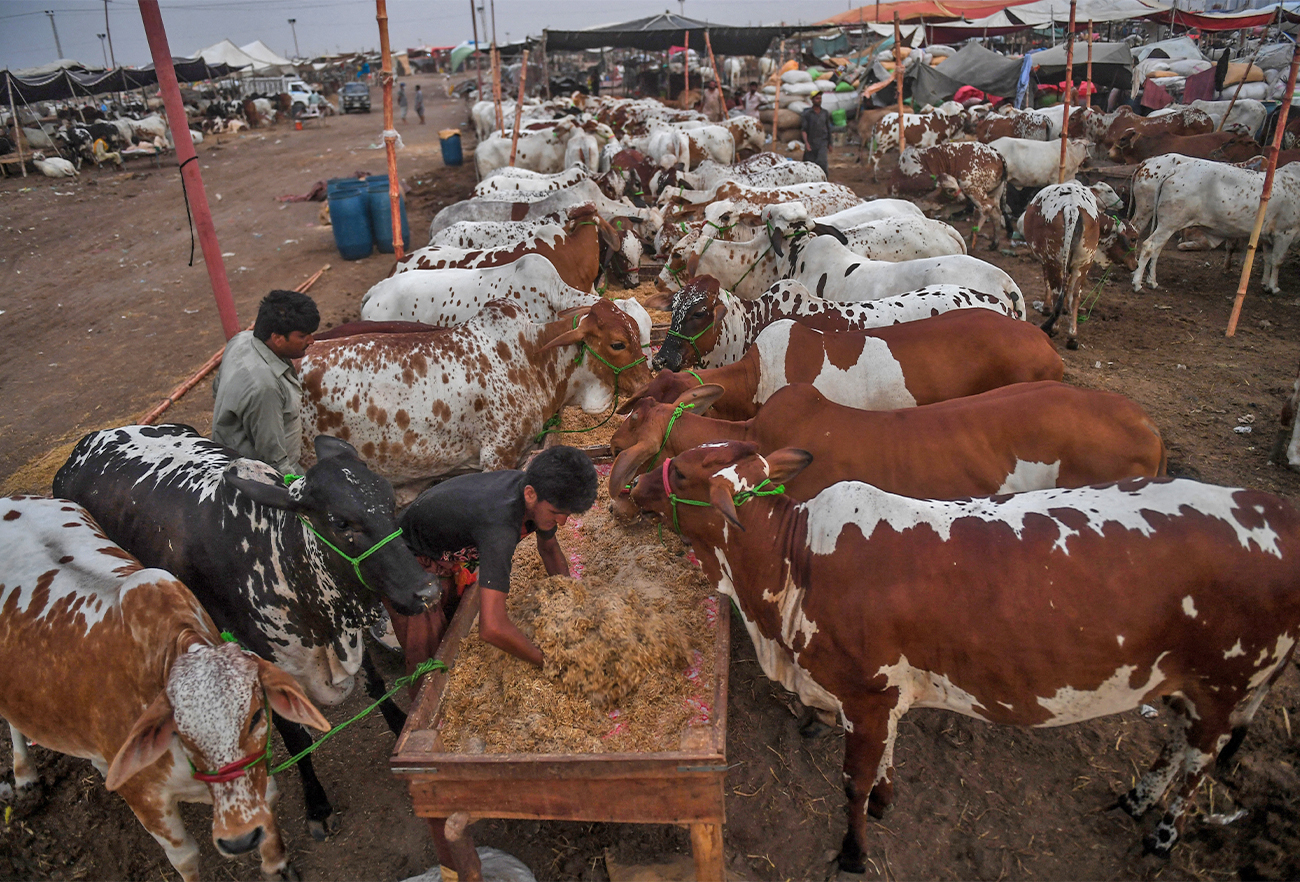


A trader feeds the cows at a cattle market in Karachi, Pakistan, on July 10, 2020. (AFP/File)

Dr. Nazeer Hussain Kalhoro, director general of livestock in the Sindh administration, said an order of 3.8 million doses was placed through a Lahore-based company, Huzaifa international, after the Drug Regulatory Authority of Pakistan (DRAP) allowed six local firms to import the vaccine.
He added the first tranche arrived on Saturday.
“The vaccine, which cost Sindh government Rs250 per dose, is administered free of cost,” he told Arab News while hoping the disease would soon be eradicated.
Kalhoro said a comprehensive plan had been made to inoculate livestock in the province, adding that arrangements had also been made to store vaccines at the required temperature.
Asked about the gravity of the situation, Gujjar said it was more serious than officials were willing to acknowledge.
“The official figures are always underreported,” he said. “But even these numbers have created panic and severely affected the sale of dairy products.”
Gujjar said the daily sale of five million liters of milk in Karachi had been reduced by 60 percent, adding that only 25 percent of average meat was sold in the city.
“There is gradual improvement now, especially in the sale of milk,” he continued. “Once the vaccination drive is complete, we will move toward normalcy.”


Pakistan Airports Authority reports ‘historic’ twin-engine aircraft landing in Lahore

Updated 13 December 2025
Follow

Pakistan Airports Authority reports ‘historic’ twin-engine aircraft landing in Lahore

  • Twin-engine aircraft are usually larger, heavier and require better airport infrastructure, navigation systems to land
  • Pakistan Airports Authority says landing reflects its commitment to enhance aviation sector, strengthen infrastructure

ISLAMABAD: The Pakistan Airports Authority (PAA) announced on Saturday that the New General Aviation Aerodrome achieved a significant milestone when it handled the landing of a twin-engine aircraft. 

A twin-engine aircraft has two engines that provide it redundancy and increased performance compared to single-engine counterparts. These aircraft range from small twin-engine propeller planes to large commercial jetliners. The presence of multiple engines enhances safety by allowing the aircraft to continue flying in the event of an engine failure.

However, twin-engine aircraft are usually larger, heavier and more complex than single-engine planes. They require advanced airport infrastructure such as better runways, navigation systems and air traffic coordination. 

“The New General Aviation Aerodrome, Lahore achieved another significant operational milestone today with the successful landing of a twin-engine aircraft, following the recent arrival of a single-engine aircraft,” the PAA said in a statement. 

It said the flight was also boarded by Air Vice Marshal Zeeshan Saeed, the director general of the PAA. The move reflected “strong institutional confidence” in the aerodrome’s safety standards, operational capability, and overall readiness, it added. 

“The landing was conducted with exceptional precision and professionalism, demonstrating the aerodrome’s robust operational framework, technical preparedness, and effective airside coordination in accordance with contemporary aviation requirements,” the PAA said. 

It said the landing represented a “major advancement” in Pakistan’s general aviation sector and underscores the PAA’s commitment to enhancing regional aviation capacity, strengthening infrastructure and promoting excellence in aviation development.