

As pandemic fears subside, Ramadan signifies a joyous return to normality in Saudi Arabia

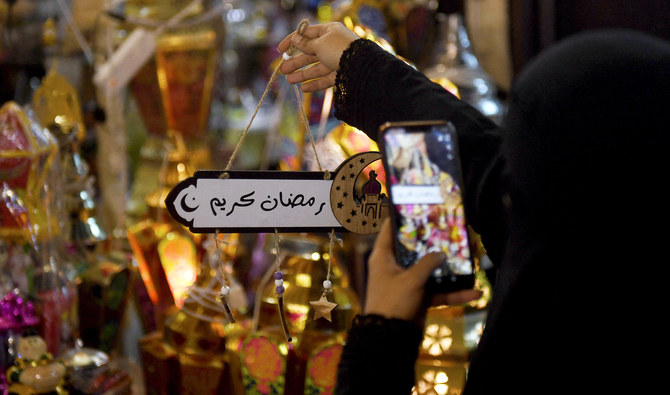
A Saudi woman takes a picture of decorations in the Saudi coastal city of Jeddah on May 3, 2019, ahead of the Muslim holy fasting month of Ramadan. (AFP/File)
Short Url
Updated 01 April 2022
Follow

As pandemic fears subside, Ramadan signifies a joyous return to normality in Saudi Arabia

  • Easing of coronavirus curbs has given the Saudis an added reason to celebrate
  • Prayers in mosques, including the taraweeh, will resume after a two-year hiatus

RIYADH: With Ramadan just around the corner, the easing of COVID-19 restrictions could not have come at a better time for Saudi Arabia’s residents and citizens.

Prayers in mosques, including the taraweeh, or late-night prayers, will resume after a two-year hiatus because of curbs on social gatherings. Bazars and other festive activities have also been given permission to operate, adding to the festive vibe.  

On March 4, 2020, Saudi Arabia suspended Umrah for citizens and residents amid fears of COVID-19 spreading, while pilgrims’ visits to the Prophet’s Mosque in Madinah were also restricted.

In March this year, the Saudi health ministry lifted most precautionary and preventive measures related to the pandemic, including the wearing of face masks in public, and social distancing in public and private spaces. 

People living in the Kingdom shared their excitement at the move ahead of the holy month.  

“I’m happy to see Ramadan being celebrated in full swing,” Wid Massoud, 26, from Jeddah, told Arab News.

“It’s been a tough two years, socially, economically and psychologically, so bringing back the festive ambience is something to look forward to.”

She added: “The last two years have really opened my eyes. Spending time at the mosque has always been one of my favorite ways to unwind and connect with God during Ramadan. Now, only time will tell if it will be a comfortable option this year, too.” 

Massoud is the youngest in her family and still lives at home. “Our house is actually the grandparents’ home where everyone gathers for fitur every day. It will be lovely to have all my nieces and nephews around on a daily basis. That part of Ramadan has definitely been missed.”

The Jeddah resident said that she also had missed being part of “Khair for All,” a group of young volunteers who donate time and effort to help provide food and other necessities for those living in poorer areas of the city. 

For the past two years the Kingdom’s 35 million people have been waiting for the moment when they could put the curbs associated with the pandemic behind them. With daily cases now in the hundreds and falling, life does seem to be returning to normal. 

“I think it’s wonderful that all COVID-19 restrictions have been lifted at this time because for two years people have been living with uncertainty and fear of contracting the virus,” said Saud Al-Saud, 26, from Jeddah.

“The lifting of these restrictions shows that the virus can be overcome. It makes it even better that this has happened in time for Ramadan, so people can properly practice all the Ramadan activities.”

Al-Saud added: “I love how Ramadan brings whole communities together and everyone seems to be in a much better mood. It’s because Ramadan is a time where you get closer to God, so for me Ramadan is all about being the best Muslim I can be.

“This Ramadan, I’m looking forward to going to the less fortunate areas of my city and giving food parcels to people in need. It’s been a missed activity during the last two years.”

Saudi Arabia no longer require travelers to show proof of vaccination against COVID-19, provide a negative PCR test, or undergo quarantine on arrival in the Kingdom.

However, wearing masks indoors is still a requirement and people still need to show their immunity status on the Tawakkalna app to enter establishments such as hotels and restaurants.


Threat to Kingdom’s security is ‘red line’ that will be ‘addressed and neutralized,’ Saudi envoy says

Updated 14 January 2026
Follow

Threat to Kingdom’s security is ‘red line’ that will be ‘addressed and neutralized,’ Saudi envoy says

  • Abdulaziz Alwasil tells UN Security Council the situation in southern Yemen is ‘a just cause with social and historic dimensions’ that can only be resolved through dialogue
  • Recent military activity in the south was unilateral, resulting in an escalation that harms the interests of Yemeni people and undermines efforts to address issues in the south, he said

NEW YORK CITY: Any attempt to threaten Saudi Arabia’s national security is a “red line” and will be met with decisive action, the Kingdom’s ambassador to the UN told the Security Council on Wednesday.

Speaking during a meeting of the council to discuss Yemen, Abdulaziz Alwasil said the situation in the south of the country is “a just cause with social and historic dimensions” that can only be resolved through dialogue.

“We stress that any attempt to threaten our national security is a red line, and we will not hesitate to take the necessary actions and steps to address it and neutralize it,” he added.

Alwasil reaffirmed Saudi Arabia’s support for Yemeni President Rashad Al-Alimi, the Presidential Leadership Council, and the Yemeni government in their efforts to achieve security, stability, development and peace while preserving national unity.

He said military activity by Southern Transitional Council forces in Hadramout and Al-Mahra on Dec. 2, 2025, was unilateral, did not have the approval of the Presidential Leadership Council, and was not carried out in coordination with the Coalition to Restore Legitimacy in Yemen.

It had resulted in an unjustified escalation that harmed the interests of the Yemeni people, undermined efforts to address the issues in the south, and ran counter to the coalition’s objectives, Alwasil added.

The Kingdom, working with its coalition partners, the Presidential Leadership Council and the Yemeni government, had moved to contain the situation by dispatching a military force to coordinate arrangements with the Southern Transitional Council in Aden, he said.

The aim was to ensure the return of the southern council’s forces to their previous positions outside of Hadramout and Al-Mahra, and the handover of camps to legitimate government forces and local authorities in line with agreed procedures, Alwasil added.

He expressed regret over the military operations that took place in Hadramout and Al-Mahra, close to Saudi Arabia’s southern border, which he said posed a direct threat to the Kingdom’s national security, as well as the security of Yemen and regional stability. Such steps were extremely dangerous, he added, and contradicted the principles on which the Coalition to Restore Legitimacy in Yemen had been founded.

Alwasil welcomed a prisoner and detainee exchange agreement signed in Muscat on Dec. 23, which he described as an important humanitarian measure to alleviate suffering and build confidence.

He praised Oman for hosting and sponsoring the consultations and supporting negotiations, and commended the efforts of UN’s special envoy for Yemen, Hans Grundberg, the International Committee of the Red Cross and all others that has played a part.

Regarding the political efforts to resolve the crisis, Alwasil said Saudi Arabia welcomed President Al-Alimi’s call for an inclusive conference in Riyadh to bring together all stakeholders to discuss just solutions to the situation in southern Yemen.

Preparations for the conference have begun, he added, in cooperation with the Yemeni government and southern representatives, reflecting the close ties between the two countries and their shared interests in stabilizing Yemen.

He urged all southern stakeholders to participate actively and constructively in the talks, to help find comprehensive and just solutions that meet the legitimate aspirations of the people of southern Yemen.

Alwasil called on all Yemeni forces and stakeholders to cooperate and intensify their efforts to reach a lasting political settlement that would ensure security and stability.

He described the southern issue as “a just cause with social and historic dimensions,” adding that “the only way to address it is through dialogue that leads to a comprehensive political solution” based on nationally and internationally agreed terms of reference.