

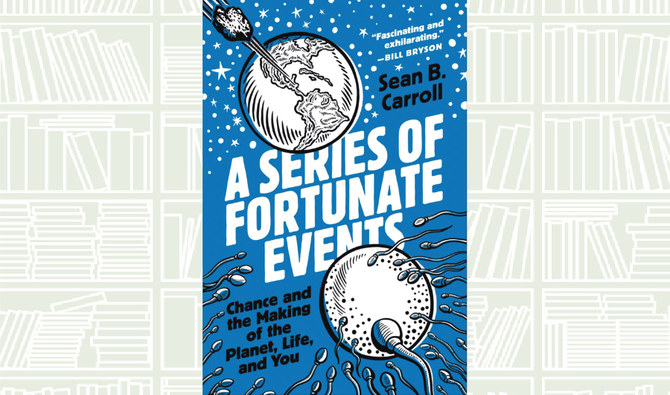
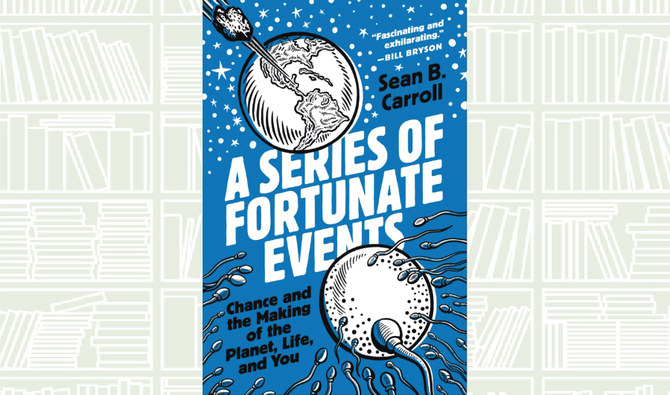
What We Are Reading Today: A Series of Fortunate Events by Sean B. Carroll

Short Url
Updated 01 April 2022
Follow

What We Are Reading Today: A Series of Fortunate Events by Sean B. Carroll

Why is the world the way it is? How did we get here? Does everything happen for a reason or are some things left to chance? Philosophers and theologians have pondered these questions for millennia, but startling scientific discoveries over the past half century are revealing that we live in a world driven by chance.

A Series of Fortunate Events tells the story of the awesome power of chance and how it is the surprising source of all the beauty and diversity in the living world.

Like every other species, we humans are here by accident. But it is shocking just how many things—any of which might never have occurred—had to happen in certain ways for any of us to exist.

From an extremely improbable asteroid impact, to the wild gyrations of the Ice Age, to invisible accidents in our parents’ gonads, we are all here through an astonishing series of fortunate events.  And chance continues to reign every day over the razor-thin line between our life and death.

This is a relatively small book about a really big idea. It is also a spirited tale.


What We Are Reading Today: Power and Possession in the Russian Revolution by Anne O’Donnell

Updated 09 March 2026
Follow

What We Are Reading Today: Power and Possession in the Russian Revolution by Anne O’Donnell

The revolutions of 1917 swept away not only Russia’s governing authority but also the property order on which it stood. The upheaval sparked waves of dispossession that rapidly moved beyond the seizure of factories and farms from industrialists and landowners, envisioned by Bolshevik revolutionaries, to penetrate the bedrock of social life: the spaces where people lived.

In Power and Possession in the Russian Revolution, Anne O’Donnell reimagines the Bolsheviks’ unprecedented effort to eradicate private property and to create a new political economy—socialism—to replace it.

O’Donnell’s account captures the story of property in reverse, showing how the bonds connecting people to their things were broken and how new ways of knowing things, valuing them, and possessing them coalesced amid the political ferment and economic disarray of the Revolution.