

Parliament adjourns session on no-trust vote against Pakistan prime minister

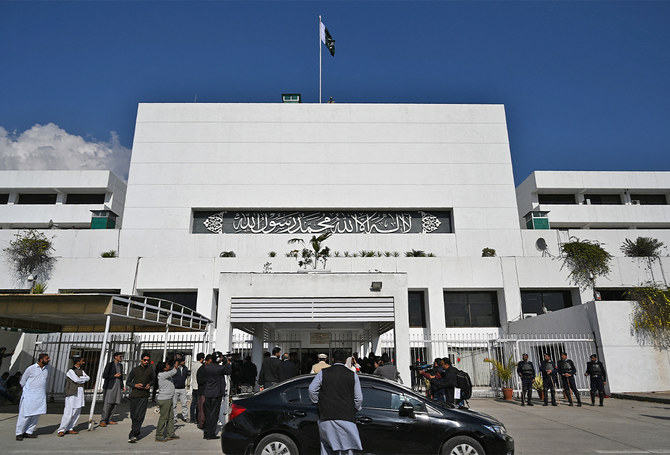
In this file photo, Pakistani media personnel gather outside the Parliament building during a joint session in Islamabad on February 28, 2019. (AFP/File)
Short Url
Updated 31 March 2022
Follow

Parliament adjourns session on no-trust vote against Pakistan prime minister

  • Khan lost majority in parliament after a key ally quit ruling coalition on Wednesday
  • Opposition tabled a no-confidence motion against him, voting on which should take place by April 4

ISLAMABAD: A key Pakistani parliament session to debate a no-confidence motion against Prime Minister Imran Khan was adjourned to April 3, minutes after it began on Thursday.

Khan, a former cricket star, is facing his toughest political challenge since assuming office in 2018 as the opposition tabled a no-confidence motion against him in the National Assembly on Monday, amid accusations he has mismanaged the economy and governed poorly.

While a vote on the motion is to be held within seven days of its tabling, Khan has already lost his majority in parliament after a key government ally said on Wednesday they had struck a deal with the opposition and subsequently quit Khan’s ruling coalition.

Thursday's National Assembly session was suspended by Deputy Speaker Qasim Suri after he opened the floor for questions but opposition leaders insisted instead that he call for the no-trust vote.

“I think nobody is interested in the question hour, therefore the house is adjourned till Sunday," Suri said amid chants "go Imran go."

Shahid Khaqan Abbasi, former prime minister and current lawmaker from the opposition Pakistan Muslim League-Nawaz party, told Arab News after the announcement that the deputy speaker was "playing a partisan role."

"They have time till Sunday to conduct the voting,” he added.

During Thursday's session, the opposition alliance had on its side 175 lawmakers in the 342-member National Assembly, or three votes more than the number required to topple Khan’s administration.

The joint opposition alliance said it would not allow Khan to escape the no-trust vote.

“There is no safe passage or backdoor passage for Khan now,” Bilawal Bhutto Zardari, chairman of the Pakistan Peoples Party, said during a press conference with other opposition leaders. “We have proved our majority in the house."

Shehbaz Sharif, leader of the opposition in the National Assembly, rejected any possibility of withdrawing the not-trust motion against the prime minister.

“The prime minister has left with no legal and moral authority to cling to his position after we have shown 175 members in the house,” he said.

The opposition alliance has nominated Sharif, president of the PML-N, for the coveted premiership slot after Khan’s exit.

The speaker of the National Assembly has to carry out the vote no sooner than three days and no later than seven days after the motion is tabled. The vote must take place by April 4.


Pakistan’s JF-17 fighter jet draws ‘strong interest’ at Riyadh defense exhibition

Updated 13 sec ago
Follow

Pakistan’s JF-17 fighter jet draws ‘strong interest’ at Riyadh defense exhibition

  • Jets showcased as Pakistan seeks to expand defense exports
  • Interest in JF-17 has heightened after May 2025 conflict with India 

ISLAMABAD: Pakistan’s JF-17 Thunder fighter jet has drawn “strong interest” at the World Defense Exhibition in Riyadh, Pakistan’s state broadcaster said on Sunday, as Islamabad promotes the aircraft to international buyers at one of the region’s largest defense industry events.

The exhibition brings together defense officials, manufacturers and military delegations from dozens of countries, offering a platform for arms exporters to showcase equipment and pursue new contracts amid heightened global and regional security concerns.

Saudi Arabia has sought to position Riyadh as a regional hub for defense and aerospace exhibitions, using such events to foster partnerships and attract international manufacturers as part of broader diversification efforts. 

Last year Islamabad signed a mutual defense pact with Riyadh and is reportedly discussing another defense agreement involving Saudi Arabia and Turkiye, although details have not been made public.

“At the World Defense Exhibition in Riyadh, the Pakistan Air Force’s JF-17 Thunder has attracted strong interest from visitors and defense experts, standing out among fighter jets displayed by the US, Saudi Arabia and other countries,” state broadcaster Pakistan Television reported.

Islamabad is attending the exhibition in the backdrop of talks with at least 13 countries, six to eight of which are in an advanced stage, for deals involving JF-17 jets made jointly with China as well as training aircraft, drones, and weapons systems, according to recent media reports. 

Interest in the JF-17 jets has been bolstered by its operational visibility following the Pakistan-India military confrontation in May 2025, which Pakistani officials and defense analysts have cited as reinforcing the aircraft’s combat credibility.

Islamabad has increasingly positioned the JF-17 as a cost-effective multirole combat aircraft for countries seeking alternatives to high-end Western fighter jets. The aircraft is already in service with several foreign air forces and remains central to Islamabad’s defense export strategy.

Countries engaged in talks include Sudan, Saudi Arabia, Indonesia, Morocco, Ethiopia, and Nigeria as well as the government in eastern Libya led by Khalifa Haftar. Discussions on JF-17s and other weapons with Bangladesh and Iraq have been publicly acknowledged by Pakistan’s military, although more details have not been made public.

Almost all the potential buyers are Muslim-majority nations, like Pakistan. Many are from the predominantly Muslim Middle East, where Pakistan has historically been a security provider.