Jordan eases COVID-19 restrictions

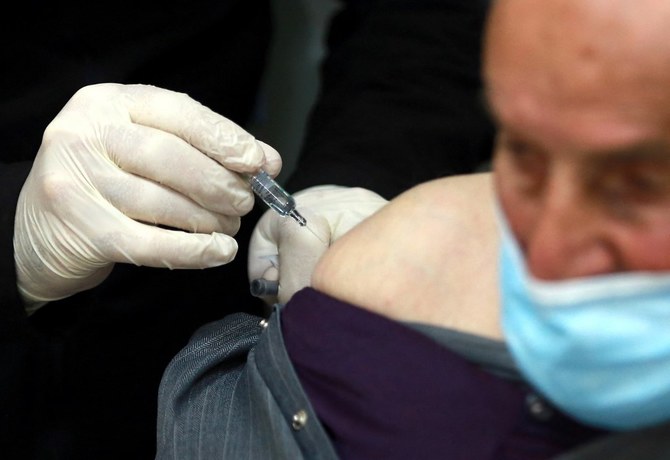
A total of 4,730,727 individuals have taken the first dose of COVID-19 vaccines so far, while 4,438,091 persons have been double-jabbed. (AFP)
Short Url
Updated 28 March 2022
Follow

Jordan eases COVID-19 restrictions

  • Worshippers however are still required to wear masks

DUBAI: Jordan has eased COVID-19 restrictions that were implemented more than two years ago as the country aims for a return to normality.
Social distancing rules in places of worship and removing capacity limits in restaurants, cafes and wedding venues have been lifted and would go into effect as soon as they are published in the Official Gazette, state news agency Petra reported.
“Mosques and churches are now allowed to receive worshippers at full capacity under a new defense order relaxing much of the restrictions which have been in place for more than two years in the wake of the coronavirus pandemic,” Defense Order No. 36 of 2022, issued by Prime Minister Bisher Khasawneh on Sunday, stated.
Worshippers however are still required to wear masks.
Meanwhile, the use of facial coverings is no longer required in open places and businesses and other entities are no longer required to observe a limit for on-premise staff.
Jordan on Sunday reported 3,171 coronavirus cases and 28 COVID-19 related deaths for the week ending March 25, bringing the country’s caseload to 1,692,485 infections and 14,031 deaths since the pandemic started.
A total of 4,730,727 individuals have taken the first dose of COVID-19 vaccines so far, while 4,438,091 persons have been double-jabbed.


German parliament speaker visits Gaza

Updated 54 min 1 sec ago
Follow

German parliament speaker visits Gaza

  • Germany has been one of Israel’s staunchest supporters as the European power seeks to atone for the legacy of the Holocaust

BERLIN: The speaker of Germany’s lower house of parliament briefly visited the Israeli-controlled part of the Gaza Strip on Thursday, the body told AFP.
Julia Kloeckner spent “about an hour in the part of Gaza controlled by Israeli army forces,” parliament said, becoming the first German official to visit the territory since Hamas’s attack on Israel in October 2023 that sparked the devastating war.
Since the start of the conflict, Israel has drastically restricted access to the densely populated coastal strip.
In a statement shared by her office, Kloeckner said it was essential for politicians to have access to “reliable assessments of the situation” in Gaza.
“I expressly welcome the fact that Israel has now, for the first time, granted me, a parliamentary observer, access to the Gaza Strip,” she said.
However, she was only able to gain a “limited insight” into the situation on the ground during her trip, she said.
Kloeckner appealed to Israel to “continue on this path of openness” and emphasized that the so-called yellow line, which designates Israeli military zones inside the Gaza Strip, must “not become a permanent barrier.”
The German foreign ministry did not immediately respond to a request for comment from AFP.
Germany has been one of Israel’s staunchest supporters as the European power seeks to atone for the legacy of the Holocaust.
But in recent months, Chancellor Friedrich Merz has occasionally delivered sharp critiques of Israeli policy as German public opinion turns against Israel’s actions in Gaza.
In August, Germany imposed a partial arms embargo on Israel, which was lifted in November after the announcement of what has proved to be a fragile ceasefire for Gaza.
Merz visited Israel in December and reaffirmed Germany’s support.
But in a sign of lingering tension, Germany’s foreign ministry on Wednesday criticized Israeli plans to tighten control over the occupied West Bank as a step toward “de facto annexation.”