

Ukraine war reverberates on Taiwan’s ‘frontline of democracy’

1 / 4
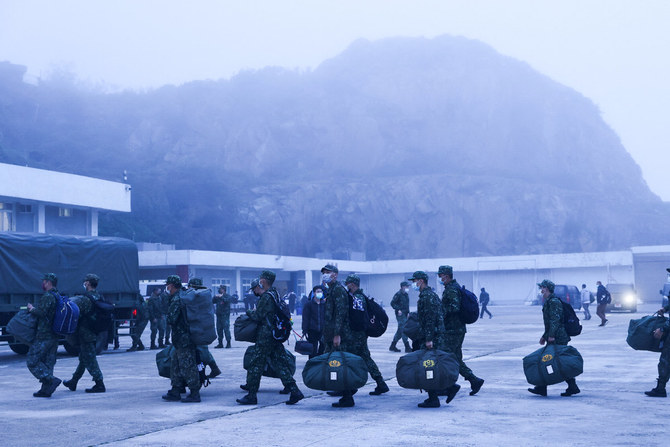
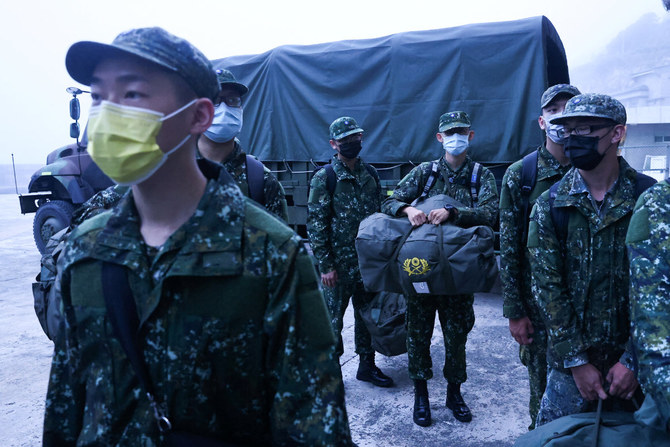
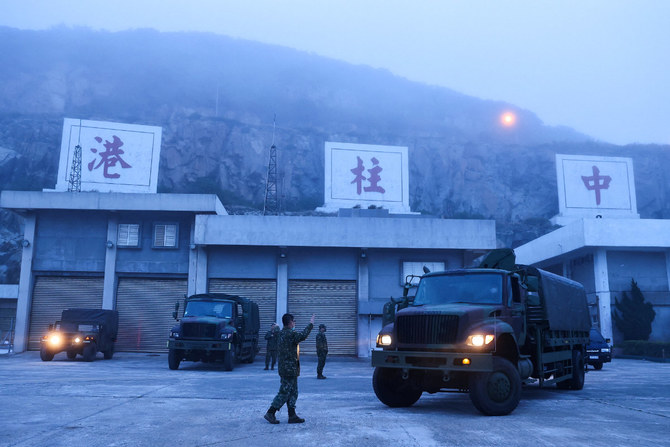
Taiwanese soldiers arrive by ferry at Dongyin island, near China's coast, on March 17, 2022. (REUTERS/Ann Wang)
2 / 4
Taiwanese soldiers arrive by ferry at Dongyin island, near China's coast, on March 17, 2022. (REUTERS/Ann Wang)
3 / 4
Taiwanese soldiers stand on the deck of a ferry bound for the mainland on March 17, 2022, after completing their three-month mandatory military service in Matsu island in Dongyin. (REUTERS/Ann Wang)
4 / 4
Taiwanese soldiers arrive by ferry at Dongyin island, near China's coast, on March 17, 2022. (REUTERS/Ann Wang)
Short Url
Updated 25 March 2022
Follow

Ukraine war reverberates on Taiwan’s ‘frontline of democracy’

  • Taiwan’s outlying islands, long known as military strongholds, can are being as “a frontline of democracy”
  • The Ukraine war is a common topic of conversation for some — including jokes about where to hide if China invades

DONGYIN/NANGAN, Taiwan: Lin Jih-shou was brewing tea last month in his popular breakfast joint when he heard the buzz of a plane – a rare sound on the remote Taiwanese-held island of Dongyin near China’s coast, which does not have an airport.
Lin, 64, rushed outside, but only saw the shadow of what the government later described as a small, propeller-driven Chinese aircraft that most likely was testing Taiwan’s military response.
It was a stark reminder to residents of Dongyin and Taiwan’s other islands off China’s coast of the threat from their huge neighbor, which considers Taipei’s democratically elected government illegitimate and Taiwan a rogue province to be taken by force if needed.
The Matsu islands were regularly bombarded by China at the height of the Cold War, and the history of conflict has focused minds on Russia’s invasion of Ukraine and whether the same fate may befall them.
“When we watch Russia and Ukraine fighting, our hearts hurt,” Lin told Reuters. “War is too scary. There’s no need.”
Taiwan has raised its alert level since the invasion, but has not reported any signs of imminent attack.
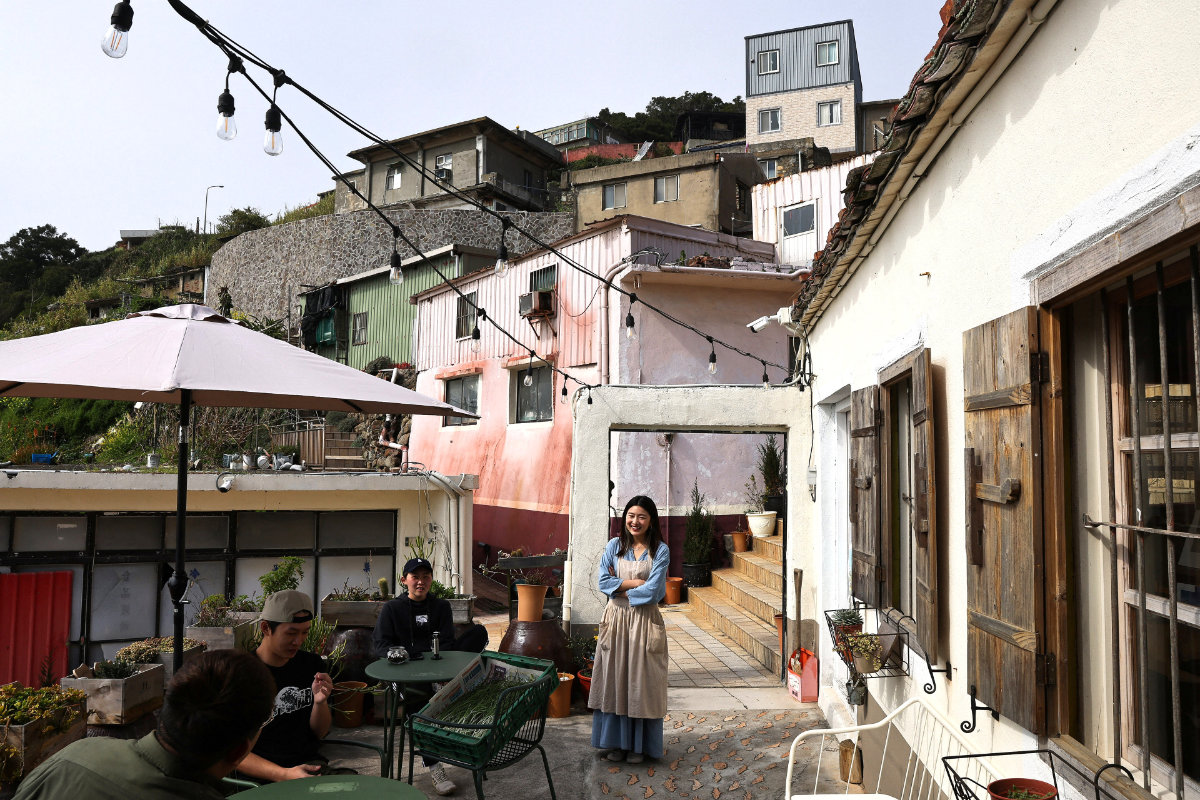


Dongyin native Tsai Pei-yuan chats with other co-founders of Salty Island Studio in Dongyin, Taiwan, on March 15, 2022. (REUTERS/Ann Wang)

Held by Taiwan since the defeated Republic of China government fled to Taipei in 1949 after losing the Chinese civil war, Matsu would probably be an immediate target for Beijing in a conflict, especially Dongyin’s missile base.
Yet even with China’s increased military pressure in recent years, the archipelago has seen trendy businesses and a nascent art scene spring up.
On the main island of Nangan, former military brothels and underground bunkers house exhibits that opened last month as part of the inaugural Matsu Biennial art festival.
“It’s a way to rebrand and retell the stories of Matsu,” said Lii Wen, who established the local branch of the ruling Democratic Progressive Party in 2020.
Taiwan’s outlying islands, long known as military strongholds, can be reframed as “a frontline of democracy,” Lii said, as a Ukrainian flag fluttered outside his office window. Although their regional contexts differ, Lii said, Taiwan stands in solidarity with Ukraine as a smaller democracy facing potential invasion.

Dongyin native Tsai Pei-yuan, born in 1993, the year after Matsu’s strict military rule ended, is part of a generation for whom war feels distant. Two years ago, Tsai and two former classmates co-founded Salty Island Studio, a cafe and community hub that has hosted arts workshops and plays.
“More urgent is trying to preserve our culture, which is disappearing,” Tsai said before a wine-tasting event last week.
The Ukraine war is a common topic of conversation for some — including jokes about where to hide if China invades.
“When we explore strongholds, we ask, if a war really starts, which nearby stronghold would we run to?” said Chung Jing-yei, 26, who manages Nangan’s Xiwei Peninsula restaurant.
Chung said it was only after she moved to Nangan that she understood why so many here want to maintain the status quo.
“My belief that we should be an independent country is resolute, but at the same time, I don’t want war to happen,” she said.
Dotting the islands’ rugged coastlines are bunkers, abandoned or transformed into tourist destinations and boutique hotels.
Older Matsu residents have vivid memories of hiding in shelters from Chinese shelling and not being allowed to own basketballs for fear that they may use them to float across to China.
“I don’t think the two sides will fight,” Lucy Lin, a 62-year-old taxi driver and bakery owner, said as a Chinese radio station played in her car. “As long as you don’t step over the red lines.”
Shih Pei-yin, who worked as an urban planner in Taipei before starting Xiwei, is keen to play her part in bettering the lives of Matsu’s people.
“For as long as it is possible, we hope to work with the island’s residents to improve this place,” Shih said. “Even if it is short-term, that is okay. At least we tried our best.”


In rare overlap, Chinese Muslims observe Ramadan with Lunar New Year

Updated 6 sec ago
Follow

In rare overlap, Chinese Muslims observe Ramadan with Lunar New Year

  • Lunar New Year started on Feb. 17 and is celebrated for another two weeks
  • Chinese Indonesians make up about 3 percent of the Indonesian population

JAKARTA: Every year, on the first day of Lunar New Year, Febriani visits relatives and gathers for a feast with her Chinese Muslim family, part of a long-standing tradition honoring their ethnic heritage.

But this year, as Thursday marks the beginning of Ramadan, she is celebrating two important occasions within the same week, in a rare overlap that last took place in 1995.

“I’m very happy and grateful that Lunar New Year and Ramadan are celebrated so closely. I observe both every year, so it’s truly special,” she told Arab News.

Widely observed across Asia, the Lunar New Year or Chinese New Year festival is believed to date back to the 14th century B.C., to the times of the Shang Dynasty, China’s earliest ruling dynasty, when people celebrated good harvests.

In 2026, it started on Feb. 17 and is celebrated for another two weeks. For many, celebrations typically involve elaborate feasts, giving children pocket money in red envelopes, and watching dragon dance parades.

In Indonesia, Chinese-descent citizens make up an estimated 3 percent of the country’s Muslim-majority population of more than 280 million. While most are either Buddhists or Christians, a small minority professes Islam.

For 25-year-old Febriani, both Lunar New Year and Ramadan are equally meaningful.

“The two celebrations teach us to strengthen bonds, to share with one another, and to become closer to family,” she said.

“They are both important to me because they happen only once every year and they’re always an occasion to gather with the extended family. It is also a chance to self-reflect and strengthen relationships with your loved ones.”

For Naga Kunadi, whose family lives in Central Java’s Cepu district, Chinese New Year is all about embracing his ethnic identity.

Earlier in the week, his family was busy preparing for the new year’s feast, which was a fusion of Chinese and Indonesian dishes, such as claypot tofu, meatball soup and shumai, or steamed dumplings.

“To celebrate Chinese New Year, we prepared halal Chinese food at home. It’s also a way to introduce to my children the traditions from our Chinese side, but there’s a bit of a fusion because my wife is Javanese,” Kunadi told Arab News.

Kunadi, an Islamic teacher at the Lautze Mosque in Jakarta, sees both Chinese New Year and Ramadan as opportunities to teach important life values for his two children. 

Upholding Chinese New Year traditions with his family is for him a way of preserving his ethnic heritage.

“We want to preserve cultural values as long as it does not clash with our religion,” he said.

“If we leave our culture behind, we might lose our identity, so this is something I want to teach my children.”

The fasting month of Ramadan, on the other hand, gives him a chance to teach and practice honesty.

“I want to focus on the religious and moral aspects during the holy month of Ramadan, when we practice honesty on a personal level,” Kunadi said.

“There’s always an opportunity to eat or snack in secret without anybody knowing, but we train ourselves not to do that. For me, Ramadan is a time for everyone to put honesty into practice, including myself and my children.”