

‘As strong as Zelensky’: Indian company names new tea after Ukraine president

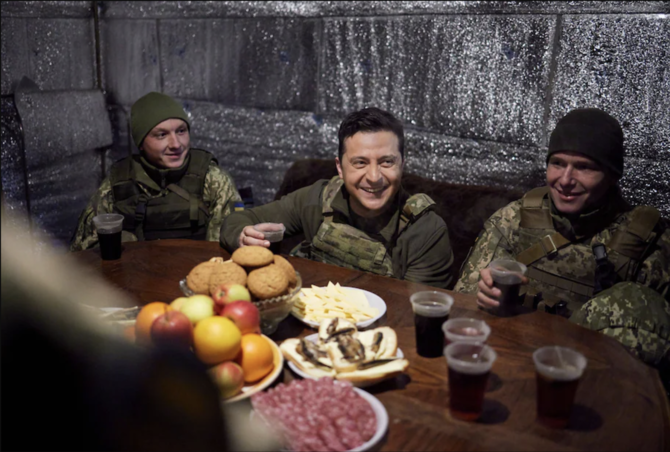
President Volodymyr Zelensky visits Ukrainian forces in the Donetsk region, eastern Ukraine. (File/Ukraine Presidential Office)
Short Url
Updated 24 March 2022
Follow

‘As strong as Zelensky’: Indian company names new tea after Ukraine president

  • Embattled leader has defied invaders and refused US offer to move to a secure location
  • Aromica Tea mulls sales in Russia — biggest importer of one of India’s favorite beverages

NEW DELHI: A company in India’s main tea-producing region has launched a new “strong” blend called “Zelenskyy” to honor the Ukrainian president who has been standing defiant in the face of Russia’s onslaught on his country. 

Russia began a multipronged invasion of Ukrainian territory and major cities, including the capital, Kyiv, on Feb. 24. Airstrikes on civilians have since intensified, forcing 3.6 million people to flee to neighboring European countries in just four weeks.

Volodymyr Zelensky (his surname is variously spelled with one or two Ys), who says he has been designated by the attackers as “the target number one,” remains in Kyiv, leading Ukraine’s defense. He refused a US offer to move to a more secure location away from the capital last month, saying “the fight is here; I need ammunition, not a ride.”

The words became some of the most-cited lines of the Russian invasion, winning Zelensky international admiration.

One of those inspired by the Ukrainian president was Ranjit Baruah, an entrepreneur in India’s northeastern state of Assam, the largest tea growing region in the world, whose Aromica Tea last week introduced the blend named after Zelensky.

“I’ve been really impressed by the way Zelensky rejected the US offer where he said he does not want a free ride but needs ammunition. It shows his character. He didn’t run away from his country,” Baruah told Arab News. “Fighting against the mighty Russian forces is showing his strength.”

On the package, the producer describes the tea as “really strong.”

“The character and strength this person has is in my tea. That is the tea. It is a strong Assam black tea,” Baruah said. “The tea is as strong in character as the Ukrainian president Zelensky is.”

The “Zelenskyy” blend is handcrafted orthodox tea that has gone through the CTC (crush, tear, curl) process — a new technique in which black tea leaves are run through a series of cylindrical rollers.

The CTC, Baruah said, “gives the punch, while the orthodox tea gives the flavor after drinking.”

With Russia being the biggest importer of Indian tea — most coming from Assam, which has over 100,000 plantations producing 630,000 tons a year — the company would not mind exporting it to the Russian market.

“I want this product to reach people (so) they can enjoy a good cup of Assam tea,” Baruah said. “If Russia does not have any problem with the name, I am willing to sell that tea to Russia.”

He believes in the centuries-old notion that a pause for tea can give peace a chance.

“Nobody wants a war. Many wars have ended in discussions over a cup of tea,” he said. “Make peace, not war, and have a cup of tea.”


In rare overlap, Chinese Muslims observe Ramadan with Lunar New Year

Updated 6 sec ago
Follow

In rare overlap, Chinese Muslims observe Ramadan with Lunar New Year

  • Lunar New Year started on Feb. 17 and is celebrated for another two weeks
  • Chinese Indonesians make up about 3 percent of the Indonesian population

JAKARTA: Every year, on the first day of Lunar New Year, Febriani visits relatives and gathers for a feast with her Chinese Muslim family, part of a long-standing tradition honoring their ethnic heritage.

But this year, as Thursday marks the beginning of Ramadan, she is celebrating two important occasions within the same week, in a rare overlap that last took place in 1995.

“I’m very happy and grateful that Lunar New Year and Ramadan are celebrated so closely. I observe both every year, so it’s truly special,” she told Arab News.

Widely observed across Asia, the Lunar New Year or Chinese New Year festival is believed to date back to the 14th century B.C., to the times of the Shang Dynasty, China’s earliest ruling dynasty, when people celebrated good harvests.

In 2026, it started on Feb. 17 and is celebrated for another two weeks. For many, celebrations typically involve elaborate feasts, giving children pocket money in red envelopes, and watching dragon dance parades.

In Indonesia, Chinese-descent citizens make up an estimated 3 percent of the country’s Muslim-majority population of more than 280 million. While most are either Buddhists or Christians, a small minority professes Islam.

For 25-year-old Febriani, both Lunar New Year and Ramadan are equally meaningful.

“The two celebrations teach us to strengthen bonds, to share with one another, and to become closer to family,” she said.

“They are both important to me because they happen only once every year and they’re always an occasion to gather with the extended family. It is also a chance to self-reflect and strengthen relationships with your loved ones.”

For Naga Kunadi, whose family lives in Central Java’s Cepu district, Chinese New Year is all about embracing his ethnic identity.

Earlier in the week, his family was busy preparing for the new year’s feast, which was a fusion of Chinese and Indonesian dishes, such as claypot tofu, meatball soup and shumai, or steamed dumplings.

“To celebrate Chinese New Year, we prepared halal Chinese food at home. It’s also a way to introduce to my children the traditions from our Chinese side, but there’s a bit of a fusion because my wife is Javanese,” Kunadi told Arab News.

Kunadi, an Islamic teacher at the Lautze Mosque in Jakarta, sees both Chinese New Year and Ramadan as opportunities to teach important life values for his two children. 

Upholding Chinese New Year traditions with his family is for him a way of preserving his ethnic heritage.

“We want to preserve cultural values as long as it does not clash with our religion,” he said.

“If we leave our culture behind, we might lose our identity, so this is something I want to teach my children.”

The fasting month of Ramadan, on the other hand, gives him a chance to teach and practice honesty.

“I want to focus on the religious and moral aspects during the holy month of Ramadan, when we practice honesty on a personal level,” Kunadi said.

“There’s always an opportunity to eat or snack in secret without anybody knowing, but we train ourselves not to do that. For me, Ramadan is a time for everyone to put honesty into practice, including myself and my children.”
