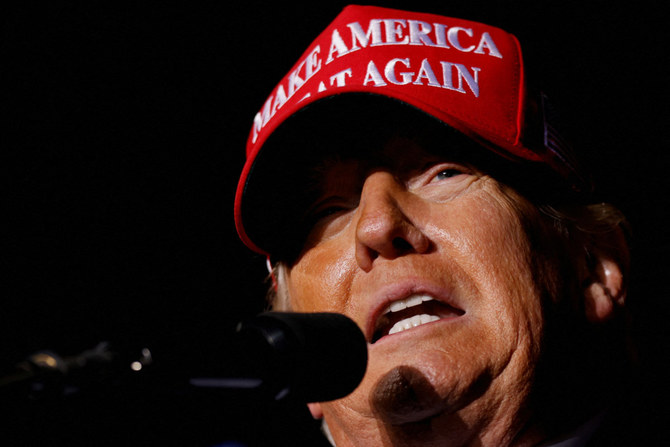
WASHINGTON: Donald Trump is “guilty of numerous felony violations,” said a prosecutor who resigned from a criminal probe into the former US president’s business practices, according to his resignation letter published Wednesday by the New York Times.
Mark Pomerantz, who led the New York investigation into Trump’s finances, resigned on February 23 along with Carey Dunne, the other lead prosecutor on the case.
Pomerantz’s letter said that he had quit over the decision by new Manhattan district attorney Alvin Bragg not to move ahead with prosecution of the Republican billionaire.
That decision, he wrote in the letter which the US daily published in full, was “contrary to the public interest.”
“The team that has been investigating Mr. Trump harbors no doubt about whether he committed crimes — he did,” Pomerantz wrote.
The investigation had probed whether Trump fraudulently overvalued multiple assets to secure loans and then undervalued them to minimize taxes.
It was launched by Bragg’s predecessor Cyrus Vance, with Bragg taking over the case when he took office in January.
When Dunne and Pomerantz resigned last month, Bragg’s spokesperson said that the investigation was “ongoing.”
The Times reported that he has told aides the case can move forward if new evidence emerges or a Trump insider decides to turn on the former president.
But, Pomerantz wrote: “No events are likely to occur that will alter the nature of the case... There are always additional facts to be pursued.”
But the decision not to prosecute “will doom any future prospects that Mr. Trump will be prosecuted for the criminal conduct we have been investigating,” he continued.
Republican Trump, 75, has not been charged and has repeatedly described the case as a political witch hunt by a Democratic prosecutor.
In July last year, the Trump Organization and its long-serving finance chief, Allen Weisselberg, were charged with 15 felony fraud and tax evasion charges.
They pleaded not guilty, and Weisselberg’s trial is due to begin in the middle of this year.
The criminal investigation into Trump is very similar to a civil inquiry being conducted by New York state Attorney General Letitia James, who is also a Democrat.
In January, she said her probe had uncovered “significant evidence” of fraudulent or misleading practices at the Trump Organization.
James can sue the Trump Organization for damages over any alleged financial misconduct but cannot file criminal charges.
Trump has so far kept Americans guessing about whether he intends to seek the Republican presidential nomination again, but the host of legal probes threaten to complicate any bid for another run at the White House in 2024.


Trump ‘guilty’ of felonies, says prosecutor who resigned: US media
https://arab.news/w9ymd
Trump ‘guilty’ of felonies, says prosecutor who resigned: US media


In rare overlap, Chinese Muslims observe Ramadan with Lunar New Year
- Lunar New Year started on Feb. 17 and is celebrated for another two weeks
- Chinese Indonesians make up about 3 percent of the Indonesian population
JAKARTA: Every year, on the first day of Lunar New Year, Febriani visits relatives and gathers for a feast with her Chinese Muslim family, part of a long-standing tradition honoring their ethnic heritage.
But this year, as Thursday marks the beginning of Ramadan, she is celebrating two important occasions within the same week, in a rare overlap that last took place in 1995.
“I’m very happy and grateful that Lunar New Year and Ramadan are celebrated so closely. I observe both every year, so it’s truly special,” she told Arab News.
Widely observed across Asia, the Lunar New Year or Chinese New Year festival is believed to date back to the 14th century B.C., to the times of the Shang Dynasty, China’s earliest ruling dynasty, when people celebrated good harvests.
In 2026, it started on Feb. 17 and is celebrated for another two weeks. For many, celebrations typically involve elaborate feasts, giving children pocket money in red envelopes, and watching dragon dance parades.
In Indonesia, Chinese-descent citizens make up an estimated 3 percent of the country’s Muslim-majority population of more than 280 million. While most are either Buddhists or Christians, a small minority professes Islam.
For 25-year-old Febriani, both Lunar New Year and Ramadan are equally meaningful.
“The two celebrations teach us to strengthen bonds, to share with one another, and to become closer to family,” she said.
“They are both important to me because they happen only once every year and they’re always an occasion to gather with the extended family. It is also a chance to self-reflect and strengthen relationships with your loved ones.”
For Naga Kunadi, whose family lives in Central Java’s Cepu district, Chinese New Year is all about embracing his ethnic identity.
Earlier in the week, his family was busy preparing for the new year’s feast, which was a fusion of Chinese and Indonesian dishes, such as claypot tofu, meatball soup and shumai, or steamed dumplings.
“To celebrate Chinese New Year, we prepared halal Chinese food at home. It’s also a way to introduce to my children the traditions from our Chinese side, but there’s a bit of a fusion because my wife is Javanese,” Kunadi told Arab News.
Kunadi, an Islamic teacher at the Lautze Mosque in Jakarta, sees both Chinese New Year and Ramadan as opportunities to teach important life values for his two children.
Upholding Chinese New Year traditions with his family is for him a way of preserving his ethnic heritage.
“We want to preserve cultural values as long as it does not clash with our religion,” he said.
“If we leave our culture behind, we might lose our identity, so this is something I want to teach my children.”
The fasting month of Ramadan, on the other hand, gives him a chance to teach and practice honesty.
“I want to focus on the religious and moral aspects during the holy month of Ramadan, when we practice honesty on a personal level,” Kunadi said.
“There’s always an opportunity to eat or snack in secret without anybody knowing, but we train ourselves not to do that. For me, Ramadan is a time for everyone to put honesty into practice, including myself and my children.”


