

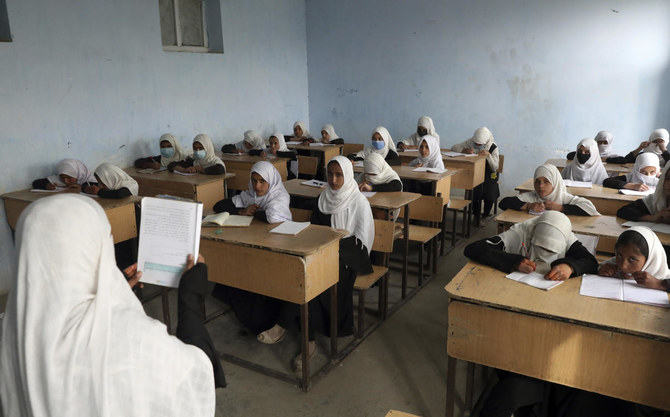
Schools reopen in Afghanistan but not for teenage girls

The Taliban have imposed a slew of restrictions on women, effectively banning them from many government jobs, policing what they wear and preventing them from traveling outside of their cities alone. (File/AP)
Short Url
Updated 23 March 2022
Follow

Schools reopen in Afghanistan but not for teenage girls

  • Schools were set to open for all boys, girls following months of restrictions after Taliban took control of country
  • Authorities suddenly changed decision, requesting girl students aged over 13 to wait until further notice

KABUL: Afghan teenage girls were sent back home when they arrived in schools after months on Wednesday, as Taliban authorities reversed their earlier decision to allow all girl students to return to classrooms.

Schools had been set to open again after restrictions were brought in when the Taliban took control of Afghanistan in August.

The Ministry of Education said on Monday that all boys and girls would be welcomed back, but it made a last-minute decision, requesting girl students above the age of 13 to wait until further notice.

Ministry spokesperson, Aziz Ahmad Rayan, told reporters on Wednesday that a plan for secondary and high schools for girls, developed in accordance with Islamic law, would be revealed at a later date.

“All secondary and high schools for girls should be informed that their studies are suspended until the next notice,” he said. “Girls’ schools will be officially informed when a comprehensive proposal regarding girls’ education is developed based on Shariah (Islamic law) and the Afghan tradition and the instructions of the Islamic Emirate’s leadership are issued.”

Many of the girls returning excitedly to schools were reduced to tears as teachers asked them to go home.

“When we went to school this morning, the head teacher told us at the school gate that only younger girls were allowed and that we should go back home,” Nasima, a 17-year-old student at the Tajwar Sultana high school in Kabul, told Arab News.

Schools had been ready to receive them, but their plans have now had to be put on hold.

“We are waiting for orders from the provincial education officials,” Alia Salaar, a school principal in Herat, said. “We are ready to start the studies in all grades.”

In a statement shared with reporters, Suhail Shaheen, Taliban government spokesperson and permanent representative-designate to the UN, said the postponement was related to school uniforms and should be resolved soon.

“There is no issue of banning girls from schools,” he added. “It is only a technical issue of deciding on form of school uniform for girls. This is the cause of postponement.”

There had been fears that the Taliban would put an end to women’s education once they regained control of the country, after they barred girls from schools during their first stint in power from 1996 to 2001.

The international community has made the education of girls one of its key demands for any future recognition of the Taliban administration.

Hamid Karzai, who served as Afghanistan’s president from 2001 to 2014 and remained in the country after the Taliban takeover in August, tweeted that he was in “deep sorrow and concern over the closure of girls’ schools.”

Karzai took office after the previous Taliban administration was ousted by a US-led invasion of Afghanistan in 2001. It was under his rule that women’s education was restored in the country.

“The former president asks the caretaker government of the Islamic Emirate to allow girls’ education for a developed and prosperous Afghanistan,” he said. “Don’t let plans of others who want an Afghanistan deprived of education to be implemented.”


Venezuela denounces ‘extremely serious military aggression’ by US

Updated 26 min 10 sec ago
Follow

Venezuela denounces ‘extremely serious military aggression’ by US

  • The explosions come as US President Donald Trump, who has deployed a navy task force to the Caribbean, raised the possibility of ground strikes against Venezuela

CARACAS: Loud explosions, accompanied by sounds resembling aircraft flyovers, were heard in Caracas around 2:00 am (0600 GMT) Saturday, an AFP journalist reported.
The explosions come as US President Donald Trump, who has deployed a navy task force to the Caribbean, raised the possibility of ground strikes against Venezuela.
Sounds of explosions were still being heard around 2:15 am, although their exact location was unclear.
Trump on Monday said the United States hit and destroyed a docking area for alleged Venezuelan drug boats.
The Republican leader would not say if it was a military or CIA operation or where the strike occurred, noting only that it was “along the shore.”
The attack would be the first known land strike on Venezuelan soil.
President Nicolas Maduro has neither confirmed nor denied Monday’s strike, but said Thursday he was open to cooperation with Washington after weeks of US military pressure.
The Trump administration has accused Maduro of heading a drug cartel and says it is cracking down on trafficking, but the leftist leader denies any involvement in the narcotics trade, saying Washington is seeking to overthrow him because Venezuela has the largest known reserves of oil on Earth.
Washington has ramped up pressure on Caracas by informally closing Venezuela’s airspace, imposing more sanctions and ordering the seizure of tankers loaded with Venezuelan oil.
For weeks Trump has threatened ground strikes on drug cartels in the region, saying they would start “soon,” with Monday being the first apparent example.
US forces have also carried out numerous strikes on boats in both the Caribbean Sea and eastern Pacific Ocean since September, targeting what Washington says are drug smugglers.
The administration has provided no evidence that the targeted boats were involved in drug trafficking, however, prompting debate about the legality of these operations.
The deadly maritime campaign has killed at least 107 people in at least 30 strikes, according to information released by the US military.

Venezuelan President Nicolas Maduro on Saturday declared a state of an emergency over what his goverment called an “extremely serious military aggression” by the United States on the capital Caracas.
Multiple explosions, accompanied by sounds resembling aircraft flyovers, were heard around the city, an AFP journalist reported.
“Venezuela rejects, repudiates, and denounces before the international community the extremely serious military aggression perpetrated by the current government of the United States of America against Venezuelan territory and people,” Maduro’s government said.