

Pakistan PM urges OIC states to mediate ceasefire between Russia and Ukraine

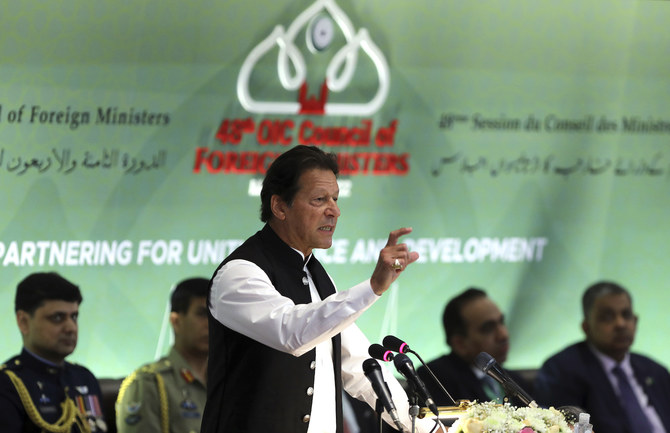
Pakistan's PM Imran Khan speaks at the start of a two-day gathering of the OIC at the Parliament House in Islamabad, Pakistan, Tuesday, March 22, 2022. (AP)
Short Url
Updated 22 March 2022
Follow

Pakistan PM urges OIC states to mediate ceasefire between Russia and Ukraine

  • Imran Khan says continued conflict “will have great consequences for the world”
  • PM spoke during conference of OIC foreign ministers hosted by Islamabad

ISLAMABAD: Pakistan Prime Minister Imran Khan on Tuesday urged member states of the Organization of Islamic Cooperation to mediate and help “bring about a ceasefire” between Russia and Ukraine.

More than 600 delegates from 56 OIC member states and observer countries are participating in the body’s 48th Council of Foreign Ministers session being held in Islamabad from March 22 to 23. The theme of this year’s conference is “Partnering for Unity, Justice, and Development.”

Though Russian troops have failed to capture any major Ukrainian city more than four weeks into their invasion, they are increasingly now resorting to causing massive destruction to residential areas using air strikes, long-range missiles and artillery.

“We, like everyone else in the world, are all worried about what’s happening there (in Ukraine),” Khan said. “May I suggest that the OIC, during its discussions, the foreign ministers, we should think how we represent 1.5 billion people, how we can mediate, how we can bring about a ceasefire, how can we bring about an end to the conflict.”

On Feb. 24, Russia launched a full-scale invasion of Ukraine, drawing widespread condemnation from countries around the world and triggering a wave of international sanctions against Moscow. Pakistan remains one of the few countries in the world that has refrained from condemning Russia directly, though it has called for the use of diplomacy to deescalate the crisis. 

During Tuesday’s address, Khan said he would hold a meeting with Chinese Foreign Minister Wang Yi during the OIC summit to discuss how Beijing, together with the OIC, could help resolve the conflict.

“This conflict will have great consequences for the world,” he warned, adding that Pakistan was already suffering as oil, wheat and gas prices had shot up in the country in the wake of the Russian invasion.

Khan also spoke about a humanitarian crisis in Afghanistan.

Following the Taliban takeover of Afghanistan in mid-August last year, the aid-dependent country was cut off from billions of dollars in international assistance and financial institutions, while nearly $10 billion of its assets were frozen by the US, triggering a banking crisis.

Khan said Afghanistan was reeling from sanctions and called on the international community to engage with Afghans to save them from a humanitarian catastrophe.

Khan also said “we (OIC) have failed both the Palestinians and the people of Kashmir.”

“I am sad to say that we have been able to make no impact at all,” he said, adding that Muslim countries were “a divided house.”

In his opening remarks as chair of the conference, Pakistan Foreign Minister Shah Mahmood Qureshi warned about the “threat of genocide” faced by the Muslims of Indian-administered Kashmir.

“The threat of genocide is most imminent,” he said.

Kashmiri territory has long been a flashpoint between India and Pakistan. Both claim all of the region but rule only in part.

Qureshi said the government of Indian Prime Minister Narendra Modi had “unleashed a reign of terror” since August 2019 when it withdrew Kashmir’s autonomy in order to tighten the central government’s grip over the region, provoking outrage in Pakistan and the downgrading of diplomatic ties and suspension of bilateral trade.

He called on the OIC member states to partner with the international community and take “concrete and tangible” steps for the resolution of the conflicts in Kashmir, as well as Palestine.

After Qureshi’s speech, Saudi Foreign Minister Prince Faisal bin Farhan delivered his opening statement, announcing “support to the people of Jammu and Kashmir.”

“We also support the efforts made by the international community to reach a just solution for the Jammu and Kashmir issue,” he said.

Prince Faisal also condemned the aggression of the Houthi rebels in Yemen and called on Muslim nations to apply more pressure on the group.

“In line (with) international resolutions, Saudi Arabia calls (for measures) to neutralize (the) Houthi groups and wants to stop the importing of arms in Yemen,” he said. “We reiterate the importance of the role of brothers to (apply) more pressure on (the) Houthis so that they can be stopped from jeopardizing the security of the Kingdom.”


North Korean leader Kim inspects new warship, claims progress toward nuclear-armed navy

Updated 9 sec ago
Follow

North Korean leader Kim inspects new warship, claims progress toward nuclear-armed navy

  • Kim has hailed the development of Choe Hyon as a significant advancement toward his goal of expanding the operational range and preemptive strike capabilities of his nuclear-armed military

SEOUL, South Korea: North Korean leader Kim Jong Un inspected his new destroyer for two straight days ahead of its commissioning and observed a test of cruise missiles fired from the warship, vowing to accelerate the nuclear-armament of his navy, state media said Thursday.
The North’s official Korean Central News Agency said Kim, during his visits to the western shipyard of Nampo on Tuesday and Wednesday, also inspected the construction of a third destroyer of the same class as his 5,000-ton warship, the Choe Hyon, first unveiled in April 2025.
Kim has hailed the development of Choe Hyon as a significant advancement toward his goal of expanding the operational range and preemptive strike capabilities of his nuclear-armed military. State media says the ship is designed to handle various weapons systems, including antiair and anti-naval weapons, as well as nuclear-capable ballistic and cruise missiles. South Korean military officials and experts say Choe Hyon was likely built with Russian assistance amid deepening military ties, but some have raised doubts about whether it’s ready for active service.
North Korea unveiled a second destroyer of the same class in May last year, but it was damaged during a botched launching ceremony at the northeastern port of Chongjin, triggering a furious reaction from Kim, who called the failure “criminal.” North Korea has said the new destroyer, named Kang Kon, was relaunched in June after repair, but outside experts have questioned whether the ship is fully operational.
After observing Choe Hyon’s sea trials on Tuesday, Kim said the ship met operational requirements and called it a symbol of the country’s expanding naval capabilities. He called for building two warships a year over the next five years of the same or higher class as the Choe Hyon.
Kim came back Wednesday to observe a test launch of cruise missiles from the Choe Hyon. State media published photos of him watching from shore as several projectiles rose from the vessel in plumes of white smoke and described the weapons as “strategic,” a term used for nuclear-capable systems.
After years of spurring ballistic missile development, Kim has shifted his focus more toward naval capabilities, including an ongoing construction of a nuclear-powered submarine. KCNA said the third destroyer under construction at the Nampo shipyard is expected to be completed by the ruling Workers’ Party’s founding anniversary in October.
Naval capabilities were also a key focus when Kim outlined his five-year military goals at last month’s Workers’ Party congress, which included calls for intercontinental ballistic missiles capable of being launched from underwater.
Kim on Tuesday claimed that his efforts to arm his navy with nuclear weapons were “making satisfactory” progress. He said those purported advancements would “constitute a radical change in defending our maritime sovereignty, something that we have not achieved for half a century.”
KCNA did not elaborate on what Kim meant. Some analysts say North Korea may be preparing to formally declare a maritime boundary that could encroach on waters controlled by rival South Korea.
As inter-Korean tensions worsen, Kim has repeatedly said he does not recognize the Northern Limit Line, drawn by the US-led UN Command at the end of the 1950-53 Korean War. The poorly drawn western sea boundary has been the site of several deadly naval clashes in past years.
At the party congress, Kim doubled down on plans to expand North Korea’s nuclear arsenal, which already is equipped with various weapons systems threatening the United States and US allies in Asia, and confirmed his hard-line view of rival South Korea.
But he left the door open for dialogue with the Trump administration, reiterating Pyongyang’s demand that Washington drop its insistence on denuclearization as a precondition for resuming long-stalled talks.