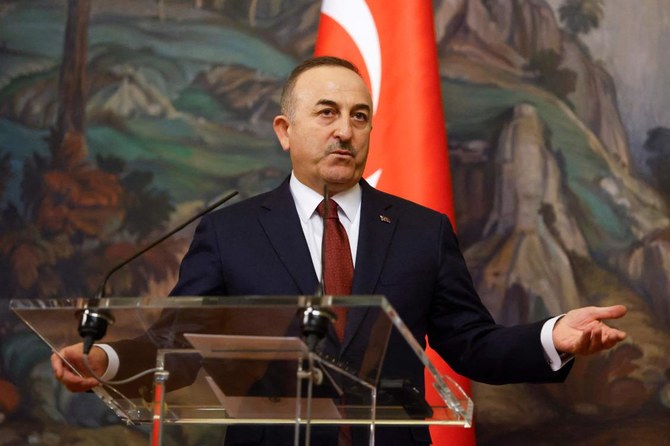
ISTANBUL: Turkey’s foreign minister said in an interview published on Sunday that Russia and Ukraine were nearing agreement on “critical” issues and he was hopeful for a cease-fire if the two sides did not backtrack from progress achieved so far.
Russian forces invaded Ukraine on Feb. 24. President Vladimir Putin has called Russia’s actions a “special operation” meant to demilitarize Ukraine and purge it of what he sees as dangerous nationalists. Ukraine and the West say Putin launched an aggressive war of choice.
Foreign ministers Sergei Lavrov of Russia and Dmytro Kuleba of Ukraine met in the Turkish resort town of Antalya earlier this month with Turkish Foreign Minister Mevlut Cavusoglu also attending. The discussions did not yield concrete results.
But Cavusoglu, who also traveled to Russia and Ukraine last week for talks with Lavrov and Kuleba, told Turkish daily Hurriyet that there had been “rapprochement in the positions of both sides on important subjects, critical subjects.”
“We can say we are hopeful for a cease-fire if the sides do not take a step back from the current positions,” he said, without elaborating on the issues.
Turkish presidential spokesman Ibrahim Kalin, speaking to al Jazeera television, said the two sides were getting closer on four key issues. He cited Russia’s demand for Ukraine to renounce ambitions to join NATO, demilitarization, what Russia has referred to as “de-nazification,” and the protection of the Russian language in Ukraine.
Ukraine and the West have dismissed Russian references to “neo-Nazis” in Ukraine’s democratically elected leadership as baseless propaganda, and Kalin said such references were offensive to Kyiv.
Kyiv and Moscow reported some progress in talks last week toward a political formula that would guarantee Ukraine’s security, while keeping it outside NATO, though each sides accused the other of dragging matters out.
Kalin said a permanent cease-fire could come only through a meeting between Putin and Ukrainian President Volodymyr Zelenskiy. But he said Putin felt that positions on the “strategic issues” of Crimea and Donbas were not close enough for a meeting.
Russia annexed the Crimean peninsula from Ukraine in 2014 while part of the eastern industrial Donbas region was seized by Russian-backed separatist forces that year.
NATO member Turkey shares a maritime border with Ukraine and Russia in the Black Sea, has good relations with both and has offered to mediate between them.
It has voiced support for Ukraine, but has also opposed far-reaching Western sanctions imposed on Moscow over the invasion.
While forging close ties with Russia on energy, defense and trade and relying heavily on Russian tourists, Turkey has sold drones to Ukraine, angering Moscow.
Turkey also opposes Russian policies in Syria and Libya, as well as Moscow’s annexation of Crimea.
President Tayyip Erdogan has repeatedly said Turkey will not abandon its relations with Russia or Ukraine, saying Ankara’s ability to speak to both sides was an asset.

Turkey says Russia and Ukraine nearing agreement on ‘critical’ issues
Short Url
https://arab.news/9rsy5
Turkey says Russia and Ukraine nearing agreement on ‘critical’ issues
- ‘We can say we are hopeful for a cease-fire if the sides do not take a step back from the current positions’
Militants kill 6 officers and a civilian in ambushes on police vehicles in northwest Pakistan
- Assailants ambushed a police vehicle and killed one officer in Kohat — When police reinforcements arrived minutes later, they launched another attack and killed five more officers and a civilian
- No group claimed responsibility for this week’s attacks, but suspicion may fall on the Pakistani Taliban, also known as Tehrik-e-Taliban Pakistan, or the TTP
PESHAWAR, Pakistan: A pair of attacks on police vehicles by suspected militants killed at least six police officers and a civilian in northwest Pakistan on Tuesday, authorities said.
The assailants ambushed a police vehicle and killed one officer in Kohat, a district in Khyber Pakhtunkhwa province. When police reinforcements arrived minutes later, they launched another attack and killed five more officers and a civilian, police official Kamran Khan said.
Separately on Tuesday, a suicide bomber detonated explosives at a police post in Bukkur, a district in eastern Punjab province, killing two officers and wounding four others, police official Shahzad Rafiq said.
He provided no further details and only said officers were still investigating.
No group immediately claimed responsibility for the attacks, which have increased across the country in recent months.
President Asif Ali Zardari condemned the attacks in Kohat and Bukkur and offered condolences to the victims’ families.
The latest violence followed an attack on a paramilitary post in Karak on Monday, when a drone loaded with explosives wounded several officers. The attackers later ambushed two ambulances transporting the wounded, killing three officers and burning their bodies before fleeing. The driver of the second ambulance transported several wounded officers despite suffering burn injuries and authorities recovered the remains of the three officers.
No group claimed responsibility for this week’s attacks, but suspicion may fall on the Pakistani Taliban, also known as Tehrik-e-Taliban Pakistan, or the TTP. The TTP is separate from, but closely allied with, Afghanistan’s Taliban. Islamabad has accused the group of operating from inside Afghanistan, a claim the TTP and Kabul deny.
Pakistan’s military said it killed at least 70 militants on Sunday in strikes along the Afghan border, targeting hideouts of Pakistani militants blamed for recent attacks inside the country.
The assailants ambushed a police vehicle and killed one officer in Kohat, a district in Khyber Pakhtunkhwa province. When police reinforcements arrived minutes later, they launched another attack and killed five more officers and a civilian, police official Kamran Khan said.
Separately on Tuesday, a suicide bomber detonated explosives at a police post in Bukkur, a district in eastern Punjab province, killing two officers and wounding four others, police official Shahzad Rafiq said.
He provided no further details and only said officers were still investigating.
No group immediately claimed responsibility for the attacks, which have increased across the country in recent months.
President Asif Ali Zardari condemned the attacks in Kohat and Bukkur and offered condolences to the victims’ families.
The latest violence followed an attack on a paramilitary post in Karak on Monday, when a drone loaded with explosives wounded several officers. The attackers later ambushed two ambulances transporting the wounded, killing three officers and burning their bodies before fleeing. The driver of the second ambulance transported several wounded officers despite suffering burn injuries and authorities recovered the remains of the three officers.
No group claimed responsibility for this week’s attacks, but suspicion may fall on the Pakistani Taliban, also known as Tehrik-e-Taliban Pakistan, or the TTP. The TTP is separate from, but closely allied with, Afghanistan’s Taliban. Islamabad has accused the group of operating from inside Afghanistan, a claim the TTP and Kabul deny.
Pakistan’s military said it killed at least 70 militants on Sunday in strikes along the Afghan border, targeting hideouts of Pakistani militants blamed for recent attacks inside the country.
© 2026 SAUDI RESEARCH & PUBLISHING COMPANY, All Rights Reserved And subject to Terms of Use Agreement.


