

Recipes for success: Chef Stefano Nava shares advice and a delicious spaghetti recipe

Stefano Nava is a chef at Prato Restaurant in Dubai. (Supplied)
Short Url
Updated 18 March 2022
Follow

Recipes for success: Chef Stefano Nava shares advice and a delicious spaghetti recipe

  • Stefano Nava is a culinary chef at Prato Restaurant in Dubai’s Trump International Golf Club

Q: What’s your top tip for amateur chefs?

A: Always ensure that you’re organized. It’s a cliché, but it really does make a huge difference — in the kitchen or any space that you’re working in. Be prepared, and familiarize yourself with the products and ingredients before you start cooking any dish.

What single ingredient do you think improves any dish?

I mean, I don’t think there’s one specific ingredient that can improve every single dish. I would say, though, that although it’s an acquired taste, I really believe that truffle can improve so many dishes — enhancing them with a rich, earthy flavor.
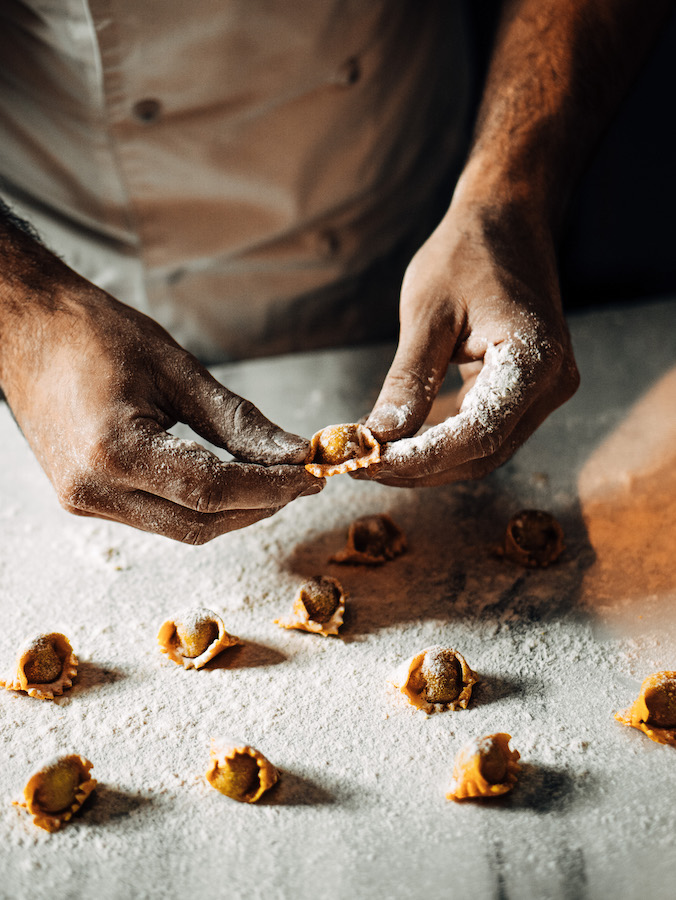


Stefano Nava’s favorite dish to cook is Plin carne. (Supplied)

What was the biggest challenge for you when you first started out as a professional chef?

Seasoning and balancing the flavors of dishes. I mean, I think that’s a challenge for any new chef, honestly. And you only get better with experience.

What’s your favorite cuisine when you go out to eat?

At the moment, I’m really enjoying what’s on offer in the Middle East: Koftas, various Arabic breads, and the amazing variety of dips and preserves.

What’s your go-to dish if you need to cook something up quickly?

Spaghetti aglio olio (a traditional Neopolitan dish). It’s quick, simple, tasty, and very Italian.

What’s your favorite dish to cook?

Plin carne (small pasta pockets — a dish from Nava’s native region of Piedmont in Northern Italy). We actually have it on our menu at Prato. It’s a very traditional dish, and it reminds me of my grandma. It takes a lot of work, but the end result is super-satisfying.



(Supplied)

And what dish do you find most challenging?

Risotto. So many people get it wrong — it really does take skill and experience. Finding the right balance in the dish is quite complicated, but I love the challenge.

What customer behavior most annoys you?

Nothing really annoys me. It can be frustrating when people want to change a perfect dish with certain requests, but at the end of the day preferences vary from person to person and we need to understand that.

Do you find yourself critiquing the food when you go out to other restaurants? And what’s the most common issue you find in other restaurants?

Most, if not all, restaurants have high points and low points. I’m not really someone who critiques food when I eat out; I always go into restaurants with an open mind and I love to learn from each place.

Q: What are you like in the kitchen? Are you a shouter? Or are you quite chilled-out?

I’m very laid-back. The thing is, we employ the right people for our teams. That’s essential. Our success lies in balancing our teams and picking out the best personas to work together. That makes it possible for me to focus more on encouragement and progression.

Chef Stefano’s spaghetti puttanesca
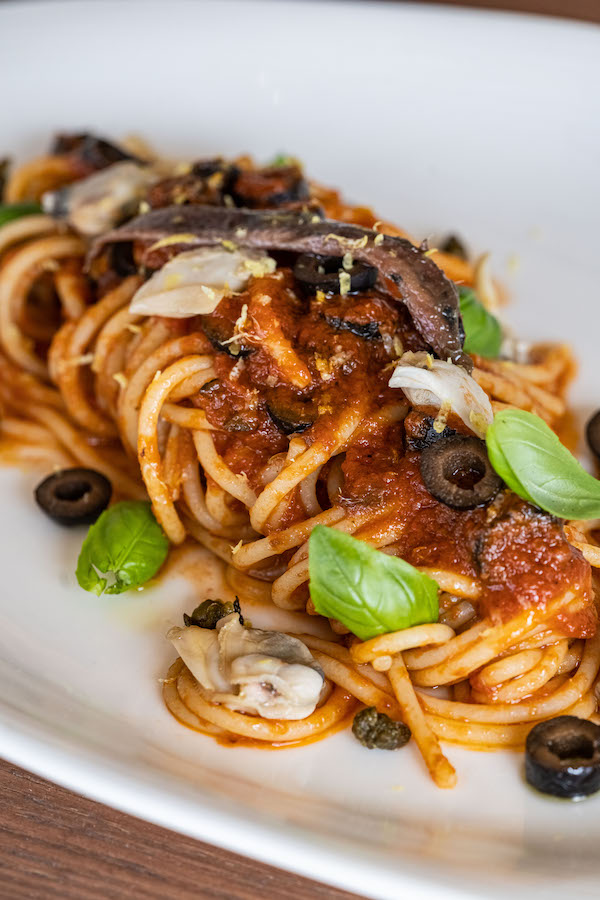


This recipes serves two. (Supplied)

INGREDIENTS:

250gm spaghetti; 130gm tomato passata sauce; 40gm tuna fresh or canned; 15gm anchovy fillets; 10gm capers in brine; 10gm chopped parsley; 50ml olive oil; 2 chopped garlic cloves; salt to taste.

INSTRUCTIONS:

1. Bring a pot of water to a boil and season generously with salt. Place spaghetti in the pot and cook for 11 minutes. Once al dente, place to one side.

2. Add oil to a skillet and sauté the chopped garlic on medium heat. Cook for one minute until fragrant.

3. After sautéing the garlic, add the remaining ingredients apart from the parsley and anchovy. Simmer until the mixture thickens.

4. Add the pasta to the sauce. Let all the ingredients combine for at least two minutes, or until all ingredients are cooked through and mixed.

5. Plate the dish while hot, garnish with fresh parsley and serve with anchovy pieces.


Robert Duvall: understated actor’s actor, dead at 95

Updated 7 sec ago
Follow

Robert Duvall: understated actor’s actor, dead at 95

  • One of his most memeorable characters was the maniacal, surfing-mad Lt. Gen. William Kilgore in Francis Ford Coppola’s 1979 Vietnam War epic ‘Apocalypse Now’
  • One regret was turning down the lead part in ‘Jaws’ (which went to Roy Scheider) because he instead wanted to play the salty fisherman, a role that went to Robert Shaw

LOS ANGELES: Robert Duvall, a prolific, Oscar-winning actor who shunned glitz and won praise as one of his generation’s greatest and most versatile artists, has died at age 95.
Duvall’s death on Sunday was confirmed by his wife Luciana Duvall in a statement posted Monday on Facebook.
Duvall shone in both lead and supporting roles, and eventually became a director over a career spanning six decades. He kept acting in his 90s.
His most memorable characters included the soft-spoken, loyal mob lawyer Tom Hagen in the first two installments of “The Godfather” and the maniacal, surfing-mad Lt. Gen. William Kilgore in Francis Ford Coppola’s 1979 Vietnam War epic “Apocalypse Now.”
The latter earned Duvall an Oscar nomination and made him a bona fide star after years playing lesser roles. In it he utters what is now one of cinema’s most famous lines.
“I love the smell of napalm in the morning,” his war-loving character — bare chested, cocky and sporting a big black cowboy hat — muses as low-flying US warplanes strafe a beachfront tree line with the incendiary gel.
That character was originally created to be even more over the top — his name was at first supposed to be Col. Carnage — but Duvall had it toned down in a show of his nose-to-the-grindstone approach to acting.
“I did my homework,” Duvall told veteran talk show host Larry King in 2015. “I did my research.”
Duvall was a late bloomer in the profession — he was 31 when he delivered his breakout performance as the mysterious recluse Boo Radley in the 1962 film adaptation of Harper Lee’s novel “To Kill a Mockingbird.”
He would go on to play myriad roles — a bullying corporate executive in “Network” (1976), a Marine officer who treats his family like soldiers in “The Great Santini” (1979), and a washed-up country singer in “Tender Mercies” (1983), for which he won the Oscar for best actor. Duvall was nominated for an Oscar six other times as well.
Duvall often said his favorite role, however, was one he played in a 1989 TV mini-series — the grizzled, wise-cracking Texas Ranger-turned-cowboy Augustus McCrae in “Lonesome Dove,” based on the novel by Larry McMurtry.
Film critic Elaine Mancini once described Duvall as “the most technically proficient, the most versatile, and the most convincing actor on the screen in the United States.”
In her statement Luciana Duvall said, “to the world, he was an Academy Award-winning actor, a director, a storyteller. To me, he was simply everything. His passion for his craft was matched only by his deep love for characters, a great meal, and holding court.”

‘A lot of crap’ 

Born in 1931, the son of a Navy officer father and an amateur actress mother, Duvall studied drama before spending two years in the US Army.
He then settled in New York, where he shared an apartment with Dustin Hoffman. The pair were friends with Gene Hackman as all three worked their way up in showbiz. These were lean times for the future stars.
“Hoffman, me, my brother, three or four other actors and singers had a place on 107th and Broadway in Manhattan, uptown,” Duvall told GQ in 2014.
Duvall said he had few regrets in his career.
But one was turning down the lead part in “Jaws” (which went to Roy Scheider) because he instead wanted to play the salty fisherman, a role that went to Robert Shaw.
Director Steven Spielberg told Duvall he was too young for that part.
Duvall also admitted he took some jobs just for the money.
“I did a lot of crap,” he told The Wall Street Journal in 2017. “Television stuff. But I had to make a living.”
Duvall made his home far from the glitz and chatter of Hollywood — in rural Virginia, where his family had roots.
He and his fourth wife, Argentine-born Luciana Pedraza, 40 years his junior, lived in a nearly 300-year-old farmhouse. Duvall never had children.
He said he went to New York and Los Angeles only when necessary.
“I like a good Hollywood party,” he told the Journal. “I have a lot of friends there. But I like living here.”
And of all his storied roles, Duvall says his favorite was indeed that of the soft-hearted cowboy McCrae in “Lonesome Dove.”
“That’s my ‘Hamlet,’” he told The New York Times in 2014.
“The English have Shakespeare; the French, Moliere. In Argentina, they have Borges, but the Western is ours. I like that.”