

Oil jumps as Russia-Ukraine talks stall

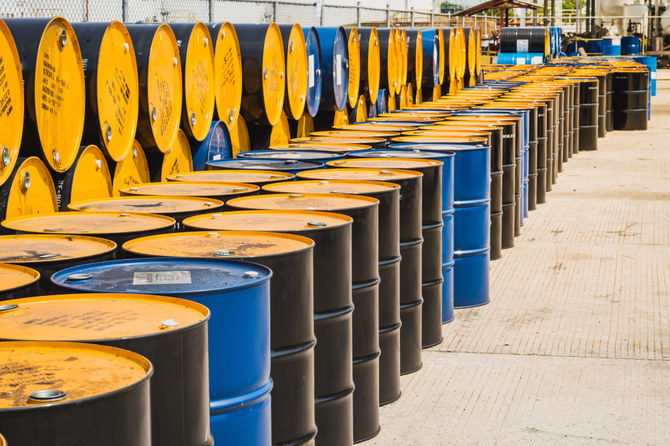
More volatility is expected in the oil market (Shutterstock)
Short Url
Updated 18 March 2022
Follow

Oil jumps as Russia-Ukraine talks stall

MELBOURNE: Oil prices extended their rally on Friday at the end of a third volatile week of trade after slim progress in peace talks between Russia and Ukraine raised the spectre of tighter sanctions and a prolonged disruption to oil supply, according to Reuters.

Despite battleground setbacks and punitive sanctions by the West, Russian President Vladimir Putin has shown little sign of relenting. A fourth day of talks between Russian and Ukrainian negotiators took place by videolink, but the Kremlin said an agreement had yet to be reached.

Brent crude futures jumped $2.75, or 2.6 percent, to $109.39 a barrel at 0405 GMT, after surging nearly 9 percent on Thursday in the largest percentage gain since mid-2020.

US West Texas Intermediate crude futures climbed $2.93, or 2.9 percent, to $105.91 a barrel, adding to an 8 percent jump on Thursday.

Despite the rebound, both benchmark contracts were set to end the week down about 3 percent, after having traded in a $16 range. Prices have dropped from 14-year highs hit nearly two weeks ago.

“I’m still expecting more volatility. There’s a lot of uncertainty out there still,” said Justin Smirk, senior economist at Westpac in Sydney.

The supply crunch from sanctions on Russia, stuttering nuclear talks with Iran, dwindling oil stockpiles and worries about a surge of COVID-19 cases in China hitting demand all drove the rollercoaster ride over the week.

Analysts said comments from a Kremlin spokesperson saying a report of major progress in peace talks was “wrong” and US President Joe Biden calling Putin a “war criminal” all stoked a wave of buying on Thursday.

RBC Capital analyst Helima Croft cautioned that Russian oil export losses will likely prove enduring and that offsetting barrels are in short supply.

“US Secretary of State Blinken is reportedly preparing to visit UAE and Saudi Arabia later this month and the oil ask will presumably be close to the top of the agenda,” she said in a note.

Underscoring tight supplies, consultancy FGE said on-land product stocks at key countries are 39.9 million barrels lower for this time of the year relative to the 2017-2019 average and also 45 million barrels lower year on year.

The volatility has scared players out of the oil market, which in turn is likely to exacerbate price swings, traders, bankers and analysts said.

“In such a tight market and such an illiquid paper market — you’re going to get some volatility,” Smirk said.


Islamic banks’ market share in Turkiye rises to 9.2%: Fitch Ratings

Updated 9 sec ago
Follow

Islamic banks’ market share in Turkiye rises to 9.2%: Fitch Ratings

RIYADH: Islamic banks in Turkiye lifted their asset market share to 9.2 percent in 2025 from 8.1 percent a year earlier, as financing and deposits outpaced the broader banking sector, a new analysis showed. 

In its latest report, Fitch Ratings said financing and deposit market shares rose to 7.9 percent and 10.4 percent, respectively, by the end of 2025, compared with 7.3 percent and 9.4 percent in 2024.

The agency noted that new digital Islamic banks are emerging in the country, with investment from Gulf Cooperation Council countries expected to continue. 

Turkiye’s strong ties with Islamic countries across the Balkans, Africa and the Middle East support the development of its Islamic banking sector, attracting investors and contributing to the industry’s growth.

In its latest report, Fitch stated: “Three recently established private Islamic banks (two digital) grew rapidly in the first nine months of 2025. Investment in digital participation banking from the Gulf Cooperation Council countries underscores the potential for further investment from the region.” 

It added: “Planned establishment of new participation banks, and rapid growth of recently established banks – albeit from small bases – means that the segment landscape may be reshaped in 2026.” 

Dubai Islamic Bank PJSC’s investment in digital bank TOM underscores the potential for further GCC investment. 

Turkish regulators have approved the establishment of Halk Katilim Bankasi A.S. and Adil Katilim Bankasi A.S. (digital), while BIM Birlesik Magazalar A.S.’s application is pending. 

Fitch added that state-owned participation banks may merge or pursue initial public offerings, potentially reshaping the banking landscape. 

The report predicts Islamic banks’ market share will rise further in 2026, supported by strong internal capital generation and growth appetite. However, the non-performing financing ratio may increase moderately due to high inflows. 

“The segment’s non-performing financings ratio deteriorated to 2 percent at end-2025 compared to 1.2 percent in 2024 but remained below the sector average of 2.5 percent,” said Fitch. 

It added: “We expect pressure to persist given still-high financing rates, high but declining inflation, and the sensitivity of unsecured retail (lower share than conventional banks) and SME segments to economic cycles. We forecast a moderate increase in the segment NPF ratio in 2026.”