Strong quake strikes off Indonesia, no tsunami potential seen

Short Url
Updated 14 March 2022
Follow

Strong quake strikes off Indonesia, no tsunami potential seen

  • The Indonesian Meteorology and Geophysics Agency said the quake was felt in many parts of the province but there was no danger of a tsunami

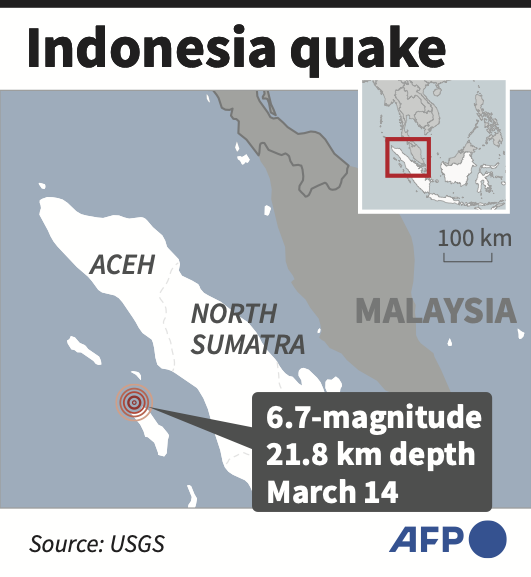
JAKARTA: A powerful earthquake struck off the west coast of Indonesia’s Sumatra island early on Monday and was felt strongly in some areas, including the city of Padang, though there were no immediate reports of casualties or damage, officials said.
The magnitude 6.7 quake, which struck at 04:09 local time (21:09 GMT on Sunday), did not have the potential to cause a tsunami, the head of Indonesia’s geophysics agency (BMKG) Dwikorita Karnawati said.
The European Mediterranean Seismological Center (EMSC) had put the strength of the earthquake near Kepulauan Batu at 6.8 magnitude, at a depth of 40 km (24.85 miles).
The Indonesian BMKG agency described the quake as feeling like a “truck passing through” in some areas, and said there had been four aftershocks with the biggest of magnitude 6. Padang is about 1,000 kilometers north west of capital Jakarta.
So far officials had not received any information on damage, but were still assessing the impact in some remote areas including north Sumatra’s Nias Selatan, where communications were difficult, an official said.
Indonesia suffers frequent earthquakes, straddling the so-called “Pacific Ring of Fire,” a seismically active zone where different plates of the earth’s crust meet.
The fault along Sumatra island can be particularly active and dangerous. In 2004, a massive 9.1 magnitude quake and a tsunami off the northern tip of Sumatra killed 226,000 people in Indonesia, Sri Lanka, India, Thailand and nine other countries.
Last month, a magnitude 6.1 earthquake in the area killed at least 10 people, the local disaster mitigation agency in West Sumatra said.


India’s new budget bets on AI, data centers to sustain growth

Updated 42 min 32 sec ago
Follow

India’s new budget bets on AI, data centers to sustain growth

  • Budget features new Bharat‑VISTAAR AI‑powered platform for agriculture sector
  • It also includes tax holiday until 2047 for foreign companies using Indian data centers

NEW DELHI: India’s latest budget has emerged as one of its most technology-focused, with new measures to utilize artificial intelligence, semiconductor manufacturing, and expand digital infrastructure aimed at offsetting the impact of global tariff wars.

Finance Minister Nirmala Sitharaman presented the 2026-27 budget in parliament on Sunday, saying it would “accelerate and sustain economic growth by enhancing productivity and competitiveness” at a time when India was facing “an external environment in which trade and multilateralism are imperiled and access to resources and supply chains are disrupted.”

New Delhi has yet to secure a trade deal with its largest trading partner, the US, which last year hit it with punitive tariffs of up to 50 percent over India’s purchases of Russian oil. To mitigate their impact, India has been looking for alternative agreements, including last week’s agreement with the EU, cutting duty on 99.5 percent of Indian exports to the bloc.

The new budget prioritizes infrastructure and domestic manufacturing, with a total expenditure estimated at $583 billion.

It offers tariff concessions for products from the marine, leather, and textile industries — all of which have been affected by US tariffs — and provides duty exemptions on materials and goods used to process rare-earth minerals, make lithium ion batteries, solar glass, and components for electric vehicles.

The finance minister also announced doubled spending for semiconductor manufacturing to $4.8 billion and a tax holiday until 2047 for foreign companies providing cloud services using Indian data centers.

The budget also features Bharat‑VISTAAR (Virtually Integrated System to Access Agricultural Resources), a multilingual AI‑powered platform for the agriculture sector to give farmers customized, real‑time advisory on crop management, weather, soil conditions and government schemes in different Indian languages.

“There is a lot of focus on AI and technology. It is to achieve the ambitious target India has already declared — Viksit Bharat 2047. It is very clear that without technology, it would be difficult to achieve that target,” Prof. Pardeep S. Chauhan, Centre for Economic Studies and Planning, Jawaharlal Nehru University, told Arab News, referring to the government’s plan to transform the nation into a fully developed country by 2047 — the 100th anniversary of its independence.

“That was the need of the hour, and the government has taken care of it, focusing on semiconductors, AI, and rare-earth minerals.”

The technology focus also comes against the backdrop of China’s dominance in the global critical minerals supply chains, and last year’s restrictions imposed by Beijing in the wake of escalating trade tensions with the US.

“India lags far behind the US and China, particularly China,” Chauhan said. “India has taken this move to maybe after five, 10, 15 years ... compete up to some extent. Without technology, nobody can think of establishing (their) leadership — whether it’s in the economy, defense or financial infrastructure architecture. Everywhere you need technology.”