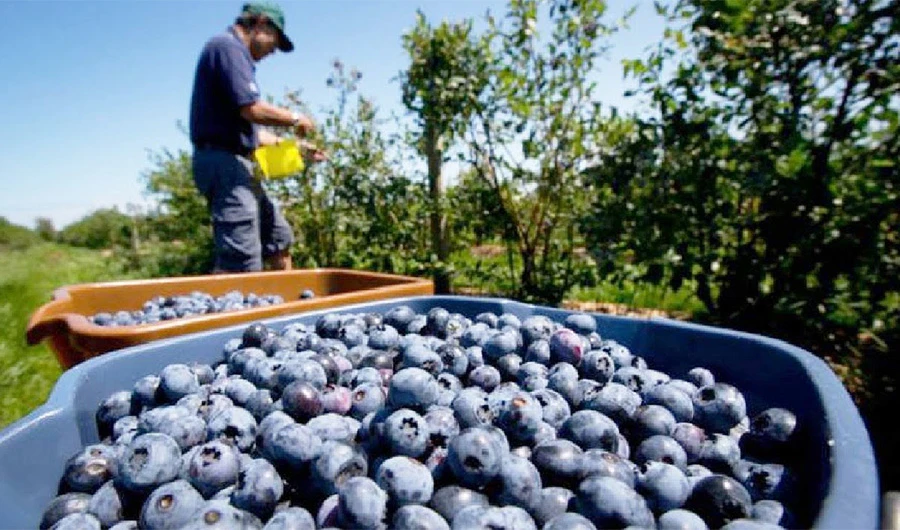
- New plant species will be imported from California for mass production in Punjab and Gilgit-Baltistan
- Pakistan’s soil is rich for the production of blueberry varieties and most heat-tolerant blackberries
KARACHI: The Barani Agriculture Research Institute (BARI), the Punjab government’s agriculture research arm, and Pak Greenland Corporation, an overseas body that focuses on investment in the northern Gilgit-Baltistan (GB) region, will launch separate cultivation projects to produce blueberries and blackberries in Punjab and GB respectively, with eyes on Middle East exports.
Pakistan’s soil is rich for the production of blueberry varieties and most heat-tolerant blackberries, though the country has not fully utilized its potential.
Now, BARI is working to launch berry cultivation projects in Punjab at a cost of Rs200 million and the Pak Greenland Corporation in GB for Rs157 million.
“We are launching the project to cultivate blueberries and blackberries over 25 acres of land in various parts of Gilgit-Baltistan,” Milad Ul Salman, a Pak Greenland Corporation manager, told Arab News. “The wild varieties of berries are found in abundance in the region, which are mostly consumed domestically and not considered for exports.”
“The varieties we want to produce have been imported from California in the United States. Most of our dried fruits are exported to the gulf countries. We also plan to export these berries to the United Arab Emirates and its neighboring states.”
Salman said his company had mostly acquired barren and rocky land in the remote areas to encourage mass production of the fruits for commercial purposes. The project cost was estimated at Rs200 million, which included the cost to purchase land in Gilgit-Baltistan.
“We have been working on blackberry production for the last six years while we have spent about two years on blueberries on a trial basis,” he said. “After getting encouraging results, we are now moving to launch the project to produce both varieties of berries at a large level through flower pot and drip irrigation cultivation.”
A similar project is also being undertaken by the Barani Institute to mass farm blackberries across the province of Punjab.
“We have submitted a proposal to scale up the project to the Punjab Agricultural Research Board for approval,” Aqeel Feroz, project director for the production of blackberries at the research institute, told Arab News. “We hope it will be approved by June since the cultivation season begins in July.”
Like the varieties being planted in Gilgit-Baltistan, the plant species in Punjab have also been imported from California.
“We have already imported some nine fruits, including blackberry, fig, peaches etc., under our high-value fruit crops project,” Feroz said. “The cultivation of blackberry was very successful and now we are multiplying it and encouraging farmers to grow the fruit because it can be monetarily beneficial.”
He added that the project was estimated to cost about Rs157 million, including the cost of distributing blackberry plants among farmers in Punjab.
Speaking about the price differential of berries in GB and Punjab, officials explained that in Gilgit-Baltistan, the prices of berries were much lower than those available in Punjab mainly due to the domestic consumption of the fruits amid their low production.
“Currently, people don’t grow berries for commercial purposes,” Salman said. “This explains why the prices are low. The blueberries are sold for Rs1,500 per kilogram and blackberries for Rs800.”
However, Feroz said blackberries were not easily available in Punjab which pushed their prices as high as Rs3,000 per kilogram there.
Going forward, fruit exporters in Gilgit-Baltistan are seeking government support against shipment delays and for the timely delivery of their produce to the Islamabad Airport.
“Berries are perishable items,” Salman said. “Our fresh fruits are exported from Islamabad, but it takes a lot of time to deliver the shipment to the capital due to lack of trucks. We need the government’s support to cut the waiting period at Islamabad Airport to make timely shipments.”
Blueberries are considered an excellent source of dietary fiber along with vitamins C and K. They also have iron and a number of antioxidants. Blackberries are also nutritious and generally eaten fresh or used in baked goods such as pies.