

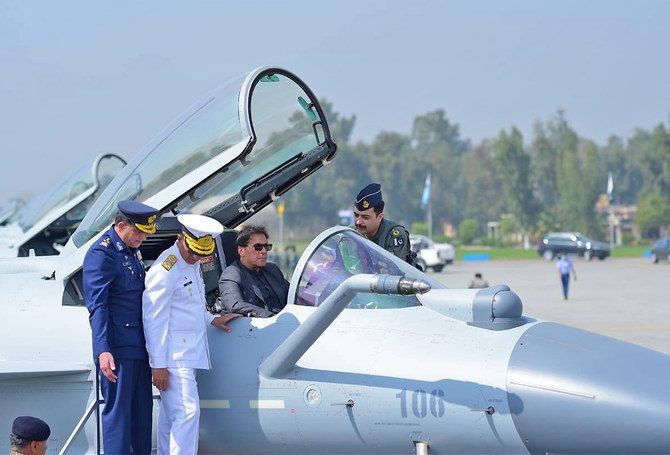
Pakistan air force inducts Chinese-made J-10C fighter jets

Pakistan Prime Minister Imran Khan (third left) inspects newly inducted Chinese-made J-10C fighter jets in Kamra Base, Pakistan, on March 11, 2022. (PMO Office/Twitter)
Short Url
Updated 11 March 2022
Follow

Pakistan air force inducts Chinese-made J-10C fighter jets

  • Planes inducted in response to arch-rival India’s purchase of French-made Rafale combat jets
  • Induction ceremony on Friday was attended by PM Imran Khan and the military service chiefs

ISLAMABAD: Pakistan Air Force on Friday inducted Chinese-made J-10C fighter jets into its fleet, with the country’s air chief calling it a “historic occasion.”
China is one of the biggest weapons suppliers for the Pakistani armed forces.
The induction ceremony on Friday was attended by Prime Minister Imran Khan and the military service chiefs. 
“Unfortunately, there are efforts to create an imbalance in South Asia and to address that security imbalance, thank god, we have made a major induction today in our defense system,” Khan said. 
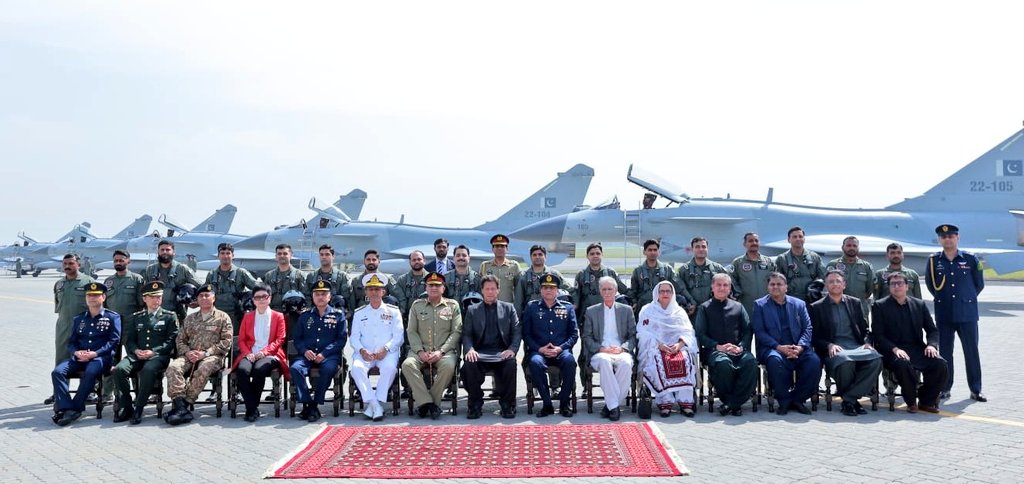


Pakistan Prime Minister Imran Khan (eight from left in first row) poses for a group photograph during the induction of Chinese-made J-10C fighter jets in Kamra Base, Pakistan, on March 11, 2022. (PMO Office/Twitter)

He was referring to arch-rival India’s purchase of French-made Rafale combat jets, which employ dual-capable systems that can be modified as nuclear weapon delivery platforms. 
In 2016, India signed a deal to buy 36 Rafale fighter jets from France for around $8.7 billion, the country’s first major acquisition of combat planes in two decades and a boost for Prime Minister Narendra Modi’s plan to rebuild an aging fleet. India has so far received 26 of the 36 planes.
Air Chief Marshal Zaheer Ahmad Babar said the J-10C can detect, engage and destroy targets at long range both in the air to air and air to surface domains.
“With multi domain capability J-10C would indeed revolutionize Pakistan Air Force’s operational thought. It will enhance net centric and integrated employment of electronic warfare while ensuring retention of first shoot capabilities,” he said.
It is reported the new jets will also fly-past at the Pakistan day military parade on March 23.
The Pakistan Day parade is held on March 23 every year to commemorate the Lahore Resolution, which was adopted on the same day in 1940 and laid the foundation for a Muslim-majority state in South Asia. 


Pakistan and Italy mark 70 years of archaeological cooperation in Swat

Updated 9 sec ago
Follow

Pakistan and Italy mark 70 years of archaeological cooperation in Swat

  • Founded in 1955, Italy’s Swat mission has led excavations and conservation work at major Gandhara sites
  • Italian archaeologists have also contributed to training Pakistani researchers and museum development

ISLAMABAD: Pakistan and Italy marked 70 years of archaeological cooperation, said an official statement on Sunday, with officials highlighting decades of joint work in preserving ancient sites in the country’s northwest, where Italian researchers have played a central role in documenting and conserving remnants of the Gandhara civilization.

The Italian Archaeological Mission in Swat was established in 1955 by Italian scholar Giuseppe Tucci, a leading expert on Asian art and religions, with the aim of studying, excavating and preserving Buddhist and pre-Islamic sites in what is now Pakistan’s Khyber Pakhtunkhwa province.

Over the decades, the mission has become one of the longest-running foreign archaeological projects in the country, working closely with Pakistani authorities and academic institutions.

“Pakistan is committed to advancing archaeological research, conservation and education, and looks forward to deepening cooperation with Italy in both scope and dimension,” Pakistan’s Minister for National Heritage and Culture Aurangzeb Khan Khichi said while addressing a ceremony in Rome marking the mission’s anniversary.

The event was organized by Italy’s International Association for Mediterranean and Oriental Studies (ISMEO), with support from the Italian Agency for Development Cooperation and the University of Venice, and was attended by Pakistani and Italian academics, diplomats and cultural officials.

The Italian mission was originally conceived to systematically document Buddhist sites in the Swat Valley, once a major center of the ancient Gandhara civilization, which flourished from around the first century BCE and became a crossroads of South Asian, Central Asian and Hellenistic influences.

Since its inception, the mission has led or supported excavations and conservation work at several key sites, including Barikot, believed to be ancient Bazira mentioned by classical sources, as well as Butkara and Saidu Sharif, helping establish chronologies, preserve stupas and monasteries and train generations of Pakistani archaeologists.

Italian researchers have also worked with local authorities on site protection, museum development and post-conflict rehabilitation, particularly after natural disasters and periods of unrest that threatened archaeological heritage in the region.

The anniversary program featured sessions on the history of the mission, its collaboration with the provincial government of Khyber Pakhtunkhwa, and future research areas such as archaeobotany, epigraphy and geoarchaeology.

The event was moderated by Professor Luca Maria Olivieri of the University of Venice, who has been associated with archaeological fieldwork in Pakistan for nearly four decades and was awarded Pakistan’s Sitara-e-Imtiaz for his contributions to heritage preservation.

Officials said the mission’s longevity reflected a rare continuity in international cultural cooperation and underscored Pakistan’s efforts to protect its archaeological legacy through partnerships with foreign institutions.