Israeli president ends Turkey trip with synagogue visit

1 / 3
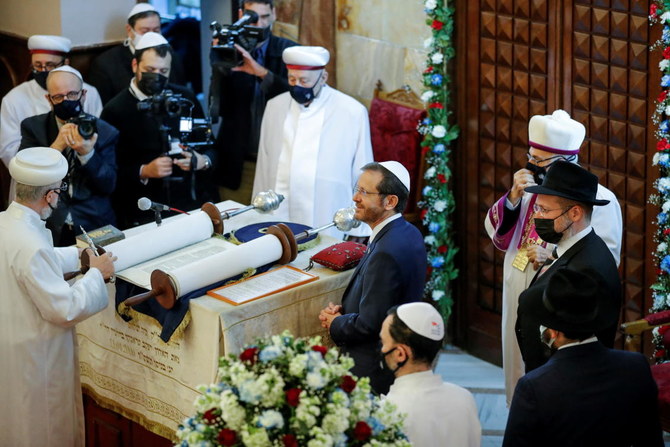
Israeli President Isaac Herzog attends a ceremony during his visit at the Neve Shalom Synagogue in Istanbul on Thursday. (Reuters)
2 / 3
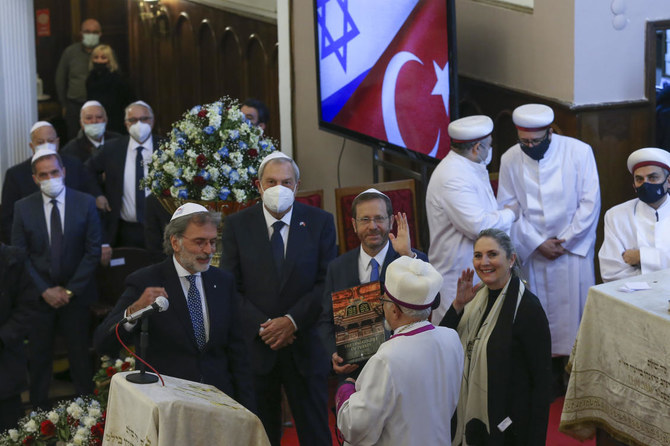
Israel’s President Isaac Herzog and his wife Michal Herzog gestures during their visit to Neve Shalom synagogue, in Istanbul on Thursday. (AP)
3 / 3
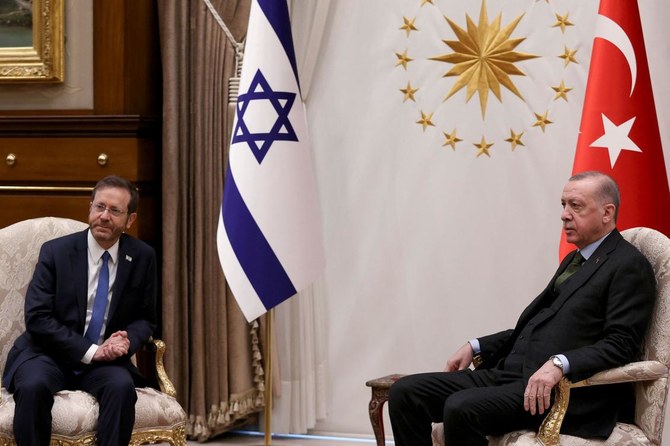
Turkish President Recep Tayyip Erdogan meets with Israel’s President Isaac Herzog during an official ceremony at the Presidential Complex in Ankara, on Wednesday. (AFP)
Short Url
Updated 10 March 2022
Follow

Israeli president ends Turkey trip with synagogue visit

  • Isaac Herzog held talks in Ankara on Wednesday with Turkish counterpart Recep Tayyip Erdogan
  • He took part in a prayer for Ukrainian refugees as well as "Turkey and President Erdogan"

ISTANBUL: Israel’s president on Thursday ended his landmark trip to Turkey with a visit to the Jewish community in Istanbul, a day after the two countries hailed a new era in relations.
Isaac Herzog held talks in Ankara on Wednesday with Turkish counterpart Recep Tayyip Erdogan in the first visit by an Israeli president since 2007.
He then took part in a prayer for Ukrainian refugees as well as “Turkey and President Erdogan” with members of the Jewish community in Istanbul at the Neve Shalom synagogue in the historic Galata district.
“The entire process is without illusions, but reflects strategic and bilateral interests,” Herzog told journalists about the visit and talks before entering the synagogue. He left Turkey shortly after.
“We will not agree on everything... But we shall aspire to solve our disagreements with mutual respect and goodwill,” Herzog said during a press conference with Erdogan on Wednesday.
The Neve Shalom synagogue, which is also home to a museum about Jewish heritage, holds a special place for local Jews.
It is a synagogue which “suffered in the past,” Herzog said, referring to terror attacks in 1986 which left 22 dead, and others in 1992 and 2003.
On November 15, 2003, 30 were killed and over 300 others were injured after vehicles filled with explosives targeted two synagogues in Istanbul.
The attacks were claimed by a Turkish cell of Al-Qaeda.
Under the Ottoman Empire, Istanbul, then Constantinople, welcomed many Jews expelled from Spain in 1492 who found refuge and established thriving communities until the 20th century.
In the 1930s, Jews were subject to discriminatory laws and pogroms.
These “500 years” of living together is often cited by Turkish officials, although the status of Turkish Jews has sometimes been less than equal.
Around 15,000 Jews live in Turkey today, the majority in Istanbul, compared with 200,000 at the start of the 20th century.


UN rights chief shocked by ‘unbearable’ Darfur atrocities

Updated 19 January 2026
Follow

UN rights chief shocked by ‘unbearable’ Darfur atrocities

  • Mediation efforts have failed to produce a ceasefire, even after international outrage intensified last year with reports of mass killings, rape, and abductions during the RSF’s takeover of El-Fasher in Darfur

PORT SUDAN: Nearly three years of war have put the Sudanese people through “hell,” the UN’s rights chief said on Sunday, blasting the vast sums spent on advanced weaponry at the expense of humanitarian aid and the recruitment of child soldiers.
Since April 2023, Sudan has been gripped by a conflict between the army and the paramilitary Rapid Support Forces that has left tens of thousands of people dead and around 11 million displaced.
Speaking in Port Sudan during his first wartime visit, UN Human Rights commissioner Volker Turk said the population had endured “horror and hell,” calling it “despicable” that funds that “should be used to alleviate the suffering of the population” are instead spent on advanced weapons, particularly drones.
More than 21 million people are facing acute food insecurity, and two-thirds of Sudan’s population is in urgent need of humanitarian aid, according to the UN.
In addition to the world’s largest hunger and displacement crisis, Sudan is also facing “the increasing militarization of society by all parties to the conflict, including through the arming of civilians and recruitment and use of children,” Turk added.
He said he had heard testimony of “unbearable” atrocities from survivors of attacks in Darfur, and warned of similar crimes unfolding in the Kordofan region — the current epicenter of the fighting.
Testimony of these atrocities must be heard by “the commanders of this conflict and those who are arming, funding and profiting from this war,” he said.
Mediation efforts have failed to produce a ceasefire, even after international outrage intensified last year with reports of mass killings, rape, and abductions during the RSF’s takeover of El-Fasher in Darfur.
“We must ensure that the perpetrators of these horrific violations face justice regardless of the affiliation,” Turk said on Sunday, adding that repeated attacks on civilian infrastructure could constitute “war crimes.”
He called on both sides to “cease intolerable attacks against civilian objects that are indispensable to the civilian population, including markets, health facilities, schools and shelters.”
Turk again warned on Sunday that crimes similar to those seen in El-Fasher could recur in volatile Kordofan, where the RSF has advanced, besieging and attacking several key cities.
Hundreds of thousands face starvation across the region, where more than 65,000 people have been displaced since October, according to the latest UN figures.