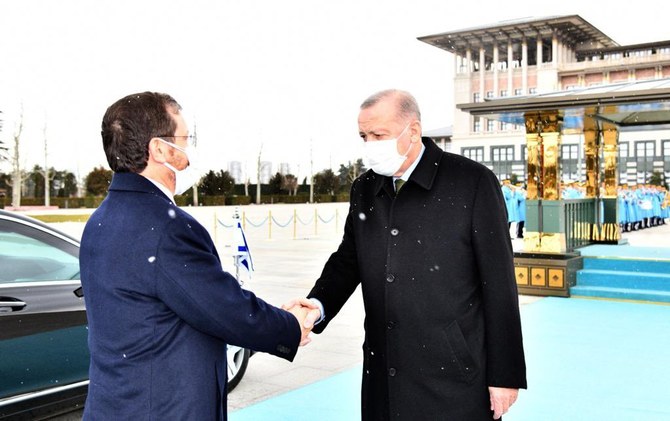
ANKARA: Israeli President Isaac Herzog arrived in Turkey Wednesday for talks with President Recep Tayyip Erdogan, becoming the first leader from Israel to visit in 14 years as the two countries move to turn a new page in their troubled relationship.
Escorted by a Turkish mounted color guard, Herzog arrived at the Turkish presidential palace in the capital Ankara as light snow began to fall.
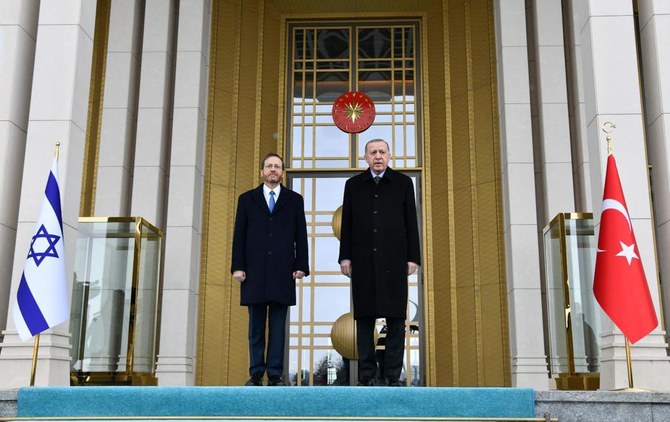
He was greeted by Erdogan and a military honor guard, while a band played the Israeli anthem for the first time since 2008.
Turkey and Israel once were close allies, but the relationship frayed under Erdogan, who is an outspoken critic of Israel’s policies toward the Palestinians. Israel also has been angered by Erdogan’s embrace of Hamas, the militant group that controls the Gaza Strip. Israel considers Hamas a terrorist group.
The countries withdrew their respective ambassadors in 2010 after Israeli forces stormed a Gaza-bound flotilla carrying humanitarian aid for Palestinians that broke an Israeli blockade. The incident resulted in the deaths of nine Turkish activists.
Relations broke down again in 2018 when Turkey, angered by the US moving its embassy in Israel to Jerusalem, once more recalled its ambassador, prompting Israel to respond in kind. The two countries have not reappointed their ambassadors.
The steps toward a rapprochement with Israel comes as Turkey, beset by economic troubles, has been trying to end its international isolation by normalizing its ties with several countries in the Mideast region.
“We will not agree on everything, and the relationship between Israel and Turkey has certainly known ups and downs and not-so-simple moments in recent years,” Herzog said before his departure. “But we shall try to restart our relations and build them in a measured and cautious manner, and with mutual respect between our states.”
In Istanbul, a group of about 150 people protested Herzog’s visit, chanting anti-Israeli slogans and holding up banners calling the Israeli president a “killer.”
The protesters included members of the Turkish Islamic relief group IHH, which organized the Gaza-bound flotilla that broke the Israeli blockade in 2010.
In a step toward reconciliation, Erdogan called Herzog by phone after the Israeli head of state took office last year. The two have held several telephone conversations since then. Erdogan has also spoken to Prime Minister Naftali Bennett following the release of an Israeli couple who were arrested in Istanbul on suspicion of spying.
During a visit to Cyprus last week, Herzog offered reassurance that Israel’s warming relation with Turkey would not come at the expense of ties with Nicosia. Herzog made similar remarks in Greece last month, insisting Israel would continue to expand its cooperation with Greece and Cyprus, which both have tense relations with Turkey.
Israel’s ties with Greece and Cyprus blossomed following the discovery of sizeable natural gas deposits in eastern Mediterranean waters and the countries look for ways to build on energy-based cooperation.
Turkey has said there would be no change to Ankara’s position toward the Palestinians despite the normalization efforts with Israel.
Herzog is scheduled to meet with members of Turkey’s Jewish community in Istanbul on Thursday.

Israel’s president arrives in Turkey as countries heal rift
https://arab.news/pd79r
Israel’s president arrives in Turkey as countries heal rift
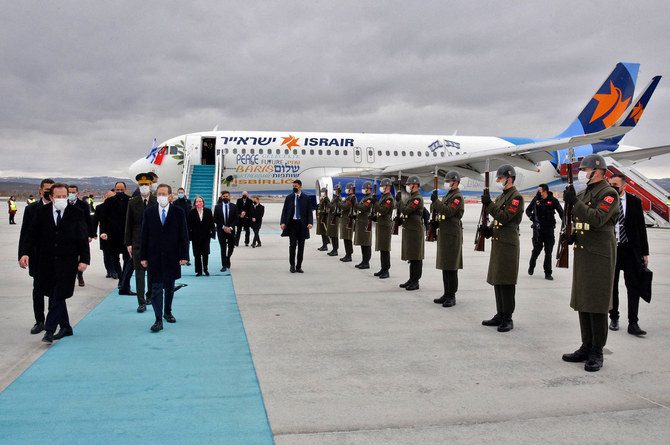
- Herzog was greeted by Erdogan and a military honor guard
- The countries withdrew their respective ambassadors in 2010 after Israeli forces stormed a Gaza-bound flotilla carrying humanitarian aid for Palestinians
US strike on Venezuela to embolden China’s territorial claims, Taiwan attack unlikely, analysts say
- Beijing condemned Trump’s strike on Venezuela, saying it violated international law and threatened peace and security in Latin America
- China claims democratically governed Taiwan as its own province — an assertion the island’s government rejects — and claims almost all of the South China Sea, a position that puts it at odds with several Southeast Asian nations
SHANGHAI/BEIJING: The US attack on Venezuela will embolden China to strengthen its territorial claims over areas such as Taiwan and parts of the South China Sea but will not hasten any potential invasion of Taiwan, analysts said.
Chinese President Xi Jinping’s considerations about Taiwan and his timeline are separate from the situation in Latin America, influenced more by China’s domestic situation than by US actions, they said.
Still, analysts said, President Donald Trump’s audacious attack on Saturday, capturing Venezuelan leader Nicolas Maduro, hands China an unexpected opportunity that Beijing will likely use in the near term to amplify criticism of Washington and bolster its own standing on the international stage.
HIGHLIGHTS
• China could leverage US strikes to strengthen its claims over Taiwan, South China Sea islands — analysts
• US attack an opportunity for China to boost criticism of Washington
• China likely won’t use attack as example for action against Taiwan
Further out, Beijing could leverage Trump’s move to defend its stance against the US on territorial issues including Taiwan, Tibet and islands in the East and South China seas.
’CHEAP AMMUNITION’ FOR A CHINA PUSHBACK
“Washington’s consistent, long-standing arguments are always that the Chinese actions are violating international law but they are now damaging that,” said William Yang, an analyst at International Crisis Group, a Brussels-based NGO.
“It’s really creating a lot of openings and cheap ammunition for the Chinese to push back against the US in the future.”
China claims democratically governed Taiwan as its own province — an assertion the island’s government rejects — and claims almost all of the South China Sea, a position that puts it at odds with several Southeast Asian nations that also claim parts of the vital trade route.
China’s foreign ministry and Taiwan Affairs Office, and Taiwan’s presidential office did not immediately respond to requests for comment.
Beijing condemned Trump’s strike on Venezuela, saying it violated international law and threatened peace and security in Latin America. It has demanded the US release Maduro and his wife, who are being detained in New York awaiting trial.
Hours before his capture, Maduro met with a high-level Chinese delegation in Caracas, according to photos he posted on his Instagram page.
The Chinese foreign ministry did not immediately respond to a request for comment on the whereabouts of the delegation, which included China’s special representative for Latin American and Caribbean affairs, Qiu Xiaoqi.
On Sunday China’s official Xinhua news agency called the US attack “naked hegemonic behavior.”
“The US invasion has made everyone see more and more the fact that the so-called ‘rules-based international order’ in the mouth of the United States is actually just a ‘predatory order based on US interests’,” state-run Xinhua news agency said.
’CHINA ISN’T THE US, TAIWAN ISN’T VENEZUELA’
Taiwan, in particular, has been facing growing pressure from Beijing. China last week encircled the island in its most extensive war games to date, showcasing Beijing’s ability to cut off the island from outside support in a conflict.
But analysts said they did not expect China to capitalize on the Venezuelan situation to escalate that into an attack anytime soon.
“Taking over Taiwan depends on China’s developing but still insufficient capability rather than what Trump did in a distant continent,” said Shi Yinhong, professor of international relations at Renmin University in Beijing.
Neil Thomas, a fellow on Chinese politics at the Asia Society, said China sees Taiwan as an internal affair and so was unlikely to cite US actions against Venezuela as precedent for any cross-strait military strikes.
“Beijing will want a clear contrast with Washington to trumpet its claims to stand for peace, development and moral leadership,” Thomas said. “Xi does not care about Venezuela more than he cares about China. He’ll be hoping that it turns into a quagmire for the United States.”
Wang Ting-yu, a senior lawmaker from Taiwan’s ruling party who sits on the parliament’s foreign affairs and defense committee, rejected the idea that China might follow the US example and strike Taiwan.
“China has never lacked hostility toward Taiwan, but it genuinely lacks the feasible means,” Wang posted on Facebook. “China is not the United States, and Taiwan is certainly not Venezuela. If China could actually pull it off, it would have done so long ago!“
Still, the situation amplifies risks for Taiwan and could press Taipei to seek more favor from the Trump administration, some observers said.
On China’s Weibo social media platform, discussions of the US attack trended heavily on Sunday, with several users saying Beijing should learn from what Trump did.
Lev Nachman, a political science professor at National Taiwan University, said he expected Taiwan’s government to express lightly worded support for American action on Venezuela. Taiwan has not yet made any statement.
“What I do think Trump’s actions could do is to help Xi Jinping’s narrative in the future to create more justification for action against Taiwan,” he said.