ISTANBUL: Israel’s president on Thursday ended his landmark trip to Turkey with a visit to the Jewish community in Istanbul, a day after the two countries hailed a new era in relations.
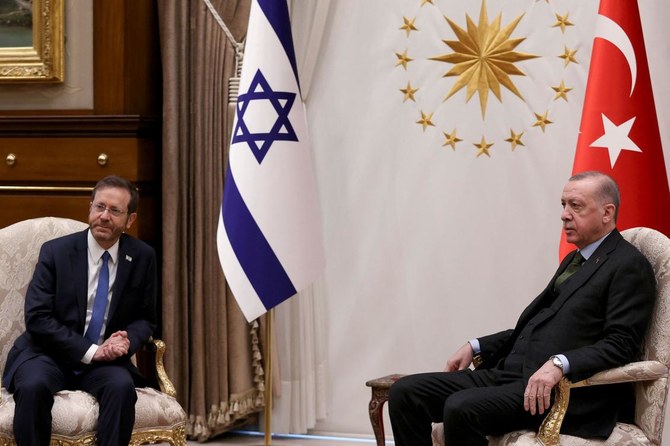
Isaac Herzog held talks in Ankara on Wednesday with Turkish counterpart Recep Tayyip Erdogan in the first visit by an Israeli president since 2007.
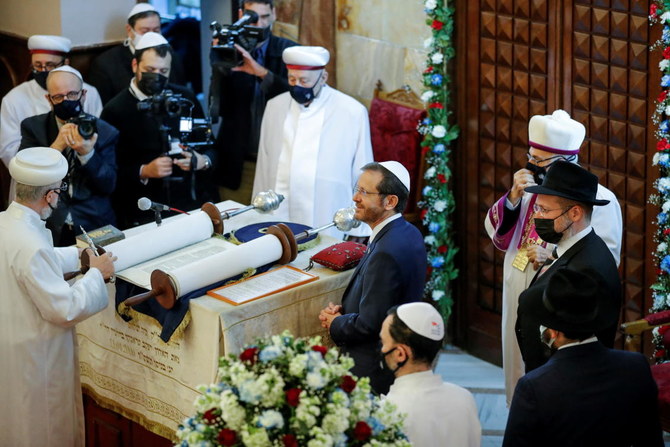
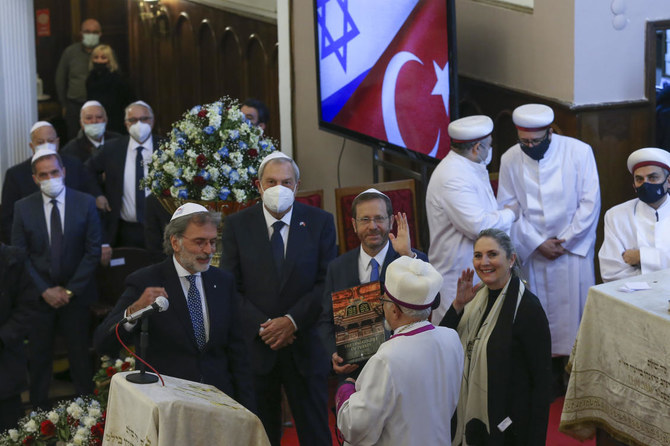
He then took part in a prayer for Ukrainian refugees as well as “Turkey and President Erdogan” with members of the Jewish community in Istanbul at the Neve Shalom synagogue in the historic Galata district.
“The entire process is without illusions, but reflects strategic and bilateral interests,” Herzog told journalists about the visit and talks before entering the synagogue. He left Turkey shortly after.
“We will not agree on everything... But we shall aspire to solve our disagreements with mutual respect and goodwill,” Herzog said during a press conference with Erdogan on Wednesday.
The Neve Shalom synagogue, which is also home to a museum about Jewish heritage, holds a special place for local Jews.
It is a synagogue which “suffered in the past,” Herzog said, referring to terror attacks in 1986 which left 22 dead, and others in 1992 and 2003.
On November 15, 2003, 30 were killed and over 300 others were injured after vehicles filled with explosives targeted two synagogues in Istanbul.
The attacks were claimed by a Turkish cell of Al-Qaeda.
Under the Ottoman Empire, Istanbul, then Constantinople, welcomed many Jews expelled from Spain in 1492 who found refuge and established thriving communities until the 20th century.
In the 1930s, Jews were subject to discriminatory laws and pogroms.
These “500 years” of living together is often cited by Turkish officials, although the status of Turkish Jews has sometimes been less than equal.
Around 15,000 Jews live in Turkey today, the majority in Istanbul, compared with 200,000 at the start of the 20th century.

Israeli president ends Turkey trip with synagogue visit
https://arab.news/nsnvu
Israeli president ends Turkey trip with synagogue visit
- Isaac Herzog held talks in Ankara on Wednesday with Turkish counterpart Recep Tayyip Erdogan
- He took part in a prayer for Ukrainian refugees as well as "Turkey and President Erdogan"
Syrian government and SDF agree to de-escalate after Aleppo violence
- Turkiye views the US-backed SDF, which controls swathes of northeastern Syria, as a terrorist organization and has warned of military action if the group does not honor the agreement
DAMASCUS: Syrian government forces and the Kurdish-led Syrian Democratic Forces agreed to de-escalate on Monday evening in the northern city of Aleppo, after a wave of attacks that both sides blamed on each other left at least two civilians dead and several wounded.
Syria’s state news agency SANA, citing the defense ministry, said the army’s general command issued an order to stop targeting the SDF’s fire sources. The SDF said in a statement later that it had issued instructions to stop responding to attacks by Syrian government forces following de-escalation contacts.
HIGHLIGHTS
• SDF and Syrian government forces blame each other for Aleppo violence
• Turkiye threatens military action if SDF fails integration deadline
• Aleppo schools and offices closed on Tuesday following the violence
The Syrian health ministry said two people were killed and several were wounded in shelling by the SDF on residential neighborhoods in the city. The injuries included two children and two civil defense workers. The violence erupted hours after Turkish Foreign Minister Hakan Fidan said during a visit to Damascus that the SDF appeared to have no intention of honoring a commitment to integrate into the state’s armed forces by an agreed year-end deadline.
Turkiye views the US-backed SDF, which controls swathes of northeastern Syria, as a terrorist organization and has warned of military action if the group does not honor the agreement.
Integrating the SDF would mend Syria’s deepest remaining fracture, but failing to do so risks an armed clash that could derail the country’s emergence from 14 years of war and potentially draw in Turkiye, which has threatened an incursion against Kurdish fighters it views as terrorists.
Both sides have accused the other of stalling and acting in bad faith. The SDF is reluctant to give up autonomy it won as the main US ally during the war, which left it with control of Daesh prisons and rich oil resources.
SANA, citing the defense ministry, reported earlier that the SDF had launched a sudden attack on security forces and the army in the Sheikh Maqsoud and Ashrafiyah neighborhoods of Aleppo, resulting in injuries.
The SDF denied this and said the attack was carried out by factions affiliated with the Syrian government. It said those factions were using tanks and artillery against residential neighborhoods in the city.
The defense ministry denied the SDF’s statements, saying the army was responding to sources of fire from Kurdish forces. “We’re hearing the sounds of artillery and mortar shells, and there is a heavy army presence in most areas of Aleppo,” an eyewitness in Aleppo told Reuters earlier on Monday. Another eyewitness said the sound of strikes had been very strong and described the situation as “terrifying.”
Aleppo’s governor announced a temporary suspension of attendance in all public and private schools and universities on Tuesday, as well as government offices within the city center.