

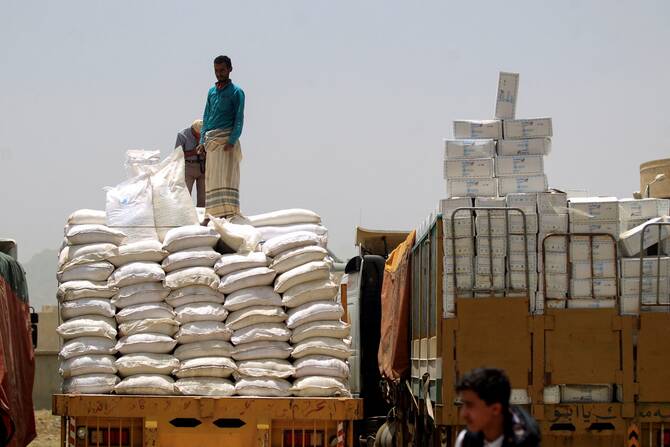
Aid mechanisms deployed to fill UN void in Yemen’s Houthi-controlled areas

Yemenis inspect food and medicine expired aid packages from the World Food Organisation in the Huthi-rebel-held Yemeni capital Sanaa on June 23, 2019. (File/AFP)
Short Url
Updated 16 February 2026
Follow

Aid mechanisms deployed to fill UN void in Yemen’s Houthi-controlled areas

  • Upcoming donor conference in Jordan seen as pivotal opportunity to re-mobilize international support

ADEN: Humanitarian operations in Yemen are entering a new and more complex phase after the UN was forced to rely on alternative aid-delivery mechanisms in Houthi-controlled areas, following the closure of its offices and the seizure of its assets.

The move has reshaped relief efforts in one of the world’s worst humanitarian crises.

The shift comes as Amman prepares to host an international donor conference aimed at curbing the rapid deterioration in food security, amid warnings that hunger could spread to millions more people this year.

Recent humanitarian estimates show that about 22.3 million Yemenis — nearly half the population — will require some form of assistance in 2026, an increase of 2.8 million from last year. The rise reflects deepening economic decline and persistent restrictions on humanitarian work in conflict zones.

Aid sources say the UN is reorganizing its operations by transferring responsibility for distributing life-saving assistance to a network of partners, including international and local non-governmental organizations and the International Committee of the Red Cross, which continues to operate in those areas.

The transition aims to ensure continued access to food and medicine for the most vulnerable despite the absence of a direct UN presence, which has been undermined by restrictions imposed by the Houthis.

International agencies are increasingly adopting a “remote management” model to reduce risks to staff and maintain aid flows.

Relief experts caution, however, that this approach brings serious challenges, including limited field oversight and difficulties ensuring aid reaches beneficiaries without interference.

Humanitarian reports warn that operational constraints have already deprived millions of Yemenis of essential assistance at a time of unprecedented food insecurity.

More than 18 million people are suffering from acute hunger, with millions classified at emergency levels under international food security standards.

The upcoming donor conference in Jordan is seen as a pivotal opportunity to re-mobilize international support and address a widening funding gap that threatens to scale back critical humanitarian programs.

Discussions are expected to focus on new ways to deliver aid under security and administrative constraints and on strengthening the role of local partners with greater access to affected communities.

Yemen’s crisis extends beyond food.

The health sector is under severe strain, with about 40 percent of health facilities closed or at risk of closure due to funding shortages.

Women and girls are particularly affected as reproductive health services decline, increasing pregnancy and childbirth-related risks.

The World Health Organization has warned that deteriorating conditions have fueled outbreaks of preventable diseases amid falling immunization rates, with fewer than two-thirds of children receiving basic vaccines.

More than 18,600 measles cases and 188 deaths were recorded last year, while Yemen reported the world’s third-highest number of suspected cholera cases between March 2024 and November 2025.


Family of Palestinian-American shot dead by Israeli settler demand accountability

Updated 21 February 2026
Follow

Family of Palestinian-American shot dead by Israeli settler demand accountability

  • Relatives say Abu Siyam was among about 30 residents from the village of Mukhmas who confronted armed settlers attempting to steal goats from the community

LONDON: The family of a 19-year-old Palestinian-American man reportedly shot dead by an Israeli settler in the occupied West Bank have demanded accountability, amid mounting scrutiny over a surge in settler violence and a lack of prosecutions.

Nasrallah Abu Siyam, a US citizen born in Philadelphia, was killed near the city of Ramallah on Wednesday, becoming at least the sixth American citizen to die in incidents involving Israeli settlers or soldiers in the territory in the past two years.

Relatives say Abu Siyam was among about 30 residents from the village of Mukhmas who confronted armed settlers attempting to steal goats from the community. Witnesses said that stones were thrown by both sides before settlers opened fire, wounding at least three villagers.

Abu Siyam was struck and later died of his injuries.

Abdulhamid Siyam, the victim’s cousin, said the killing reflected a wider pattern of impunity.

“A young man of 19 shot and killed in cold blood, and no responsibility,” he told the BBC. “Impunity completely.”

The US State Department said that it was aware of the death of a US citizen and was “carefully monitoring the situation,” while the Trump administration said that it stood ready to provide consular assistance.

The Israeli embassy in Washington said the incident was under review and that an operational inquiry “must be completed as soon as possible.”

A spokesperson for the Israeli Defense Forces said troops were deployed to the scene and used “riot dispersal means to restore order,” adding that no IDF gunfire was reported.

The military confirmed that the incident remained under review and said that a continued presence would be maintained in the area to prevent further unrest.

Palestinians and human rights organizations say such reviews rarely lead to criminal accountability, arguing that Israeli authorities routinely fail to prosecute settlers accused of violence.

A US embassy spokesperson later said that Washington “condemns this violence,” as international concern continues to grow over conditions in the occupied West Bank.

Palestinians and human rights groups say Israeli authorities routinely fail to investigate or prosecute settlers accused of violence against civilians.

Those concerns were echoed this week by the UN, which warned that Israel’s actions in the occupied West Bank may amount to ethnic cleansing.

A UN human rights office report on Thursday said that Israeli settlement expansion, settler attacks and military operations have increasingly displaced Palestinian communities, with dozens of villages reportedly emptied since the start of the Gaza war.

The report also criticized Israeli military tactics in the northern West Bank, saying that they resembled warfare and led to mass displacement, while noting abuses by Palestinian security forces, including the use of unnecessary lethal force and the intimidation of critics.

Neither Israel’s foreign ministry nor the Palestinian Authority has commented on the findings.