

UAE’s DP World revenues climb to $10.8bn in 2021 despite supply chain woes

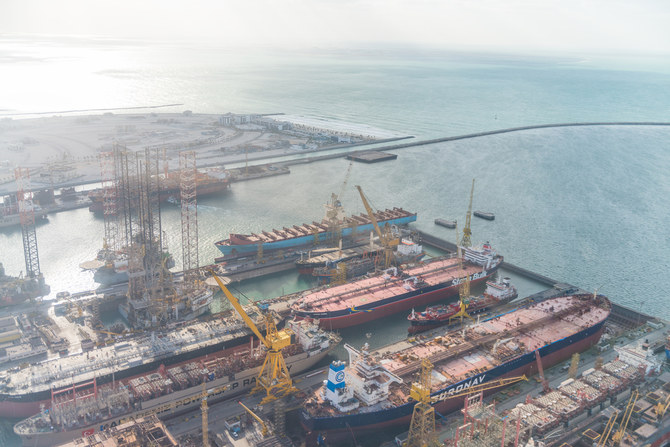
City port aerial view. Jebel Ali is the world's ninth busiest port in Middle-East. Image: Shutterstock
Short Url
Updated 10 March 2022
Follow

UAE’s DP World revenues climb to $10.8bn in 2021 despite supply chain woes

RIYADH: Global port operator DP World saw its revenue soar 26 percent to $10.8 billion on an annual basis, fueled by strong operational performance in 2021.

The revenue hike was “supported by acquisitions and new concessions including Angola, Unico, and Transworld,” the UAE port operator said in a statement.

Earnings before interest, taxes, depreciation and amortization grew 15.3 percent on the year, reaching as high as $3.83 billion.

DP World’s terminals remained operational with high productivity, despite global supply chain disruptions.

It said it also boomed on the back of partnerships that exposed it to “high growth markets and long-term relationship with cargo owners.”


“We expect our portfolio to continue to deliver growth,” commented CEO, Sultan Ahmed Bin Sulayem.

“We remain mindful that the geopolitical uncertainty, Covid-19 pandemic, continued supply chain disruptions, and rising inflation could hinder the global economic recovery,” he added.


What changed in Saudi stocks on the first day of foreign entry 

Updated 13 sec ago
Follow

What changed in Saudi stocks on the first day of foreign entry 

RIYADH: Saudi Arabia’s stock market saw foreign non-strategic investors reduce their ownership in nearly half of the companies listed on the main Tadawul All Share Index, or TASI, on the first day of implementing the decision to open the market to all categories of foreign investors, according to Tadawul data reflecting ownership positions as of Feb. 1  

According to the Financial Analysis Unit at Al-Eqtisadiah, foreign ownership declined in 120 companies, increased in 97 others, and remained unchanged in the rest, with no variation in the number of shares held by foreign investors. 

Foreign investors favor growth stocks 

Looking at the changes purely through valuation multiples — without factoring in operational or sectoral considerations — foreign investors appear to be reallocating ownership toward growth stocks at the expense of value stocks, with higher multiples used as an approximate indicator of growth. 

Ownership declines were concentrated in companies with lower valuation multiples, where the median price-to-earnings ratio stood at about 17.1 times and the median price-to-book ratio was around 2 times. 

Conversely, ownership rose in companies with higher multiples, with a median price-to-earnings ratio of 23.3 times and a median price-to-book ratio of 2.6 times. 

Mid- and small-cap firms see biggest changes 

Raoom, Entaj, and Obeikan Glass saw the largest declines in foreign ownership, dropping between 10 percent and 16 percent. In contrast, Tamkeen, SACO, and Abo Moati led gains, with foreign stakes rising 10 to 20 percent. 

In terms of overall foreign ownership, Al-Babtain, Rasan, and Etihad Etisalat topped the list at roughly 34 percent, 29 percent, and 24 percent, respectively.

Gradual foreign inflow and delayed impact 

The initial changes remain insufficient to reflect a major impact of the full foreign access decision, especially as the first day coincided with the weekend. Additionally, entry is expected to be gradual until financial institutions are fully ready to open accounts, particularly for individuals. 

Mohammed Al-Shammasi, CEO of Derayah Financial, has told Asharq that the firm received around 500 individual investor applications on the first day of full foreign access. 

Meanwhile, foreign institutions managing under $500 million can now invest directly in the market with easier access, joining more than 4,000 qualified foreign investors who already hold assets worth SR377 billion ($100.5 billion)