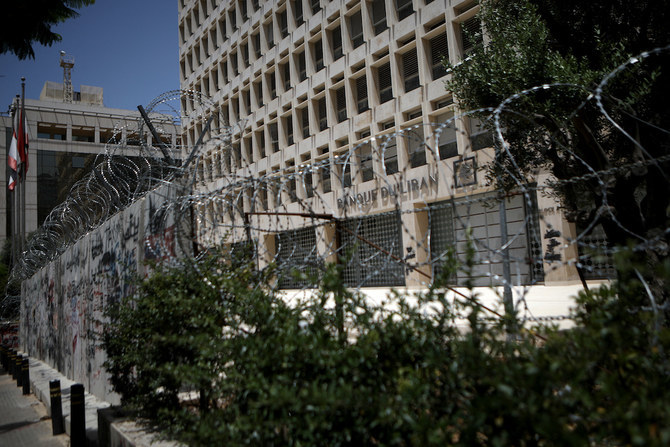
BEIRUT: Lebanon’s central bank has asked commercial banks to provide the names of political figures who failed to comply with a circular ordering them to repatriate funds sent abroad in the lead-up to the country’s 2019 financial meltdown.
Lebanon’s financial crisis, which the World Bank has labelled one of the deepest depressions of modern history, has been compounded by political deadlock and a row over the probe into the 2020 Beirut port blast that killed more than 200 people.
The central bank, known as the Banque du Liban (BDL), said banks must provide its Special Investigation Commission with the names by the end of March, adding that “cash deposits made between July 2017 and end-December 2020 are concerned as well, if the beneficiary is” a politically exposed person.
Last week, a US Treasury delegation urged Lebanon to investigate what it described as “abuses” within the banking system by members of the political and economic elite.
Allegations of financial misconduct have been widespread following the financial collapse, when banks imposed tight controls on hard currency accounts for most savers but critics say some people with influence were able to access funds more freely.
Banks have denied claims of favoritism toward certain clients, and say they have consistently called on the government to introduce a capital control law to regulate the sector — something the government has failed to do.
Central Bank Governor Riad Salameh faces corruption probes in a number of European countries and in Lebanon, where officials are investigating alleged money laundering and embezzlement of central bank funds. He has denied wrongdoing.

Lebanon central bank seeks names of those who failed to repatriate funds amid crisis
Short Url
https://arab.news/m2m7a
Lebanon central bank seeks names of those who failed to repatriate funds amid crisis
- The central bank said banks must provide its Special Investigation Commission with the names by the end of March
- A US Treasury delegation urged Lebanon to investigate what it described as "abuses" within the banking system by political and economic elite
Turkiye’s Kurdish party says Syria deal leaves Ankara ‘no excuses’ on peace process
ANKARA: Turkiye’s pro-Kurdish DEM Party said on Monday that the Turkish government had no more “excuses” to delay a peace process with the Kurdistan Workers Party (PKK) now that a landmark integration deal was achieved in neighboring Syria.
On Sunday in Syria, the Kurdish-led Syrian Democratic Forces (SDF) agreed to come under the control of authorities in Damascus — a move that Ankara had long sought as integral to its own peace effort with the PKK. “For more than a year, the government has presented the SDF’s integration with Damascus as the biggest obstacle to the process,” Tuncer Bakirhan, co-leader of the DEM Party, told Reuters, in some of the party’s first public comments on the deal in Syria.
“The government will no longer have any excuses left. Now it is the government’s turn to take concrete steps.” Bakirhan cautioned President Tayyip Erdogan’s government against concluding that the rolling back Kurdish territorial gains in Syria negated the need for a peace process in Turkiye. “If the government calculates that ‘we have weakened the Kurds in Syria, so there is no longer a need for a process in Turkiye,’ it would be making a historic mistake,” he said in the interview.
Turkish officials said earlier on Monday that the Syrian integration deal, if implemented, could
advance the more than year-long process with the PKK, which is based in northern Iraq. Erdogan urged
swift integration of Kurdish fighters into Syria’s armed forces. Turkiye, the strongest foreign backer of Damascus, has since 2016 repeatedly sent forces into northern Syria to curb the gains of the SDF — which after the 2011–2024 civil war had controlled more than a quarter of Syria while fighting Islamic State with strong US backing.
The United States has built close ties with Damascus over the last year and was closely involved in mediation between it and the SDF toward the deal.
Bakirhan said progress required recognition of Kurdish rights on both sides of the border.
“What needs to be done is clear: Kurdish rights must be recognized in both Turkiye and Syria, democratic regimes must be established, and freedoms must be guaranteed,” he said.
On Sunday in Syria, the Kurdish-led Syrian Democratic Forces (SDF) agreed to come under the control of authorities in Damascus — a move that Ankara had long sought as integral to its own peace effort with the PKK. “For more than a year, the government has presented the SDF’s integration with Damascus as the biggest obstacle to the process,” Tuncer Bakirhan, co-leader of the DEM Party, told Reuters, in some of the party’s first public comments on the deal in Syria.
“The government will no longer have any excuses left. Now it is the government’s turn to take concrete steps.” Bakirhan cautioned President Tayyip Erdogan’s government against concluding that the rolling back Kurdish territorial gains in Syria negated the need for a peace process in Turkiye. “If the government calculates that ‘we have weakened the Kurds in Syria, so there is no longer a need for a process in Turkiye,’ it would be making a historic mistake,” he said in the interview.
Turkish officials said earlier on Monday that the Syrian integration deal, if implemented, could
advance the more than year-long process with the PKK, which is based in northern Iraq. Erdogan urged
swift integration of Kurdish fighters into Syria’s armed forces. Turkiye, the strongest foreign backer of Damascus, has since 2016 repeatedly sent forces into northern Syria to curb the gains of the SDF — which after the 2011–2024 civil war had controlled more than a quarter of Syria while fighting Islamic State with strong US backing.
The United States has built close ties with Damascus over the last year and was closely involved in mediation between it and the SDF toward the deal.
Bakirhan said progress required recognition of Kurdish rights on both sides of the border.
“What needs to be done is clear: Kurdish rights must be recognized in both Turkiye and Syria, democratic regimes must be established, and freedoms must be guaranteed,” he said.
© 2026 SAUDI RESEARCH & PUBLISHING COMPANY, All Rights Reserved And subject to Terms of Use Agreement.