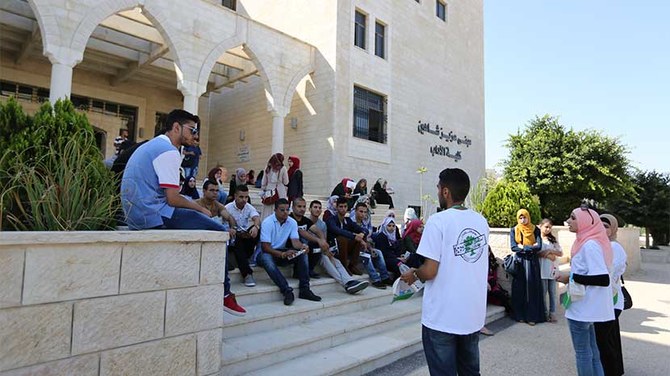

RAMALLAH: Palestinian academics are reporting their deep concerns on new Israeli restrictions for foreign workers and students that are hampering teaching at universities.
Israeli authorities have limited the number of foreign lecturers and students who can reside in the West Bank and teach in its universities, Palestinian academic sources told Arab News.
Israeli sources said on March 8 that Israel would follow a strict approach for hiring overseas lecturers to teach in Palestinian universities in the West Bank and accepting foreign students.
Israel will reportedly only permit Palestinian universities to hire lecturers from abroad if they teach in specific fields and there is a shortage of domestic academic staff.
Lecturers hoping to teach in the West Bank must also have their doctorates verified by Israeli consulates in the applicant’s country of origin, with the authorities deciding how many lecturers will receive entry visas.
Israel will also not allow anymore than 150 international students in Palestinian universities and they will all be required to pass an interview with the Israeli representative office in their home country.
Eight universities in the West Bank and East Jerusalem teach various academic and vocational subjects. All award bachelor’s and master’s degrees, while a few award Ph.Ds.
There are some 120,000 students in Palestinian universities in the West Bank, with 20,000 graduating annually.
“This means more policy of stressing and restricting the possibility of bringing visiting professors who may be Palestinians but do not bear a residency in Palestine. Instead of giving them work visas for a year, they give them tourist visas for a period ranging between one week and three months as a maximum, and they often refuse to renew it,” Ghassan Khatib, vice president of Birzeit University, told Arab News.
“There is no visiting professor who accepts to leave his job and teach at a Palestinian university without a guarantee of residency, at least for a semester of five months,” Khatib added.
Representatives from Palestinian universities said that they are handicapped because of these restrictions that limit the opportunity for academic exchange around the world.
Khatib said Palestinian universities lack teaching competencies because of the brain drain. When a new university major is established, it struggles to find local talents to teach, so it is forced to seek the assistance of international lecturers.
He cited the example of the former president of Birzeit University, Khalil Al-Hindi, who headed the university for five years, but had to travel outside to renew his visa once every three months.
The new Israeli restrictions were issued late last month and will go into effect in May.
The new rules state that the documents of applicant students and lecturers must include an official invitation from the Palestinian Authority.
Primary visas will be valid for only one year, subject to extension. The maximum teaching period allowed for lecturers is five non-consecutive years. The maximum period for a student is four years until graduation.
The new Israeli procedures only apply to citizens of countries with diplomatic relations with Israel, except for Jordan, Egypt and the UAE. However, they also have diplomatic ties with Israel and their citizens can apply for a much shorter visit.
Birzeit University hosts between 10 to 15 visiting professors, and all of them face the problem of visa renewals, which forces some of them to leave the university.
“We need to get more teachers, but we can’t. When Birzeit University obtained a license to specialize in nursing seven years ago, the start of the specialization was delayed for several months due to the university’s inability to recruit teaching staff,” said Khatib.
Like Israeli universities, Palestinian universities must have the right to bring in what they lack in qualified international academic staff, Khatib said.
Suhad Bishara, a legal director from the office that represents Birzeit University on this issue with the Israeli authorities, told Arab News: “The Israeli restrictions limit the opportunities of Palestinian universities to benefit from various international academic experiences. These restrictions constitute a conflict with international law and must be lifted permanently, and allow Palestinian universities to bring in as many professors and specialists as they wish to teach in those universities.”
Birzeit University launched an international campaign to pressure the Israeli authorities to lift its restrictions after suffering heavily from them during the 2018-2019 academic year.
Some Palestinian academics told Arab News that the new procedures violate the rights of Palestinians and their institutions to work according to their choice and their needs to develop economic, commercial and academic relations with other countries.