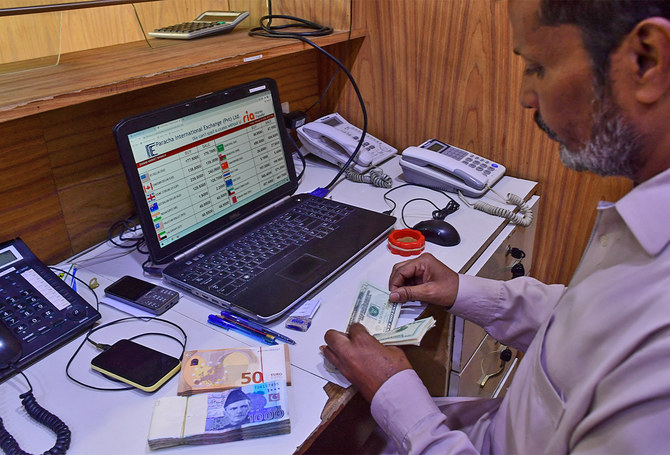
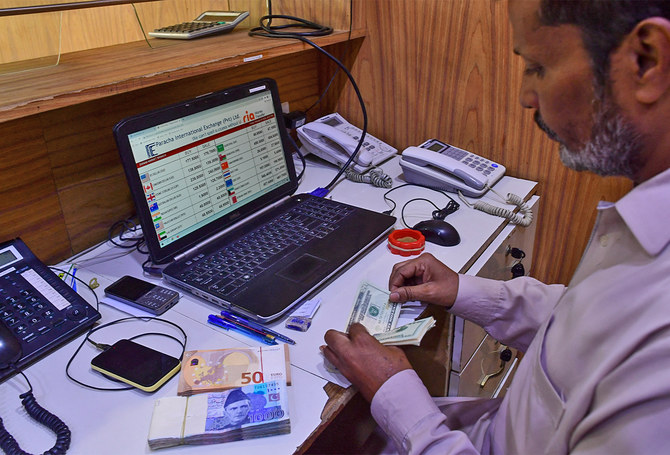
KARACHI: Pakistan’s national currency on Wednesday plunged to another record low against the US dollar to close at Rs178.63 amid mounting pressure due to spikes in commodities prices following the Russian invasion of Ukraine last month, currency traders and analysts said.
While the Pak rupee remained relatively stable as compared to a day before, it depreciated by 0.01 percent in the inter-bank market to close at the lowest historic level against Tuesday’s Rs178.61, the central bank data showed.
“The rupee is under pressure due to increasing commodity prices, particularly of oil which is trading at much higher rates since the Russian invasion of Ukraine,” Samiullah Tariq, director research at Pakistan Kuwait Investment Company, told Arab News.
“The prices of other commodities in the global market have also gone high and the outlook remains uncertain,” he added.
The Brent Crude price has increased by about 17 percent in the first few days of the month and it closed at $132.70 per barrel on March 8.
Pakistani currency dealers said the uncertain outlook would continue to keep the national currency under pressure for the foreseeable future.
“The economic and political dynamics are changing after the war in Ukraine since the demand for the greenback has surged,” Zafar Parachi, general secretary of the Exchange Companies Association of Pakistan (ECAP), told Arab News.
“The global situation will continue to exert pressure on the Pak rupee,” he added. “The national currency will also be affected by Pakistan’s import bill and trade deficit in the coming days.”
Pakistani analysts said the demand for dollar was also increasing since investors were looking for safe havens amid the changing global situation.

Pakistan’s national currency hits all-time low amid spikes in global commodity prices
https://arab.news/byqq6
Pakistan’s national currency hits all-time low amid spikes in global commodity prices
- Analysts attribute volatile commodity rates to the Russian invasion of Ukraine, say the war is also mounting pressure on Pak rupee
- Experts believe Pakistan’s import bill and trade deficit will continue to impact the value of Pak rupee in the coming days
Pakistan launches final nationwide polio drive for 2025 amid rise in global cases
- Global polio tracking data shows Pakistan accounted for 30 of the world’s 39 cases in 2025, with remainder in Afghanistan
- Health authorities urge parents to cooperate with vaccination teams and ensure all children under five receive polio drops
ISLAMABAD: Pakistan will launch its final nationwide polio vaccination campaign for 2025 from tomorrow, aiming to immunize more than 45 million children under the age of five, health authorities said on Sunday, as the country remains at the center of global efforts to eradicate the disease.
Global polio tracking data shows that 30 of the 39 confirmed wild poliovirus type 1 (WPV1) cases worldwide 2025 were reported in Pakistan, with the remainder in neighboring Afghanistan.
Pakistan recorded 74 polio cases in 2024, a sharp increase from six cases in 2023 and just one case in 2021, highlighting the volatility of eradication efforts in a country where misinformation, vaccine hesitancy and security issues have repeatedly disrupted progress.
“The final national polio campaign of 2025 will formally begin across the country from tomorrow,” Pakistan’s National Emergency Operations Center (NEOC) said in a statement.
“During the campaign, polio drops will be administered to more than 45 million children nationwide,” it said, adding that the seven-day drive would run from Dec. 15 to Dec. 21.
The NEOC said more than 400,000 male and female polio workers would take part in the campaign, with vaccination targets including over 23 million children in Punjab, 10.6 million in Sindh, 7.2 million in Khyber Pakhtunkhwa, 2.6 million in Balochistan and smaller numbers in Islamabad, Gilgit-Baltistan and Azad Jammu and Kashmir.
“Protecting children from polio is a shared national responsibility,” the NEOC said. “Parents must fully cooperate with polio workers to secure the future of the nation.”
It urged families to ensure that all children under five years of age receive the required two drops of the vaccine during the campaign.
Pakistan has drastically reduced polio prevalence since the 1990s, when annual cases exceeded 20,000.
By 2018, the number had fallen to eight. But health authorities warn that without consistent access to children — particularly in high-risk and underserved regions — eradication will remain out of reach.
Violence has also hampered the program. Polio teams and their security escorts have frequently come under attack from militants in parts of northwestern Khyber Pakhtunkhwa and southwestern Balochistan.
Officials say continued security threats, along with natural disasters such as recent flooding, remain major obstacles to reaching every child.