Malaysia to re-open for tourists after two-year COVID-19 closure

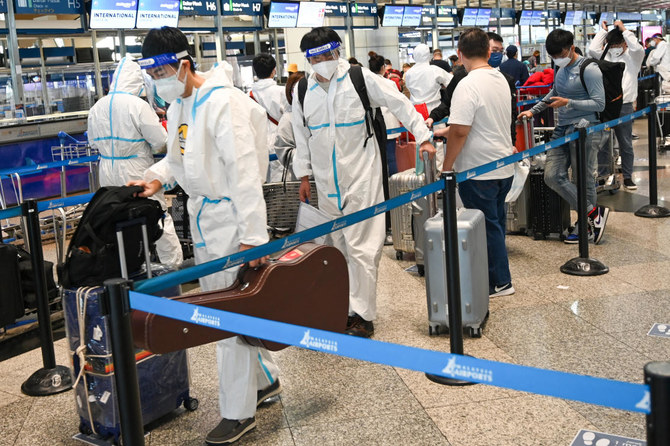
The re-opening comes despite Malaysia reporting more than 25,000 infections a day in recent weeks, though most cases have been mild. (File/AFP)
Short Url
Updated 08 March 2022
Follow

Malaysia to re-open for tourists after two-year COVID-19 closure

KUALA LUMPUR: Malaysia will re-open to all vaccinated tourists from April 1, authorities said Tuesday, joining a growing number of countries removing restrictions in an attempt to live with COVID-19.
The tourism-reliant Southeast Asian country, known for its white-sand beaches and lush rainforests, shut its borders in March 2020 but will now require only a negative coronavirus test to enter.
“The government has decided to open its borders on April 1, 2022,” Prime Minister Ismail Sabri said in media briefing.
“We believe this decision will boost our economy and help revive our ailing tourism sector.”
The re-opening comes despite Malaysia reporting more than 25,000 infections a day in recent weeks, though most cases have been mild.
Its decision mirrors those of neighboring nations including Singapore, Thailand and the Philippines that are progressively easing entry rules to lure back tourists.
Malaysia’s economy contracted 5.6 percent in 2020 as Covid hit but rebounded slightly to grow 3.1 percent last year.
Malaysia-based AirAsia, one of Southeast Asia’s top budget airlines, called the move “timely” and said it “will provide a strong impetus” for recovery in tourism and aviation.
Group chief executive Bo Lingam told AFP the carrier hoped to move around a million passengers in the first week.
Vaccinated travelers will not be subject to quarantine but will need to produce a negative PCR test two days before arrival and take an antigen test in the 24 hours after entry.
Previously only travelers from Singapore were allowed quarantine-free entry.
Malaysia has recorded more than 3.6 million Covid cases to date with more than 33,000 deaths.
About 80 percent of the country’s 32 million population have been fully vaccinated.


Russia-ally Touadera seeks third term in Central African Republic

Updated 1 sec ago
Follow

Russia-ally Touadera seeks third term in Central African Republic

BANGUI: Central African Republic President Faustin-Archange Touadera is seeking a third term in an election on Sunday, campaigning on security gains after signing deals with rebel groups and enlisting support from Russian mercenaries and Rwandan ​forces.
He faces six opposition candidates including Anicet-Georges Dologuele, a former prime minister and runner-up in the 2020 election, but is likely to win in part due to his control over state institutions, analysts say.
Such a result would likely further the interests of Russia, which has traded security assistance for access to resources including gold and diamonds. Touadera is also offering access to the country’s lithium and uranium reserves to anyone interested.
The 68-year-old mathematician took power in 2016 after the worst crisis in the chronically unstable country’s history, when three years of intercommunal strife forced a fifth of the population to flee their homes, either internally or abroad.
Touadera has signed peace deals this year with several rebel groups, while ‌others have been ‌weakened in the face of Russian mercenaries and troops from Rwanda deployed to ‌shore ⁠up Touadera’s ​government as ‌well as UN peacekeepers.
“During the 10 years that we have been working together, you yourselves have seen that peace is beginning to return, starting from all our borders and reaching the capital,” Touadera told a rally at a stadium in the capital Bangui this month.
His opponents, meanwhile, have denounced a constitutional referendum in 2023 that scrapped the presidential term limit, saying it was proof Touadera wants to be president for life.
They have also accused him of failing to make significant progress toward lifting the 5.5 million population out of poverty.
“The administrative infrastructure has been destroyed and, as you know, the roads are in a ⁠very poor state of repair,” Dologuele told a recent press conference.
“In short, the Central African economy is in ruins.”
SECURITY THREATS REMAIN DESPITE PEACE DEALS
The presidential ‌contest is taking place alongside legislative, regional and municipal elections, with provisional results ‍expected to be announced by January 5.
If no ‍candidate gets more than 50 percent of the vote, a presidential runoff will take place on February 15, while legislative ‍runoffs will take place on April 5.
A smooth voting process could reinforce Touadera’s claim that stability is returning, which was buttressed last year with the UN Security Council’s lifting of an arms embargo and the lifting of a separate embargo on diamond exports.
“The fact that these measures were lifted, it shows that we’re gradually getting back to normal. Or at least that’s the narrative,” said Romain ​Esmenjaud, associate researcher at the Institut Francais de Geopolitique.
The peace deals are credited with a decline in violence in some areas and an expected boost in economic growth projections to 3 percent this ⁠year, according to the International Monetary Fund. US President Donald Trump’s administration has said the UN should hand security back to the government soon.
But serious security threats remain. Rebels have not fully disarmed, reintegration is incomplete, and incursions by combatants from neighboring Sudan fuel insecurity in the east.
Pangea-Risk, a consultancy, wrote in a note to clients that the risk of unrest after the election was high as opponents were likely to challenge Touadera’s expected victory.
“The election will take place in an atmosphere marked by heightened grievances over political marginalization, increasing repression, and allegations of electoral fraud,” said chief executive Robert Besseling.
Dologuele alleged fraud after he was recorded as winning 21.6 percent of the vote in 2020, when rebel groups still threatened the capital and prevented voting at 800 polling stations across the country, or 14 percent of the total. A court upheld Touadera’s win.
Paul-Crescent Beninga, a political analyst, said voters will be closely scrutinizing the voting and counting processes.
“If they do not go well, it gives those ‌who promote violence an excuse to mobilize violence and sow panic among the population of the Central African Republic. So that is why we must ensure that the elections take place in relatively acceptable conditions,” he said.