

Russia urged to repeal ‘draconian’ law blocking independent media outlets

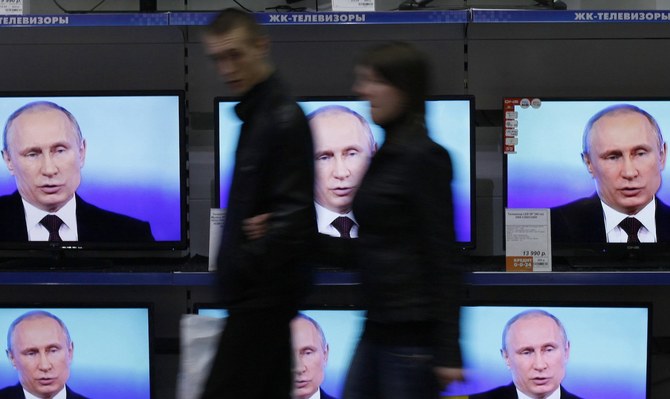
Russia has imposed almost total media censorship in the country and launched an unprecedented crackdown on news outlets. (File/Reuters))
Short Url
Updated 07 March 2022
Follow

Russia urged to repeal ‘draconian’ law blocking independent media outlets

  • Russian authorities on Sunday blocked additional independent news outlets as the Kremlin took action to control coverage of its war in Ukraine

LONDON: Media watchdog Reporters Without Borders (RSF) has urged Russian authorities to repeal a “draconian” law introduced on Saturday making the publication of “false” or “mendacious” information about the Russian armed forces punishable by up to 15 years in prison.

Following the move, Russian authorities on Sunday blocked additional independent news outlets as the Kremlin took action to control coverage of its war in Ukraine.

The clampdown targeted a number of digital media outlets, including Mediazona, Republic, Snob.ru, and Agentstvo.

Mediazona said it had been blocked, “because we cover honestly what is happening in Ukraine and call the invasion an invasion, and the war a war.”

Jeanne Cavelier, head of RSF’s Eastern Europe and Central Asia desk, said: “We are looking on helplessly as Russia’s independent media are being silenced to death.

“With this new amendment, putting journalists in Russia at risk of significant criminal penalties, (Russian President) Vladimir Putin has delivered the final blow and completed the destruction of Russia’s independent media, which had already been considerably weakened by the foreign agents’ law enacted at the end of 2017. We call on the Russian authorities to repeal this draconian law at once.”

In recent days, Russia has imposed almost total media censorship in the country and launched an unprecedented crackdown on news outlets, journalists, and social media platforms.

Last week, independent broadcasters Echo of Moscow, and Dozhd TV were taken off air and access to their websites was blocked as a result of the investigation. Meanwhile, access to Facebook, Twitter, and other social media platforms have been restricted across the country.

BBC News and Deutsche Welle also suspended their operations in Russia after the country’s parliament approved the law. Similarly, Netflix, and TikTok have suspended most of their services in Russia.

Meanwhile, other news outlets protested the decision by ceasing broadcasting or shutting down, with one news outlet replacing broadcasting with music and the repeated message: “We cannot speak, we don’t want to lie.”

Russia’s state media regulator Roskomnadzor has blocked at least 30 independent news outlets since Russia launched its invasion of Ukraine.


China’s national security agency in Hong Kong summons international media representatives

Updated 06 December 2025
Follow

China’s national security agency in Hong Kong summons international media representatives

HONG KONG: China’s national security agency in Hong Kong summoned international media representatives for a “regulatory talk” on Saturday, saying some had spread false information and smeared the government in recent reports on a deadly fire and upcoming legislative elections.
Senior journalists from several major outlets operating in the city, including AFP, were summoned to the meeting by the Office for Safeguarding National Security (OSNS), which was opened in 2020 following Beijing’s imposition of a wide-ranging national security law on the city.
Through the OSNS, Beijing’s security agents operate openly in Hong Kong, with powers to investigate and prosecute national security crimes.
“Recently, some foreign media reports on Hong Kong have disregarded facts, spread false information, distorted and smeared the government’s disaster relief and aftermath work, attacked and interfered with the Legislative Council election, (and) provoked social division and confrontation,” an OSNS statement posted online shortly after the meeting said.
At the meeting, an official who did not give his name read out a similar statement to media representatives.
He did not give specific examples of coverage that the OSNS had taken issue with, and did not take questions.
The online OSNS statement urged journalists to “not cross the legal red line.”
“The Office will not tolerate the actions of all anti-China and trouble-making elements in Hong Kong, and ‘don’t say we didn’t warn you’,” it read.
For the past week and a half, news coverage in Hong Kong has been dominated by a deadly blaze on a residential estate which killed at least 159 people.
Authorities have warned against crimes that “exploit the tragedy” and have reportedly arrested at least three people for sedition in the fire’s aftermath.
Dissent in Hong Kong has been all but quashed since Beijing brought in the national security law, after huge and sometimes violent protests in 2019.
Hong Kong’s electoral system was revamped in 2021 to ensure that only “patriots” could hold office, and the upcoming poll on Sunday will select a second batch of lawmakers under those rules.