

Israeli forensic teams describe signs of torture, abuse in bodies of Hamas massacre victims
Israeli forensic teams describe signs of torture, abuse in bodies of Hamas massacre victims/node/2391496/middle-east
Israeli forensic teams describe signs of torture, abuse in bodies of Hamas massacre victims
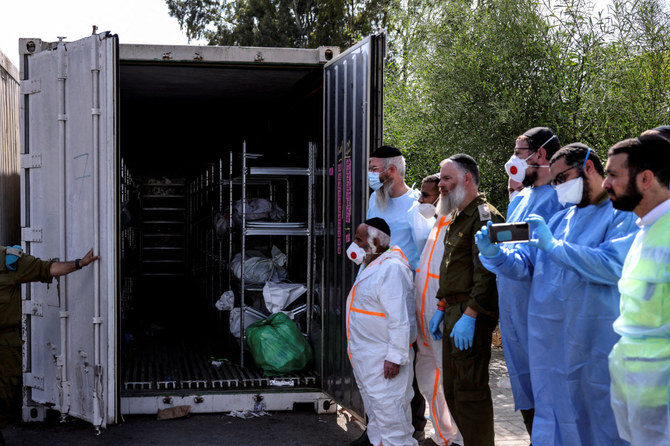
Israeli workers and military officers stand by a container with bodies of dead people in Ramla on October 13, 2023. The victims were some of hundreds killed in last week's storming of Israel by Hamas gunmen from the Gaza Strip. (REUTERS)
Israeli forensic teams describe signs of torture, abuse in bodies of Hamas massacre victims
Around 1,300 bodies have been brought to an army base in Ramla in central Israel for identification by forensic teams
Multiple cases of rape were found by forensic examination of the bodies, says one female officer
Updated 15 October 2023
Reuters
RAMLA, Israel: Military forensic teams in Israel have examined bodies of victims of last week’s Hamas attack on communities around the Gaza Strip and found multiple signs of torture, rape and other atrocities, officers said on Saturday.
Around 1,300 bodies have been brought to an army base in Ramla in central Israel where forensic checks to determine the identity of the dead and the circumstances of their death are carried out by specialist teams.
Around 90 percent of the military dead have been identified and teams are half way through identifying civilians, said Rabbi Israel Weiss, former army chief rabbi, one of the officials overseeing the identification of the dead. He said many bodies showed signs of torture as well as rape.
“We’ve seen dismembered bodies with their arms and feet chopped off, people that were beheaded, a child that was beheaded,” a reserve warrant officer identified only by her first name of Avigayil told reporters.
She said multiple cases of rape were found by forensic examination of the bodies, which have been stored in refrigerated containers.
“We do the identification with all the means that we have,” said a military dentist, identified as Captain Maayan. “We see them in severe stages of abuse. We see gunshots and we see signs that are purely torture.”
The military personnel overseeing the identification process didn’t present any forensic evidence in the form of pictures or medical records.
Hamas, the Islamist movement that controls the Gaza Strip, has denied accusations of abuse.
Hundreds of Hamas gunmen, some on motorcycles, broke through barriers around Gaza in the early hours of Oct. 7 and tore through nearby communities, attacking a large outdoor dance party as well homes and military bases and abducting more than 120 Israelis and foreigners.
The brutal assault caused profound shock in Israel due to both the unprecedented number of dead from a single day as well as the horrifying footage that has emerged from the towns and kibbutzes that were overrun.
In response, Israeli jets and artillery have bombarded the Gaza Strip for days, killing more than 2,200 Palestinians and destroying thousands of buildings ahead of an expected ground invasion.
Israeli Prime Minister Benjamin Netanyahu has compared Hamas to Daesh which gained worldwide notoriety for its campaign of public beheadings in countries like Syria and Iraq.
US president says Iranians should 'keep protesting' and that he canceled all meetings with Iranian officials
Successive nights of mass protests nationwide may have killed thousands, NGO says
Updated 4 sec ago
AFP
PARIS: US President Donald Trump urged Iranians on Tuesday to keep protesting against the country’s theocratic leadership, telling them “help is on its way” as international outrage grows over a crackdown one rights group said has likely killed thousands. Iranian authorities insisted they had regained control after successive nights of mass protests nationwide since Thursday that have posed one of the biggest challenges to the clerical leadership since the 1979 Islamic revolution that ousted the shah. Rights groups accuse the government of fatally shooting protesters and masking the scale of the crackdown with an Internet blackout that has now lasted almost five days. New videos on social media, whose location AFP verified, showed bodies lined up in the Kahrizak morgue just south of the Iranian capital, with the corpses wrapped in black bags and distraught relatives searching for loved ones. International phone links were restored on Tuesday, but only for outgoing calls, according to an AFP journalist, and the quality remains spotty, with frequent interruptions. Trump, who has repeatedly threatened Iran with military intervention, said Iranians should continue their nationwide protests, take over institutions and record the names of “killers and abusers.” “Iranian Patriots, KEEP PROTESTING,” Trump wrote on his Truth Social platform. “I have canceled all meetings with Iranian Officials until the senseless killing of protesters STOPS. HELP IS ON ITS WAY.” It was not immediately clear what meetings he was referring to or what the nature of the help would be. European nations also signalled their anger, with France, Germany and the United Kingdom among the countries that summoned their Iranian ambassadors to protest what French Foreign Minister Jean-Noel Barrot called “state violence unquestioningly unleashed on peaceful protesters.” “The rising number of casualties in Iran is horrifying,” said EU chief Ursula von der Leyen, vowing further sanctions against those responsible.
- ‘In the thousands’ -
The Norway-based NGO Iran Human Rights (IHR) said it had confirmed 734 people killed during the protests, including nine minors, but warned the death toll was likely far higher. “The figures we publish are based on information received from fewer than half of the country’s provinces and fewer than 10 percent of Iran’s hospitals. The real number of those killed is likely in the thousands,” the director of Norway-based NGO Iran Human Rights (IHR) Mahmood Amiry-Moghaddam said. Fears have also grown that the Islamic republic could use the death penalty to crack down on the protests after Tehran prosecutors said Iranian authorities will press capital charges of “moharebeh,” or “waging war against God,” against some suspects arrested over recent demonstrations. “Concerns are mounting that authorities will once again resort to swift trials and arbitrary executions to crush and deter dissent,” Amnesty International said. IHR highlighted the case of Erfan Soltani, 26, who was arrested last week in the Tehran satellite city of Karaj and who, according to a family source, has already been sentenced to death and is due to be executed as early as Wednesday. Iranian state media has said dozens of members of the security forces have been killed, with their funerals turning into large pro-government rallies. Authorities have declared three days of national mourning for those killed. Amir, an Iraqi computer scientist, returned to Baghdad on Monday and described dramatic scenes in Tehran. “On Thursday night, my friends and I saw protesters in Tehran’s Sarsabz neighborhood amid a heavy military presence. The police were firing rubber bullets,” he told AFP in Iraq.
‘Last days’
The government on Monday sought to regain control of the streets with mass nationwide rallies that supreme leader Ayatollah Ali Khamenei hailed as proof that the protest movement was defeated, calling them a “warning” to the United States. In power since 1989 and now 86, Khamenei has faced significant challenges, most recently the 12-day war in June against Israel, which resulted in the killing of top security officials and forced him to go into hiding. “When a regime can only hold on to power through violence, then it is effectively finished,” said German Chancellor Friedrich Merz during a trip to India. “I believe that we are now witnessing the last days and weeks of this regime.” Analysts, however, have cautioned that it is premature to predict the immediate demise of the theocratic system, pointing to the repressive levers the leadership has, including the Revolutionary Guards Corps (IRGC), which are charged with safeguarding the Islamic revolution. “These protests arguably represent the most serious challenge to the Islamic republic in years, both in scale and in their increasingly explicit political demands,” Nicole Grajewski, professor at the Sciences Po Center for International Studies in Paris, told AFP. She said it was unclear if the protests would unseat the leadership, pointing to “the sheer depth and resilience of Iran’s repressive apparatus.”