Pakistan stocks plummet on surging global oil prices, PM’s speech criticizing EU

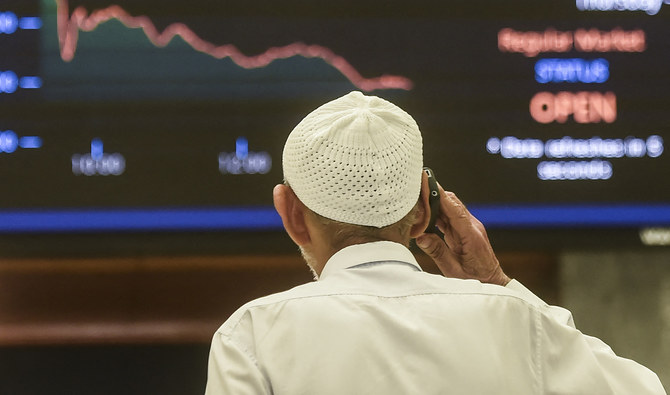
A stockbroker monitors the latest share prices during a trading session at the Pakistan Stock Exchange (PSX) in Karachi on February 24, 2022. (AFP/File)
Short Url
Updated 07 March 2022
Follow

Pakistan stocks plummet on surging global oil prices, PM’s speech criticizing EU

  • Brent Crude rises above $123 per barrel against backdrop of Russian invasion of Ukraine
  • PM Khan had criticized EU representatives for demanding Pakistan condemn Russian actions 

KARACHI: Pakistan’s equities witnessed a bearish trend on Monday as KSE 100 index declined by 2.9 percent due to global oil prices and Prime Minister Imran Khan’s speech wherein he criticized the European Union for asking his government to condemn Russian invasion of Ukraine, traders and analysts said. 
KSE 100 index closed the trading at 43,259.86 after shedding 1,291 points or 2.9 percent mainly due to panic selling after Brent Crude moved above $123.9 per barrel against the backdrop of the conflict in Ukraine. 
The Pakistani prime minister also responded to a letter written by European Union representatives in which they asked Islamabad to condemn Russia’s “unprovoked attack,” asking them if they had written a similar letter to India as well. 
“Pakistan’s equity market opened on a negative note mainly due to the oil prices and the speech of PM Khan,” Muhammad Sohail, chief executive officer of Topline Securities, told Arab News. 
Pakistani analysts urged the government not to take sides in the ongoing war in Eastern Europe and focus on its own economic interests. 
“We should be careful while making speeches or siding with any country,” Khurram Schehzad, chief executive officer of Alpha Beta Core, a financial advisory firm, told Arab News. “Economic interest should supersede everything else.” 
Brent Crude, which was trading above $130 per barrel in the morning session, had declined to $123.9 per barrel with gain of 4.86 percent in the international market by the evening. The crude is continuously increasing since the full-scale invasion of Ukraine by Russia on February 24, 2022. 
“Brent Crude on Monday morning was trading at about $135 per barrel which is the highest level since 2008,” Samiullah Tariq, director research at the Pakistan-Kuwait Investment Company, told Arab News. 
“Since the outbreak of the Russia-Ukraine war, commodity prices have come under pressure,” he added. “The commodities are trading at a higher level with upward pressure.” 


Pakistan approves first national gemstones policy, targets $1 billion exports

Updated 09 January 2026
Follow

Pakistan approves first national gemstones policy, targets $1 billion exports

  • Government seeks to overhaul certification, mining, processing to curb smuggling and boost value-added exports
  • Move follows broader push to tap Pakistan’s vast mineral wealth and attract much-needed foreign investment

ISLAMABAD: Pakistan has granted in-principle approval to its first national policy framework for gemstones and precious stones, aiming to reform the sector, align it with international standards and lift annual exports to $1 billion within five years, the prime minister’s office said on Friday.

The decision was taken during a meeting chaired by Prime Minister Shehbaz Sharif, which reviewed reforms for the largely underdeveloped gemstones sector despite Pakistan holding significant reserves of emeralds, rubies, sapphires, peridot and topaz.

The move comes as Pakistan intensifies efforts to monetize its untapped mineral resources amid fiscal pressures and an IMF-backed reform program. Over the past two years, Islamabad has hosted international minerals conferences and signed cooperation agreements with countries including the United States, Saudi Arabia and China to improve governance, attract foreign investment and move up the value chain in mining and minerals processing.

Despite officials estimating Pakistan’s gemstone reserves at around $450 billion, formal exports remain negligible, at about $5.8 million annually, due to weak certification systems, limited domestic processing capacity, widespread smuggling and fragmented regulation across federal and provincial authorities.

“Sharif has granted in-principle approval to a national policy framework to reform Pakistan’s gemstones and precious stones sector and align it with international standards,” the PM’s office said in a statement. 

“The Ministry of Industries and Commerce, after identifying challenges during the preparation of the national policy framework, has developed a comprehensive set of priority policy measures which aim to achieve $1 billion in gemstone-related exports within five years through sectoral reforms.”

According to the statement, the policy framework includes geological mapping to accurately assess reserves, the establishment of internationally accredited laboratories and certification regimes and the creation of a dedicated authority to regulate and promote the sector. The government also plans to set up a National Warranty Office and at least two centers of excellence this year to support training, research and value-added processing.

The policy prioritizes private sector participation, particularly encouraging young entrepreneurs, and seeks to shift Pakistan away from exporting raw stones toward domestic cutting, polishing and branding. The statement said this approach could significantly increase export earnings while generating skilled jobs.

The prime minister also directed the ministry of finance to ensure timely allocation of financial resources required to implement the reforms and stressed the need to involve provincial governments, industry stakeholders and international experts to address structural bottlenecks.

“Pakistani precious stones are renowned globally for their quality, and curbing smuggling while ensuring exports through legal channels will secure billions of dollars in foreign exchange,” the prime minister said, according to the statement.