BRUSSELS: NATO allies rejected Ukraine’s demand for no-fly zones on Friday, saying they were increasing support but that stepping in directly would lead to a broader, even more brutal European war so far limited to Russia’s assault on its neighbor.
Ukraine, a former Soviet republic that wants to join the European Union and Western military alliance NATO, is not a currently a member of either.
Support so far has come mainly in the form of far-reaching sanctions on Russia, with EU members on Friday saying more financial punishment was yet to come.
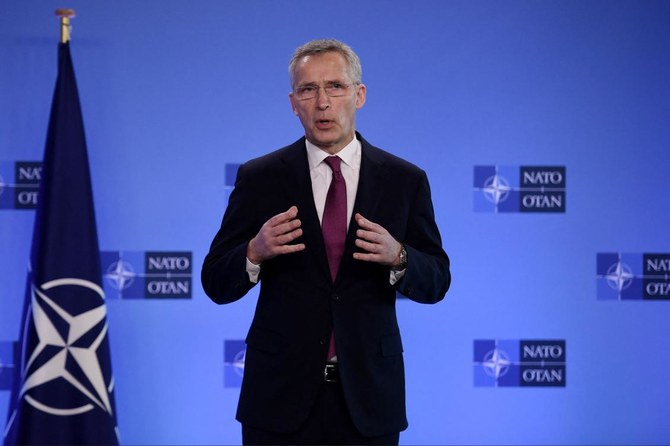
“We are not part of this conflict,” NATO Secretary-General Jens Stoltenberg told a news conference.
“We have a responsibility as NATO allies to prevent this war from escalating beyond Ukraine because that would be even more dangerous, more devastating and would cause even more human suffering.”
Ukrainian President Volodymyr Zelenskiy has called for Western powers to enforce a no-fly zone since Moscow’s invasion started nine days ago, with Russia shelling cities and bringing fighting to Europe’s largest nuclear plant.
In a video message earlier on Friday, Ukrainian Foreign Minister Dmytro Kuleba said NATO foreign ministers should not allow Putin to “turn Ukraine into Syria,” in reference to the devastating Russia-backed campaign against rebel cities in that country.
“Act now before it’s too late,” he said in the message posted on Twitter.
Stoltenberg said NATO understood Ukraine’s desperation, calling Russia’s war in Ukraine “horrific” and warning the worst was yet to come, with Russia rolling out more heavy arms.
“But we also believe that if we did that (a no-fly zone) we would end up with something that could lead to a full-fledged war in Europe” involving many more countries, he said.
NATO members have been sending arms to Ukraine, but stopped short of military action. Russia and NATO-members United States, Britain and France are all nuclear powers.
The only way for NATO to implement a no-fly zone would be to send NATO planes to shoot down Russian ones, Stoltenberg said, adding that the risk of escalation would be too big.
“Allies agree we should not have NATO planes operating over Ukrainian airspace or NATO troops operating in Ukrainian territory,” he said.
US Secretary of State Antony Blinken said the alliance would defend “every inch” of NATO territory from attack. “Ours is a defensive alliance. We seek no conflict. But if conflict comes to us, we are ready,” Blinken said.
MORE EU SANCTIONS
Instead of a military presence in Ukraine, European Union countries — most of them also NATO members — said they were eyeing more economic sanctions to add to coordinated restrictions that have already targeted Russia’s financial system and elites.
EU officials are examining curbs on Russia’s influence and access to finance at the International Monetary Fund following its invasion of Ukraine, six officials told Reuters.
The bloc’s top diplomat Josep Borrell said that all options remained on the table with regard to new sanctions.
It was not immediately clear, however, when the 27-nation EU would be able to agree on exact measures given member states’ divisions on doing business with Moscow and some countries’ heavy reliance on Russian energy supplies.
“We will consider everything,” Borrell told reporters when asked about the possible suspension of the EU’s gas imports from Russia, which think-tank Eurointelligence said amount to $700 million daily even during the war.
Ireland’s Foreign Minister Simon Coveney said no new sanctions would be announced on Friday but that a fourth round could affect more Russian banks’ access to the SWIFT international transfer system, bar Russian ships from European ports and cut imports like steel, timber, aluminum or coal.
Putin launched his “special military operation” to get rid of what he said was Ukraine’s fascist government and demilitarize the country. Zelenskiy says Moscow is trying to prevent a liberal democracy flourishing on Russia’s border.
Russian invasion forces seized Europe’s biggest nuclear power plant on Friday in heavy fighting in southeastern Ukraine, triggering global alarm, but a huge blaze in a training building has been extinguished and officials said the facility was now safe.
“This is not just about Ukraine and Russia,” Ireland’s Coveney said. “It’s about all of us who live on the continent of Europe, who could potentially be impacted by an accident or a breach of that facility.”


![]()

NATO rejects Ukraine no-fly zone, says ‘not part of this war’
Short Url
https://arab.news/mydju
NATO rejects Ukraine no-fly zone, says ‘not part of this war’
- Ukraine, a former Soviet republic that wants to join the European Union and Western military alliance NATO, is not a currently a member of either
- "We are not part of this conflict," NATO Secretary-General Jens Stoltenberg told a news conference


Latest updates


© 2026 SAUDI RESEARCH & PUBLISHING COMPANY, All Rights Reserved And subject to Terms of Use Agreement.