

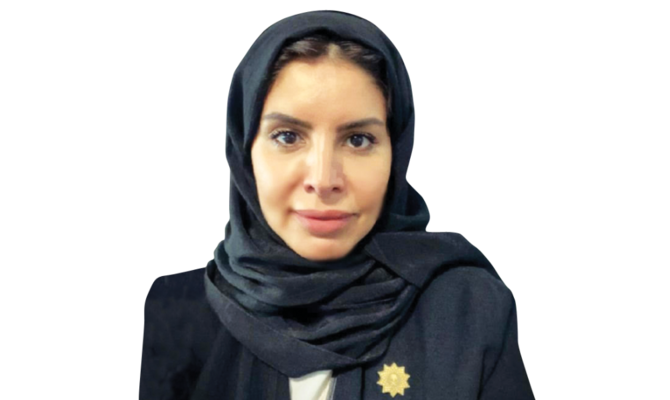
Who’s Who: Mona Sahman Al-Subaie, acting executive director of the SEHA Virtual Hospital

Mona Sahman Al-Subaie
Short Url
Updated 03 March 2022
Follow

Who’s Who: Mona Sahman Al-Subaie, acting executive director of the SEHA Virtual Hospital

Mona Sahman Al-Subaie is the general executive director of the Digital Health Center of Excellence and acting executive director of the newly launched SEHA Virtual Hospital.

With a growing live network of 130 connected hospitals, SEHA Virtual Hospital is the largest of its kind in the world. The only other virtual hospital to rival it is in the US, with 43 connected hospitals.

As well as being an engineer, she is digital health adviser to the Saudi assistant health minister.

From 2019 to 2020, she was the head of information technology projects in the King Abdullah Financial District Development and Management Co., where she was in charge of initiating, planning, designing, and executing key programs, and has held a number of positions in the Ministry of Health and the healthcare sector.

Between 2017 and 2019, she was project manager for the national Central Appointment System, known as Mawid, and from 2018 to 2019 was director of applications engineering where she led a ministry software development team that created apps. Between 2013 and 2018, she worked as a business analysis and quality assurance manager.

Among Al-Subaie’s most notable successes was her involvement in the development of a treatment abroad system that electronically links Saudi medical commissions with health attaches abroad.

In addition, she held senior system analyst and programming positions at King Faisal Specialist Hospital and Research Center between 1999 and 2013.

Al-Subaie gained a bachelor’s degree in computer and information sciences from King Saud University in 1998.


Red Sea Global unveils scientific model for regenerative tourism worldwide

Updated 5 sec ago
Follow

Red Sea Global unveils scientific model for regenerative tourism worldwide

  • The report details the model’s rollout at “The Red Sea” and “AMAALA” destinations, backed by studies covering 8 marine habitats

TABUK: Red Sea Global (RSG) has unveiled a science-based model aimed at achieving a 30% net positive conservation benefit across its tourism destinations by 2040. 

The framework is now available for global adoption, according to a statement released by RSG.

Owned by Saudi Arabia’s Public Investment Fund (PIF), Red Sea Global is the multi-project developer behind ambitious regenerative tourism destinations like “The Red Sea” and “AMAALA.” 

As a cornerstone of the Kingdom’s Vision 2030, the company aims to diversify the national economy while setting new global benchmarks for sustainable, nature-positive development.

CEO John Pagano stated that openly sharing this detailed approach will help elevate the global tourism sector and secure a healthier environment for future generations.
 

Map showing the boundaries of the Red Sea Zone. (Graphic from the RSG report)

The cornerstone of this initiative is the proprietary SIIG Model, a four-step framework:
• Survey: Establish biodiversity baselines and monitor long-term changes.
• Identify: Assess risks to priority habitats and species.
• Intervene: Execute evidence-based actions, such as regulating fishing and enhancing natural habitats.
• Gain: Measure and verify biodiversity improvements.

The report details the model’s rollout at “The Red Sea” and “AMAALA” destinations, backed by extensive 2022–2023 environmental baseline studies covering eight marine habitats and priority species groups during 2022 and 2023. 

A major intervention is the 5,015-square-kilometer Fishery Management Area in Al-Wajh Lagoon. The plan reserves 38% of the area for priority conservation—protecting 62% of local coral reefs—while allocating 61% for sustainable fishing.

According to scientific modeling, eliminating fishing in high-protection zones could increase reef fish populations by 113%, sharks and rays by 72%, and marine mammals by 24%. These measures are expected to boost coral resilience, support ecosystem recovery, and protect vulnerable species like sea turtles and seabirds.
Ihab Kindi, RSG’s Red Sea Destination Executive Director, called the data-driven model a practical roadmap for large-scale marine recovery. The complete methodology is available in the new report, “The SIIG Model: A Roadmap Toward Achieving Measurable Conservation Gains.”