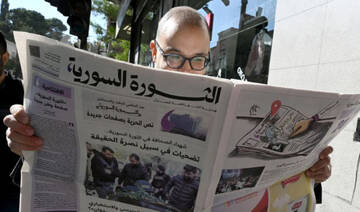
LONDON: Britain accused Russian news channel RT of being a tool of the Kremlin’s disinformation campaign on Wednesday.
It also asked the media regulator to take action if needed after Russia recognized two rebel regions of eastern Ukraine.
Russian officials say RT is a way for Moscow to compete with the dominance of global media companies based in the United States and Britain which they say offer a partial view of the world.
Critics say RT, which broadcasts news in English, Arabic, Spanish and German, is the propaganda arm of the Russian state and aims to undermine confidence in Western institutions.
Culture Secretary Nadine Dorries said in a letter to state media regulator Ofcom that she was concerned RT would seek to spread “harmful disinformation” about the Russia-Ukraine crisis.
“While respecting Ofcom’s regulatory independence, I call on you to ensure your actions are timely and transparent to reassure the British public,” the letter, seen by Reuters, said.
Asked in parliament whether he would request Ofcom review RT’s license, Prime Minister Boris Johnson said he believed Dorries had asked the regulator to review that matter.
Johnson’s spokesman, asked later if the government was looking to ban the channel, sought to clarify the prime minister’s remarks.
“All the culture secretary is asking Ofcom (is to) take any appropriate action should there be any attempt to use Russia Today to spread disinformation,” the spokesman said.
Johnson had also said the regulator should make its own decisions.
“We live in a country that believes in free speech,” Johnson told parliament. “And I think it’s important that we should leave it up to Ofcom rather than to politicians to decide which media organizations to ban — that’s what Russia does.
RT said British politicians seemed to be trying to meddle in the affairs of a regulator, undermining its independence.
“The UK culture minister is now clearly directly interfering in institutions touted as supposedly wholly free from political pressure and influence,” Anna Belkina, RT’s deputy editor in chief, told Reuters.
Belkina said despite political pressure Ofcom had not found any breaches of the Broadcasting Code by RT in the past four years.
Ofcom said it would prioritize complaints about any broadcaster’s news coverage of Russia and Ukraine.
“Given the seriousness of the Ukraine crisis, we will examine complaints about any broadcaster’s news coverage of this issue as a priority,” the regulator said.


UK says Russian channel RT is tool of Kremlin disinformation

https://arab.news/6gak5
UK says Russian channel RT is tool of Kremlin disinformation

- Russian officials say RT is a way for Moscow to compete with the dominance of global media companies
- Culture Secretary Nadine Dorries said in a letter to state media regulator Ofcom that she was concerned RT would seek to spread "harmful disinformation" about the Russia-Ukraine crisis


Paris exhibition marks 200 years of Le Figaro and the enduring power of the press
- The exhibition celebrated the bicentennial of Le Figaro, offering visitors a rare opportunity to step inside the newspaper’s vast historical archive
PARIS: One of France’s most influential newspapers marked a major milestone this month with a landmark exhibition beneath the soaring glass nave of the Grand Palais, tracing two centuries of journalism, literature and political debate.
Titled 1826–2026: 200 years of freedom, the exhibition celebrated the bicentennial of Le Figaro, offering visitors a rare opportunity to step inside the newspaper’s vast historical archive. Held over three days in mid-January, the free exhibition drew large crowds eager to explore how the title has both chronicled and shaped modern French history.
More than 300 original items were displayed, including historic front pages, photographs, illustrations and handwritten manuscripts. Together, they charted Le Figaro’s evolution from a 19th-century satirical publication into a leading national daily, reflecting eras of revolution, war, cultural change and technological disruption.
The exhibition unfolded across a series of thematic spaces, guiding visitors through defining moments in the paper’s past — from its literary golden age to its role in political debate and its transition into the digital era. Particular attention was paid to the newspaper’s long association with prominent writers and intellectuals, underscoring the close relationship between journalism and cultural life in France.
Beyond the displays, the program extended into live journalism. Public editorial meetings, panel discussions and film screenings invited audiences to engage directly with editors, writers and media figures, turning the exhibition into a forum for debate about the future of the press and freedom of expression.
Hosted at the Grand Palais, the setting itself reinforced the exhibition’s ambition: to place journalism firmly within the country’s cultural heritage. While the exhibition has now concluded, the bicentennial celebrations continue through special publications and broadcasts, reaffirming Le Figaro’s place in France’s public life — and the enduring relevance of a free and questioning press in an age of rapid change.