

Muslim Brotherhood suspected to be behind campaign of fake news on child ‘kidnappings’ in Sweden

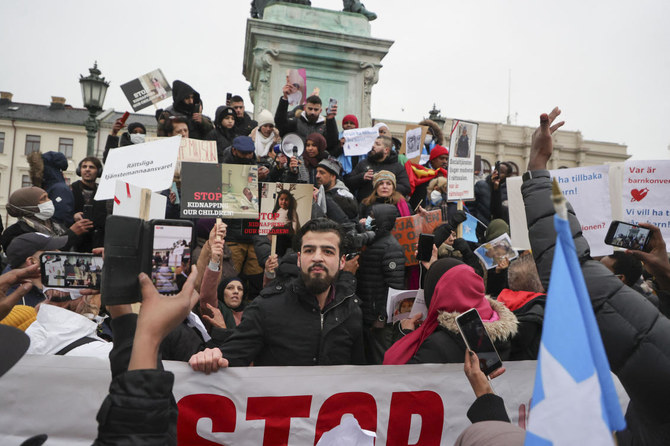
Swedish authorities are fighting back against claims its social services are “kidnapping” Muslim children. (Adam IHSE / TT NEWS AGENCY / AFP)
Short Url
Updated 23 February 2022
Follow

Muslim Brotherhood suspected to be behind campaign of fake news on child ‘kidnappings’ in Sweden

  • Videos began appearing on Arabic-language social media sites in late 2021 of real interventions by child welfare services
  • After Mideastern media outlets reported on the claims, Swedish government officials and social services have come out in force to deny the allegations

LONDON: A politically motivated campaign accusing child-protection authorities in Sweden of “kidnapping” children has exposed the activities of an extremist Islamist website suspectedly tied to the Muslim Brotherhood, which is circulating fake news designed to whip up anger in minority Muslim communities around the world.

The Shuoun Islamiya (Islamic Affairs) website was set up in 2016, claiming to be “an awareness channel to spread Muslim issues and their news around the world and to confront campaigns that aim to distort the image of Islam.”

In fact, the channel has consistently distorted the reality of treatment of immigrant Muslim communities around the world, in an apparent bid to promote sectarian strife in their adoptive countries.

In Sweden, Shuoun Islamiya has found itself an ally in a fringe political party called Nyans (Nuisance), which ahead of elections in September is claiming the state is unjustifiably taking children away from their parents.

According to research by the Washington Institute’s Fikra Forum, set up to provide “on-the-ground perspectives and insight on the most pressing current events facing the Middle East,” Nyans was founded in 2019 by Mikail Yüksel, a Swedish politician of Turkish origin and is “focused on issues that its founders view as affecting Muslims in Sweden.”

Through its website and Twitter and Telegram channels, Shuoun Islamiya has kept up a steady stream of extreme content, including videos, accusing Sweden of being a fascist state where social services place Muslim children in Christian homes with paedophiles, or force them to drink alcohol and eat pork.

Unsurprisingly, Swedish government officials and social services have denied the allegations.

“We absolutely do not do that,” Migration and Integration Minister Anders Ygeman told AFP.

The only goal was to support families, he added, and the campaign was being fueled in part by “frustrated parents who have failed in their parenting” and were projecting their anger at authorities.

But “there are also malevolent forces that want to exploit these parents’ frustration to spread mistrust and division.”

Shuoun Islamiya is one of those forces and, if its objective is to stir up unwarranted outrage among the Muslim community in Sweden and around the world, it is working. Radical imams in Sweden and abroad and Muslim online influencers with millions of followers have spread the stories, sparking street protests across Sweden.

The website’s Twitter and Instagram accounts also push and promote Muslim Brotherhood salafists and loyalists, including detained Saudi extremist salafist Abdul Aziz Al-Turaife, among others.

It is unclear where Shuoun Islamiya is based. It may even be a one-man show. Its founder is listed as Mustafa Al-Sharqawi, who on his Telegram account (@MoustafaJournalist) describes himself as an “independent Muslim journalist.” He is also associated with a Telegram channel called Arab Affairs TV, which has over 17,000 subscribers.

Arab Affairs TV’s Twitter account (@Arabaffairstv) has been suspended for violating the platform’s rules, which state that users may not “threaten or promote terrorism or violent extremism”, “promote violence against, threaten, or harass other people on the basis of race, ethnicity (or) religious affiliation,” and “may not deceptively share synthetic or manipulated media that are likely to cause harm.”

However, Shuoun Islamiya’s Twitter account (@Shuounislamiya) — which has 178,000 followers — remains active, despite a series of recent Tweets perpetuating the myth that Muslim children are being kidnapped by authorities in countries including Sweden, Japan and Germany.

It is clear that its activities are creating division between Swedish communities. One response earlier this month, apparently from a Swedish citizen and aimed at Muslims in the country, read: “Swedish social services do not act without good reason and more often than not it requires some quite extreme behavioral dysfunction before they do …  try to raise your children to respect others, get an education and become a productive member of society who understands and is invested in the social contract.”

The Muslim Brotherhood and its affiliates are using well-meaning liberals across Europe to cover for and further their own anti-democratic agenda, experts have warned.

At an event attended by Arab News and hosted by UAE think tank Trends Research and Advisory late last year, experts also cautioned that despite its relative decline in the past decade, the Brotherhood is adaptive and must be continually countered.

Dr. Lorenzo Vidino, director of the Program on Extremism at George Washington University, told participants that the Brotherhood was using “woke” language to “camouflage their true nature” as it takes hold in Europe.

“People experienced the ineffectiveness of the rule of the Brotherhood in 2012 and 2013,” he said. “People have become disenchanted with the Brotherhood.” But in the West, and particularly in Europe, the group’s status was “a more complicated question,” he added.

There, it is a “different Brotherhood, with different goals and priorities compared with Muslim countries."

There was a “coming-of-age of a second generation of activists who are European-born and are extremely well-versed in the European, Western political discourse,” he added.

Meanwhile, in Sweden, they have taken to peddling fake news about children in danger to garner support. On Feb. 20, the Shuoun Islamiya Twitter account posted four photographs, taken on the same day, of what purported to be a group of children in Syria, captioned “Solidarity of Syrian children with children in Sweden, We ask Allah to grant relief to all Muslims around the world.”

In the photographs the children are holding posters, written in Arabic, that read “Social kidnaps the children from their mothers”, “Stop kidnapping our children, whoever has humanity save the Syrian children in Sweden,” and “No happiness for the children except with their mothers.”

In a video posted on Feb. 18, Shuoun Islamiya claimed that the two daughters of Swedish-based Muslim writer Seyed Issa Musavi “were kidnapped in Sweden” and that the judge in the family court hearing the case “ruled that his daughters should not return because of the books he writes about Sweden, and this is another proof of the lie of freedom of expression in Sweden.” One of Musavi’s books is called “Forced conversion of Muslim children in Sweden.”

In one post in his own Twitter account, Musavi alleges that “Sweden Kidnapps Children (girls) move to remote areas, raped by Swedish OFFICIELS. This one, 8-years Child- girl.”

Julia Agha, head of the Arabic-language news outlet Alkompis, based in Stockholm, told AFP that the campaign had its roots in protests by Muslim families whose children had been taken into care by social services.

“What’s happened is that this campaign has ended up in the hands of forces abroad that have put a religious filter over it and are spreading disinformation, which now looks more like a hate campaign against Sweden and Swedish society.”

The disinformation campaign is exploiting the sense of isolation felt among many immigrant Muslims in Sweden, a generous country that has struggled for years to integrate new arrivals.

Sweden, a wealthy country of 10.4 million people, granted asylum and family reunification to more than 400,000 people from 2010 to 2019 — more per capita than any other European country.

“Sweden still has many integration challenges, not least when it comes to segregation,” Agha told AFP.

She said many immigrants struggled to learn Swedish, lived in areas where they interacted only with other immigrants, and didn’t feel a part of Swedish society.


A look back at how Arab News marked its 50th anniversary

Updated 31 December 2025
Follow

A look back at how Arab News marked its 50th anniversary

  • In a year crowded with news, the paper still managed to innovate and leverage AI to become available in 50 languages
  • Golden Jubilee Gala, held at the Diplomatic Quarter in Riyadh, now available to watch on YouTube

RIYADH: In 2025, the global news agenda was crowded with headlines concerning wars, elections and rapid technological change.

Inside the newsroom of Arab News, the year carried additional weight: Saudi Arabia’s first English-language daily marked its 50th anniversary.

And with an industry going through turmoil worldwide, the challenge inside the newsroom was how to turn a midlife crisis into a midlife opportunity. 

For the newspaper’s team members, the milestone was less about nostalgia than about ensuring the publication could thrive in a rapidly changing and evolving media landscape.

“We did not want just to celebrate our past,” said Faisal J. Abbas, editor-in-chief of Arab News. “But more importantly, we were constantly thinking of how we can keep Arab News relevant for the next five decades.”

Faisal J. Abbas, editor-in-chief of Arab News. (Supplied)

The solution, he added, came down to two words: “Artificial intelligence.”

For the Arab News newsroom, AI was not a replacement for journalism but as a tool to extend it.

“It was like having three eyes at once: one on the past, one on the present, and one on the future,” said Noor Nugali, the newspaper’s deputy editor-in-chief.

Noor Nugali, deputy editor-in-chief of Arab News. (Supplied)

One of the first initiatives was the 50th anniversary commemorative edition, designed as a compact historical record of the region told through Arab News’ own reporting.

“It was meant to be like a mini history book, telling the history of the region using Arab News’ archive with a story from each year,” said Siraj Wahab, acting executive editor of the newspaper.

The issue, he added, traced events ranging from the outbreak of the Lebanese civil war in 1975 to the swearing-in of Donald Trump, while also paying homage to former editors-in-chief who shaped the newspaper’s direction over five decades.

The anniversary edition, however, was only one part of a broader strategy to signal Arab News’ focus on the future.

To that end, the paper partnered with Google to launch the region’s first AI-produced podcast using NotebookLM, an experimental tool that synthesizes reporting and archival material into audio storytelling.

The project marked a regional first in newsroom-led AI audio production.

The podcast was unveiled during a special 50th anniversary ceremony in mid-November, held on the sidelines of the Arab Media Forum, hosted by the Dubai Future Foundation. The event in the UAE’s commercial hub drew regional media leaders and officials.

Remarks at the event highlighted the project as an example of innovation in legacy media, positioning Arab News as a case study in digital reinvention rather than preservation alone.

“This is a great initiative, and I’m happy that it came from Arab News as a leading media platform, and I hope to see more such initiatives in the Arab world especially,” said Mona Al-Marri, director-general of the Government of Dubai Media Office, on the sidelines of the event.

“AI is the future, and no one should deny this. It will take over so many sectors. We have to be ready for it and be part of it and be ahead of anyone else in this interesting field.”

Behind the scenes, another long-form project was taking shape: a documentary chronicling Arab News’ origins and its transformation into a global, digital-first newsroom.

“While all this was happening, we were also working in-house on a documentary telling the origin story of Arab News and how it transformed under the current editor into a more global, more digital operation,” said Nugali.

The result was “Rewriting Arab News,” a documentary examining the paper’s digital transformation and its navigation of Saudi Arabia’s reforms between 2016 and 2018. The film charted editorial shifts, newsroom restructuring and the challenges of reporting during a period of rapid national change.

The documentary was screened at the Frontline Club in London, the European Union Embassy, Westminster University, and the World Media Congress in Bahrain. It later became available on the streaming platform Shahid and onboard Saudi Arabian Airlines.

The grand slam of the anniversary year was the Golden Jubilee of Arab News gala, held in late September in Riyadh’s Diplomatic Quarter. (AN photo)

It was also nominated for an Association for International Broadcasting award.

In early July, a special screening of the documentary took place at the EU Embassy in Riyadh. During the event, EU Ambassador to Saudi Arabia Christophe Farnaud described the film as an “embodiment” of the “incredible changes” that the Kingdom is undergoing.

“I particularly appreciate … the historical dimension, when (Arab News) was created in 1975 — that was also a project corresponding to the new role of the Kingdom,” Farnaud said. “Now the Kingdom has entered a new phase, a spectacular phase of transformation.”

Part of the documentary is narrated by Prince Turki Al-Faisal, the former Saudi ambassador to the US, who in the film delves into the paper’s origins.

Prince Turki Al-Faisal, the former Saudi ambassador to the US. (AN photo)

The grand slam of the anniversary year was the Golden Jubilee of Arab News gala, held in late September in Riyadh’s Diplomatic Quarter.

Hosted by the Dean of Diplomatic Corps in Saudi Arabia and Ambassador of Djibouti to Riyadh Dya-Eddine Said Bamakhrama, the evening featured a keynote address by Prince Turki, who spoke about Arab News’ founding under his father, the late King Faisal, and its original mission to present the Kingdom to the English-speaking world.

The Dean of Diplomatic Corps in Saudi Arabia and Ambassador of Djibouti to Riyadh Dya-Eddine Said Bamakhrama (far left). (AN photo)

Arab News was established in Jeddah in 1975 by brothers Hisham and Mohammed Ali Hafiz under the slogan to give Arabs a voice in English while documenting the major transformations taking place across the Middle East.

The two founders were honored with a special trophy presented by Prince Turki, Assistant Media Minister Abdullah Maghlouth, Editor-in-Chief Abbas, and family member and renowned columnist Talat Hafiz on behalf of the founders. 

During the gala, Abbas announced Arab News’ most ambitious expansion yet: the launch of the publication in 50 languages, unveiled later at the World Media Congress in Madrid in cooperation with Camb.AI.

The grand slam of the anniversary year was the Golden Jubilee of Arab News gala, held in late September in Riyadh’s Diplomatic Quarter. (AN photo)

The Madrid launch in October underscored Arab News’ aim to reposition itself not simply as a regional paper, but as a global platform for Saudi and Middle Eastern perspectives.

The event was attended by Princess Haifa bint Abdulaziz Al-Mogrin, the Saudi ambassador to Spain; Arab and Spanish diplomats; and senior editors and executives.

As the anniversary year concluded, Arab News released the full video of the Golden Jubilee Gala to the public for the first time, making the event accessible beyond the room in which it was held.

For a newspaper founded in an era of typewriters and wire copy, the message of its 50th year was clear: longevity alone is not enough. Relevance, the newsroom concluded, now depends on how well journalism adapts without losing sight of its past.