

Thai Buddhists mark holy day in subdued celebrations

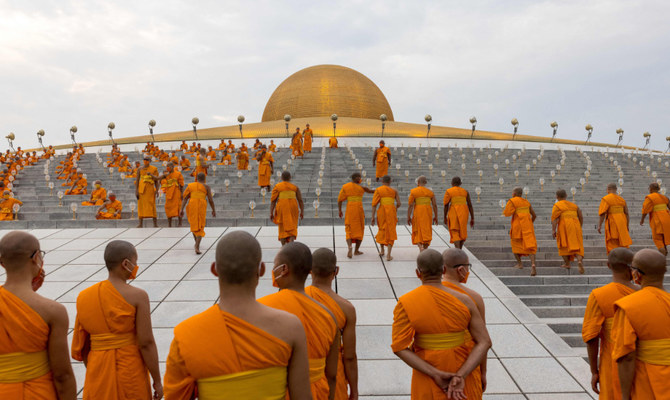
Buddhist monks attend the Makha Bucha celebrations at Wat Dhammakaya temple in Pathum Thani province, north of Bangkok on February 16, 2022. (AFP)
Short Url
Updated 16 February 2022
Follow

Thai Buddhists mark holy day in subdued celebrations

  • Some believers take part in candlelit circle-around rituals at local temples
  • Makha Bucha Day celebrates and honors Buddha’s teachings

BANGKOK: Thai Buddhists marked Makha Bucha Day on Wednesday in subdued celebrations, with some returning to traditional candle lit circle-around rituals at local temples in the third year of observing one of the religion’s holiest days during a pandemic.

Hundreds of people visited Bangkok’s most frequented temples during the day, including Wat Pho, to commemorate Makha Bucha Day.

Nittaya Duangdao, a volunteer staff member at Wat Pho, expected fewer participants to turn out for Wian Tian during the evening, as “people may still be concerned about COVID-19.”

Wian Tian, which refers to the candlelit procession and circling around the temple, is one of the hallmark rituals of the holy day. Believers also typically take part in meditations, chanting and making offerings of food, among other good deeds.

“In the last two years, only the monks and staff in the temple were allowed to do the activity (during Makha Bucha Day),” Duangdao told Arab News.

In early 2020, as COVID-19 infections began surging around the world, temples across Thailand were prohibited from allowing celebrations for Makha Bucha Day. While some temples allowed people to take part in rituals on a smaller scale in 2021, this year saw an easing of restrictions.

Thailand’s Ministry of Culture announced this week that religious sites must subject visitors to mandatory mask wearing rules and impose one-hour limits on religious ceremonies.

Makha Bucha Day, which falls on the full moon day of the third lunar month annually, celebrates Buddha’s teachings and commemorates a gathering between the Buddha and 1,250 of his first disciples. The holiday is most celebrated in Thailand, as well as other Southeast Asian countries like Laos and Myanmar.

“As a Buddhist I feel that going to the temple and making merits makes me feel good, and I believe that it could bring a good thing to life,” Bowornluk Thongmark told Arab News.

Thailand on Wednesday reported more than 16,000 new COVID-19 cases, the highest number of daily infections in months, though still below its daily case peak of over 22,000. In the last three years, officials have encouraged believers to take part in online ceremonies to contain the spread of the disease.

The Dhammakaya Temple, located in the outskirts of Bangkok and known for its lantern ritual on Makha Bucha Day, created a metaverse link this year and invited adherents to commemorate the religious holiday online.

Though concerns for infections still linger in real life, Thongmark said: “At the end of the day, we will have to return to normal life.

“I think what we can do is to be careful to not spread the virus to others and be responsible to our community.”

US judge blocks Trump plans to end of deportation protections for South Sudanese migrants

Updated 7 sec ago
Follow

US judge blocks Trump plans to end of deportation protections for South Sudanese migrants

  • Kelley issued the order after four migrants from South Sudan along with African Communities Together, a non-profit group, sued

BOSTON: A federal judge on Tuesday blocked plans ​by US President Donald Trump’s administration to end temporary protections from deportation that had been granted to hundreds of South Sudanese nationals living in the United States.
US District Judge Angel Kelley in Boston granted an emergency request by several South Sudanese nationals and an immigrant rights group to prevent the temporary protected status they had been granted from expiring as planned after January 5.
The ruling is a temporary victory for immigrant advocates and a setback for the Trump administration’s broader effort to curtail the humanitarian program. It is the latest in a series of legal ‌challenges to the ‌administration’s moves to end similar protections for nationals from several ‌other ⁠countries, including ​Syria, Venezuela, ‌Haiti and Nicaragua.
Kelley issued the order after four migrants from South Sudan along with African Communities Together, a non-profit group, sued. The lawsuit alleged that action by the US Department of Homeland Security was unlawful and would expose them to being deported to a country facing a series of humanitarian crises.
Kelley, who was appointed by Democratic former President Joe Biden, issued an administrative stay that temporarily blocks the policy pending further litigation.
She wrote that allowing it to take effect before the courts had time ⁠to consider the case’s merits “would result in an immediate impact on the South Sudanese nationals, stripping current beneficiaries of lawful status, ‌which could imminently result in their deportation.”
Homeland Security Department spokesperson ‍Tricia McLaughlin said in a statement that the ‍judge’s ruling ignored Trump’s constitutional and statutory authority and that the temporary protected status extended to ‍South Sudanese nationals “was never intended to be a de facto asylum program.”
Conflict has ravaged South Sudan since it won independence from Sudan in 2011. Fighting has persisted in much of the country since a five-year civil war that killed an estimated 400,000 people ended in 2018. The US State Department advises citizens not ​to travel there.
The United States began designating South Sudan for temporary protected status, or TPS, in 2011.
That status is available to people whose home countries ⁠have experienced natural disasters, armed conflicts or other extraordinary events. It provides eligible migrants with work authorization and temporary protection from deportation.
About 232 South Sudanese nationals have been beneficiaries of TPS and have found refuge in the United States, and another 73 have pending applications, according to the lawsuit.
Homeland Security Secretary Kristi Noem published a notice on November 5 terminating TPS for South Sudan, saying the country no longer met the conditions for the designation.
The lawsuit argues the agency’s action violated the statute governing the TPS program, ignored the dire humanitarian conditions that remain in South Sudan, and was motivated by discrimination against migrants who are not white in violation of the US Constitution’s Fifth Amendment.
“The singular aim of this mass deportation agenda is to remove as many Black and Brown immigrants from this ‌country as quickly and as cruelly as possible,” Diana Konate, deputy executive director of policy and advocacy at African Communities Together, said in a statement.